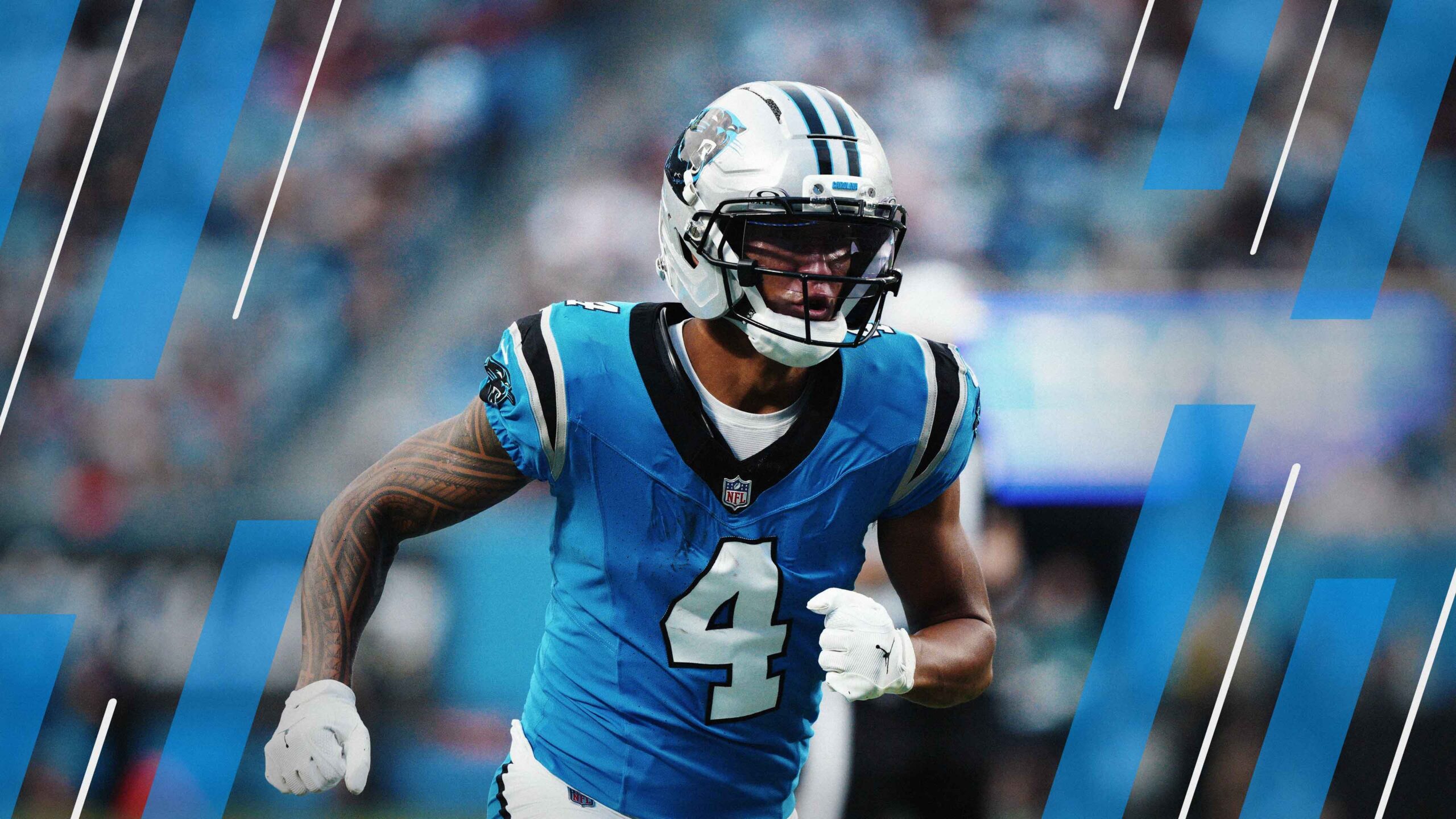
- Abdul Carter flashed in his first season: The No. 3 overall pick heated up late in the year, with four of his five sacks arriving in his final five games.
- Get PFF+ for 30% off: Use promo code HOLIDAY30 to unlock the PFF Player Prop Tool, Premium Stats, fantasy dashboards, the PFF Mock Draft Simulator, industry-leading fantasy rankings and much more — everything you need to win your season.
Estimated Reading Time:12 minutes
Throughout the season, we at PFF have been putting together a Rookie Team of the Week series highlighting the top performances of first-year players. To close out this set, we’ll be looking at which players shined the brightest over the course of the year as a whole.
Normally, this is where I’d acknowledge a snap count requirement to make this list. But this time, I’m going to use common sense when choosing a player — but will acknowledge when someone narrowly missed due to snap counts.
Quarterback: Tyler Shough, New Orleans Saints – 75.0
With Shedeur Sanders still on the board, many were surprised when the Saints selected Louisville’s Tyler Shough with the 40th pick in the draft — but based on early returns, it seems they made the right call. Shough saw his first significant playing time in Week 8 against the Buccaneers, and since then, had six games with an overall PFF grade of at least 70.0.
While playing just a little over half a season, Shough completed 221-of-327 passes for 2,384 yards with 10 touchdowns and six interceptions while adding 13 big-time throws and just seven turnover-worthy plays. In nine starts, the Saints went 5-4 with Shough at the helm.
Running Back: Cam Skattebo, New York Giants – 82.0
Cam Skattebo was lost for the season in Week 8 with an ankle injury. Despite this, he still logged the ninth-most snaps amongst rookie running backs, so we felt satisfied with having him take the top spot on this list.
Although he was a fourth-round pick out of Arizona State, Skattebo continued the smashmouth play that made him so beloved among college football fans. Skattebo carried the ball 101 times for 410 yards and five scores while also forcing 22 missed tackles for an 82.3 PFF rushing grade. As a pass-catcher, Skattebo caught 24 receptions for 207 yards and two scores with an 84.9 PFF receiving grade.
Wide Receiver: Luther Burden III, ChicagoBears – 80.6
Having been considered a first-round talent for much of the pre-draft process, Burden fell to the second round. However, that may have been a blessing in disguise, as he thrived in what has become a potent Bears offense. Burden’s 79.9 PFF receiving grade led all rookie receivers to play at least 20 snaps, catching 47 of his 60 targets for 652 yards and two touchdowns.
Wide Receiver: Tetairoa McMillan, Carolina Panthers– 79.6
No rookie receiver logged more snaps than the former eighth overall pick out of Arizona, and McMillan more than proved worthy of the workload. McMillan caught 70 of his 120 targets for 1,014 yards, the only rookie to eclipse 1,000 yards in receiving or rushing, with seven touchdowns. He played a big part in Carolina winning the NFC South for the first time since its Super Bowl run in 2015.
Wide Receiver: Emeka Egbuka, Tampa Bay Buccaneers – 69.5
Egbuka got off to a roaring start to his career, catching five touchdowns in his first five games. However, he cooled off considerably after that, scoring one touchdown the rest of the season — though part of that may be attributed to being a member of what was already a loaded Buccaneers receiving room. The overall statline for Egbuka should have Bucs fans excited for what’s to come, though, as he caught 63 passes for 938 yards and six scores.
Seattle’s Tory Horton actually edged Egbuka in terms of PFF grade with a 69.8 figure, but considering Egbuka played almost quadruple the snaps that Horton did, I made the executive decision to give the spot to the former Buckeye.
Tight End: Jackson Hawes, BuffaloBills– 86.6
Jackson Hawes is a unique case when it comes to rating tight ends. Only 99 of his 476 offensive snaps came as a receiver, with the rest arriving as a blocker. However, Hawes was such a good blocker that it elevated his status amongst the rookie class.
The former Georgia Tech Yellow Jacket caught just 16 passes for 187 yards and three scores, numbers you’d see out of a reserve tight end. However, he only lost two of his 42 pass-blocking snaps, none of which resulted in pressure for a 78.5 PFF pass-blocking grade. He was just as good as a run-blocker, carrying a 75.0 grade that included a 77.8 figure on 89 outside zone runs and 81.7 on 52 inside zone runs.
Offensive Tackle: Kelvin Banks Jr., New Orleans Saints – 77.7
Banks was quietly the top rookie tackle in this year’s class despite being the third one selected in April. On 642 pass-blocking snaps, Banks permitted 46 pressures, five of which being converted into sacks for a 72.5 PFF pass-blocking grade.
As a run-blocker, he carried a 76.1 grade, with three different games going over 80.0. Banks specialized in zone-blocking schemes, as he boasted an 81.1 grade on 129 inside zone runs and a 73.2 grade on 89 outside zone runs.
Offensive Tackle: Will Campbell, New England Patriots– 76.9
After concerns about his arm length had people questioning the Patriots taking the LSU product fourth overall, Campbell proved them wrong with a 77.3 PFF pass-blocking grade that trailed only Kansas City’s Josh Simmons’ 77.5 figure among rookie tackles. On 449 pass-blocking snaps, Campbell yielded 26 pressures — never more than four in a game — and five sacks, though four of those came in a three-game stretch in the middle of the season. Campbell didn’t allow a single sack in any of his last four games.
Despite missing time due to injury, Campbell narrowly bests fellow AFC East rookie tackle Armand Membou — Membou finished at 76.2 — for the other tackle spot.
Interior Offensive Line: Tyler Booker, Dallas Cowboys – 73.7
Booker was the top interior lineman off the board, and he certainly played like it. Despite missing three games early in the season, Booker suited up on nearly 1,000 snaps.
As a pass-blocker, he was inconsistent, carrying a 62.6 grade while allowing 25 pressures and three sacks on 578 such snaps. He was much better in the ground game, though, posting a 75.7 grade. Booker was at his best on inside zone runs, as he produced an 82.5 mark on 113 such runs — including 27 positively graded blocks.
Interior Offensive Line: Tate Ratledge, Detroit Lions – 72.2
Ratledge was thrust into a starting role sooner than expected with the surprise retirement of Frank Ragnow. While he had his struggles, he definitely found more consistency as the season went along.
As a pass-blocker, Ratledge’s 58.3 grade is bogged down by some early-season issues, including five different games with that number at 40.0 or below. However, starting in Week 14, Ratledge rattled off a stretch of five games in which he carried at least a 75.0 PFF pass-blocking grade in four of them. In all, Ratledge gave up 24 pressures and two sacks, none of which came after Week 5.
Interior Offensive Line: Dylan Fairchild, Cincinnati Bengals – 64.3
Ratledge’s teammate at Georgia, Fairchild also started right away for a Bengals offensive line that was desperately looking to improve. Among rookie interior linemen to play at least 100 snaps, Fairchild’s 69.7 PFF pass-blocking grade was the best. On 596 pass blocking snaps, Fairchild relinquished 31 pressures and just two sacks.
Like Ratledge, Fairchild improved greatly as the season went along, as his final six games saw him eclipse a 70.0 pass-blocking grade four times.
Edge Defender: Abdul Carter, New York Giants – 78.8
The third overall pick in the draft and first true defensive player off the board, Carter showed flashes of a potential superstar in this league — particularly as a pass-rusher. Carter had two games with a PFF pass-rush grade over 90.0 and another three over 80.0.
In all, Carter recorded 66 pressures, another 24 pass-rush wins and five sacks, four of which came in his final five games. During that stretch, Carter tallied at least four pressures in every game.
Edge Defender: Donovan Ezeiruaku, Dallas Cowboys – 72.9
After trading away Micah Parsons shortly before the season, the Cowboys desperately needed pass rush help, and their second-rounder out of Boston College proved up to the task. Despite totaling only two sacks, Ezeiruaku got pressure 36 times and won another 20 pass-rush reps for a 66.1 grade. As a run defender, Ezeiruaku produced a 63.3 grade that included 18 stops and an average depth of tackle just under a yard past the line of scrimmage.
Defensive Interior: Mason Graham, Cleveland Browns – 68.6
In a controversial move, the Cleveland Browns passed on Travis Hunter to trade down to pick No. 5 in order to select Michigan’s Mason Graham. While Graham wasn’t a superstar by any means, he was a starter from Day 1 and was consistently reliable for a Browns defense that vastly outplayed the team’s win-loss record.
Graham appeared in all 17 games and only played fewer than 40 snaps three times. As a pass-rusher, Graham recorded just one sack but did get pressure 36 times with an additional 18 pass-rush wins. Likewise, as a run defender, Graham accrued 27 stops while only missing four tackles.
Defensive Interior: Jamaree Caldwell, Los Angeles Chargers – 62.9
Among rookie interior defenders to play at least 200 snaps, Caldwell’s 66.2 PFF run-defense grade was the best, which is pretty impressive considering he had to wait until Pick 86 to hear his name called. As a run defender, Caldwell recorded 14 stops and didn’t miss any tackles in his last five games of the season. In fact, 20.1% of his run-defense snaps received a positive grade.
Linebacker: Jihaad Campbell, Philadelphia Eagles – 78.9
Starting in Week 8, Campbell’s role in the Eagles’ defense decreased as other members of the team’s linebacking room got healthier — but perhaps that was a mistake. Heading into his playing time drop, Campbell had seen at least 50 snaps in every game and carried an 82.6 overall PFF grade. Following the diminished role, Campbell only eclipsed 50 snaps twice and his grade dropped to 66.1.
Cumulatively, though, Campbell had an excellent rookie season. That was particularly true in coverage, where he carried an 81.1 grade — allowing just 24 receptions into his coverage for 271 yards and a touchdown that came all the way back in Week 4.
Linebacker: Carson Schwesinger, Cleveland Browns – 73.7
If you’ve been following along with these lists throughout the season, it should come as no surprise that the top linebacker spots are occupied by Campbell and Schwesinger, as these two regularly flipped on who held the top rookie linebacker grade each week. Like his fellow rookie teammate Mason Graham, Schwesinger was a starter from the jump and was a key cog in the league’s fourth-most efficient defense in terms of EPA per play allowed. Schwesinger was at his best as a run defender, carrying an 80.6 grade with 37 stops.
Cornerback: Nohl Williams, Kansas City Chiefs – 75.7
Despite having been the 12th corner taken in the 2025 draft, Williams played like a potential lockdown option opposite Trent McDuffie. A third-rounder out of California, Williams recorded a grade of at least 70.0 as a run defender (77.1), pass-rusher (73.9) and in coverage (75.3).
On 257 coverage snaps, Williams allowed just 20 of his 36 targets to be caught for 227 yards and one score. Only eight of those 20 receptions resulted in first downs while forcing seven incompletions.
Cornerback: Marcus Harris, TennesseeTitans – 71.7
While his college teammate Nohl Williams was picked a bit earlier, Harris saw 22 corners taken ahead of him — yet he played nearly as well. Harris was particularly good in coverage, permitting just 13 of his 25 targets to be caught for 151 yards and a touchdown on 208 coverage snaps.
Cornerback: Jacob Parrish, Tampa Bay Buccaneers – 70.0
No rookie corner played more defensive snaps than Parrish’s 716, and no first-year cornerback had a higher PFF run-defense grade than Parrish’s 78.5 mark. As a run defender, Parrish recorded seven stops and missed just four tackles all season, never more than one in a game.
Parrish was targeted often in coverage, yielding 60 receptions for 665 yards and three scores, but he also picked off two passes while forcing an additional four incompletions. That was good for a 66.3 PFF coverage grade.
Safety: Xavier Watts, Atlanta Falcons – 74.4
Watts and Baltimore’s Malaki Starks were the only rookie safeties to log over 1,000 defensive snaps this season, yet Watts outplayed the first-rounder out of Georgia. Watts led all rookie safeties in PFF coverage grade, recording a 75.5 figure by permitting just 21 receptions on 623 coverage snaps for 341 yards. He did allow three touchdown passes, but he also recorded five interceptions — which tied for second in the entire NFL.
Safety: Nick Emmanwori, Seattle Seahawks – 74.1
After a dominant performance at the NFL Combine, the Seahawks took Emmanwori with the 35th overall selection. While he did miss time early in his rookie season due to injury, Emmanwori still managed to play the sixth-most snaps amongst rookie safeties, and his 73.9 PFF coverage grade trailed only Watts.