- Jalen Jones introduces lightning vertical speed to Texas Tech: The Alabama State transfer steps into a wide-open Red Raiders passing game after leading all collegiate wide receivers with a spectacular average of 13.4 yards after the catch per reception.
The ability to generate yards after the catch has become one of the clearest separators between average and elite offenses in college football. While NFL defenses are built on sound tackling and limiting explosive plays in space, the college game is far more forgiving once the ball reaches a playmaker’s hands.
College wide receivers consistently generate more yards after the catch than their NFL counterparts. Offensive coordinators understand this reality, which is why so many passing concepts are designed to create opportunities in space through screens, glance routes, crossers and other quick-hitting throws that allow receivers to do damage after the catch.
The players who excel in these situations rely on more than just straight-line speed. Elite YAC receivers combine vision, tackle-breaking ability and one often-overlooked trait: confidence with the ball in their hands.
With that in mind, here are the five most dangerous returning receivers after the catch entering the 2026 college football season.
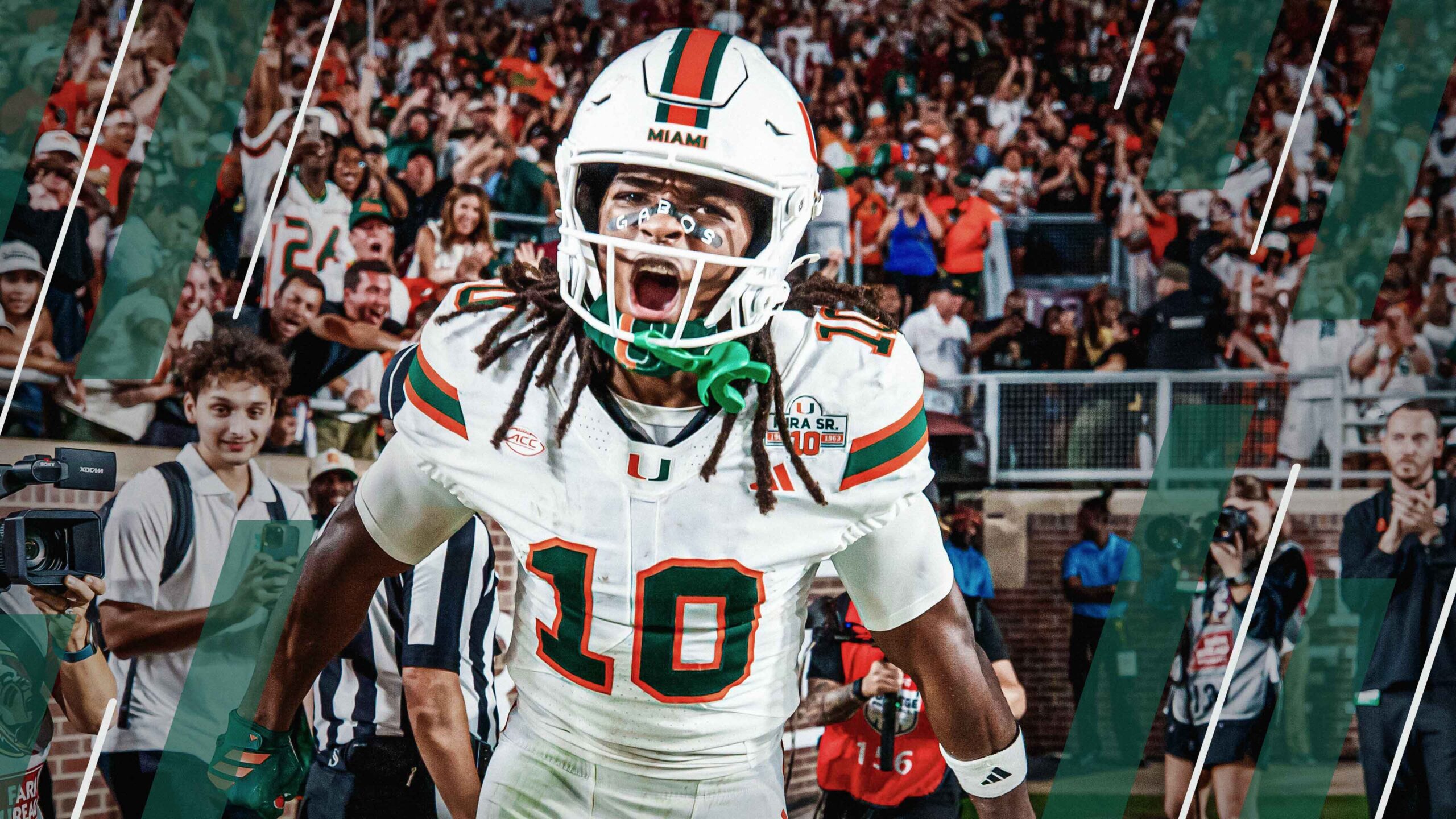
Rank 1 —Malachi Toney
Miami (FL) Hurricanes · WR
87.6 OVR Grade 88.5 REC GRADE 841 YAC 33 MTF 1. WR Malachi Toney, Miami (FL) Hurricanes (opens in new tab)Toney burst onto the scene as a true freshman despite joining the Hurricanes as a three-star recruit and the 14th-ranked player in the Hurricanes’ 2025 recruiting class. By season’s end, he had a legitimate case as the most dynamic offensive player in college football.
He finished with 1,211 receiving yards, a league-best 841 of which came after the catch. His 33 missed tackles forced on receptions also led the nation, and he added five more on rushing attempts.
Miami’s offense quickly became centered around finding ways to get the ball into Toney’s hands. He generated 446 receiving yards on screen passes alone, the second-most by any receiver since PFF began charting college football in 2014, trailing only Malachi Corley’s 2022 season.
Although listed at just 188 pounds, Toney is far more than an elusive open-field runner. He consistently plays through contact and possesses remarkable competitive toughness for a player his size. His 285 yards after contact led all returning Power Four wide receivers last season.
Toney will still be only 18 years old when he begins his sophomore campaign, and Miami’s coaching staff has likely spent the offseason designing even more ways to get him the ball in space. Ball security remains an area for improvement after three fumbles last season, but otherwise Toney sets the standard when discussing the most dangerous playmakers in college football.
Rank 2 —Wyatt Young
Oklahoma State Cowboys · WR
89.0 OVR Grade 89.9 REC GRADE 768 YAC 32 MTF 2. WR Wyatt Young, Oklahoma State Cowboys (opens in new tab)Young followed head coach Eric Morris and quarterback Drew Mestemaker to Stillwater after the trio spearheaded a record-breaking season at North Texas. The Mean Green finished 12-2 in 2025 and fielded the nation's most productive offense, averaging 512 yards and 45.1 points per game.
Only Jeremiah Smith and Makai Lemon earned higher PFF receiving grades than Young's 89.9 last season. Operating almost exclusively from the slot, Young averaged 11.0 yards after the catch per reception and forced 32 missed tackles, just one fewer than FBS leader Malachi Toney.
Young is arguably even more dangerous once defenders get their hands on him. His 385 yards after contact led all FBS receivers in 2025, highlighting the physicality that complements his open-field elusiveness. Unlike some YAC specialists who rely heavily on manufactured touches, Young generated his production while working farther downfield. His average depth of target from the slot was 11.1 yards, compared to Toney's 6.8.
He also provides value as a punt returner, adding another dimension to his game. The jump to the Big 12 will bring a significantly tougher weekly test, including an early-season matchup with Oregon, which many consider the top defense in college football.
The increased visibility could solidify Young's NFL draft stock — he currently ranks 51st on PFF's 2027 Big Board. However, if Morris, Mestemaker and the rest of North Texas' transfer contingent continue their rapid ascent at Oklahoma State, another season in Stillwater with legitimate championship aspirations in 2027 cannot be ruled out.
Rank 3 —Jalen Jones
Texas Tech Red Raiders · WR
89.6 OVR Grade 89.6 REC GRADE 684 YAC 18 MTF 3. WR Jalen Jones, Texas Tech Red Raiders (opens in new tab)The Red Raiders remain committed to the transfer portal-heavy approach that helped deliver a Big 12 title last season. Texas Tech has a proven track record of identifying portal talent, which makes the addition of Alabama State transfer Jalen Jones especially intriguing.
Jones was formerly an unranked recruit, but after a breakout 2025 season in which he earned an 89.8 PFF receiving grade and totaled 1,083 receiving yards, he is ready for a significant jump in competition.
Jones averaged 13.4 yards after the catch per reception last season, comfortably the highest mark among college football wide receivers. At just 5-foot-8 and 175 pounds, he does have clear size limitations and recorded only one contested catch last season. He profiles more as a true speedster and deep threat than a receiver who consistently wins through contact.
Texas Tech led the Big 12 in yards after the catch last season and must replace the production of draft picks Caleb Douglas and Reggie Virgil. Jones remains unproven at this level, but he may need only a few manufactured touches to show how dangerous he can be in space.
Rank 4 —Mario Craver
Texas A&M Aggies · WR
81.4 OVR Grade 82.7 REC GRADE 575 YAC 22 MTF 4. WR Mario Craver, Texas A&M Aggies (opens in new tab)The 59th-ranked player on PFF’s 2027 NFL Draft Big Board, Craver is one of the most dangerous run-after-catch threats in college football. At just 5-foot-9 and 165 pounds, his emergence as one of the nation’s top receivers speaks to the problems he creates once the ball is in his hands.
Among 184 Power Four wide receivers with at least 40 targets last season, Craver led the group in yards after the catch per reception (9.8). He also forced 22 missed tackles and generated 250 yards after contact, ranking fifth in both categories behind only Malachi Toney and several receivers who have since been drafted.
Unlike many players on this list, Craver does most of his damage underneath. Just 14% of his targets traveled more than 20 yards downfield last season. Instead, he consistently stressed defenses on screens, hitch routes and drag routes, turning routine completions into explosive gains.
Rank 5 —Ryan Coleman-Williams
Alabama Crimson Tide · WR
66.5 OVR Grade 66.0 REC GRADE 331 YAC 12 MTF 5. WR Ryan Coleman-Williams, Alabama Crimson Tide (opens in new tab)No list of college football's top run-after-catch threats would be complete without Coleman-Williams. Although he took a slight step back in 2025 after a standout freshman season, he still ranks third among returning Power Four wide receivers in yards after the catch, second in yards after contact and fourth in missed tackles forced over the past two seasons.
His ability with the ball in his hands is unquestionable. The challenge has been getting him enough opportunities. Coleman-Williams recorded three receptions or fewer in seven games last season, and his 10 drops did little to help his target volume.
Despite his improvisational style in the open field, ball security has never been a concern. Coleman-Williams has fumbled just once on more than 100 career touches. His iconic 75-yard touchdown against Georgia remains one of the best examples of his rare balance, acceleration and change-of-direction ability after the catch.
The Alabama star still has questions to answer if he wants to cement himself as a first-round prospect, but his ability after the catch is not one of them.