Every draft cycle, the FCS produces a handful of prospects capable of making NFL rosters. However, the level of competition will always be the biggest question mark on their scouting reports, and for good reason.
Every year, some of those players pass the film test and back it up during the pre-draft process. The 2026 class features a particularly intriguing group of FCS prospects, headlined by a name many football fans will already recognize.
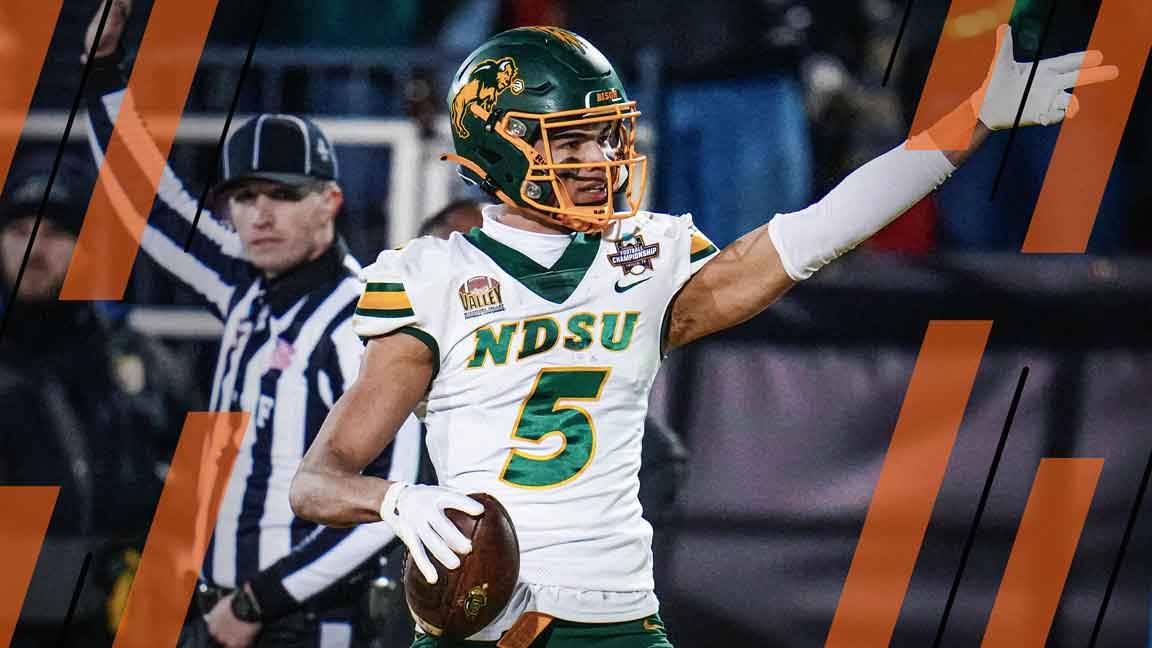
WR Bryce Lance, North Dakota State
The family name is well known, but Bryce Lance has done more than enough to earn his own evaluation. The younger brother of former No. 3 overall pick Trey Lance exploded onto the scene in 2024, when his 17 touchdowns set the single-season conference record.
Lance recorded back-to-back 1,000-yard seasons, registering overall PFF grades of 86.7 and 89.5 in the past two years.
At 6-foot-3 with a 4.34 40-yard dash time, Lance’s 9.98 relative athletic score suggests he’s one of the most athletic receivers in draft history, ranking seventh all-time at the position. This isn’t anything new for North Dakota State — the same school also developed Christian Watson, who ranks second all-time by the same metric.
The tape backs up his athleticism. Lance’s size-speed combination will provide an NFL play caller with a boundary threat and red zone attention magnet. Lance’s hands aren’t in doubt either — his 3.8% career drop rate ranks 14th among the top 150 draft-eligible wide receivers in targets.
As will be a common theme with this list, Lance’s biggest knock is his competition level. Given the athletic mismatch he presented, he rarely needed to win with precise route running or a refined release package. These are traits associated with a developmental receiver, but Lance will be 24 years old before he ever takes an NFL snap.
Lance will be one of the final draft picks in the FCS era for the North Dakota State dynasty, who are now bound for the Mountain West Conference. They had nine alumni take snaps in the NFL last season, by far the most of any FCS school.
If Christian Watson could carve out a real NFL role from a very similar spot, Lance’s physical tools give him every reason to do the same.
DI Kaleb Proctor, Southeastern Louisiana
PFF Big Board Rank: 111
Proctor arrived at Southeastern Louisiana as an unranked linebacker prospect who transitioned to the defensive line and grew, both physically and metaphorically, into a major disrupter on the interior.
His two-sack, three-TFL performance against LSU helped put him on the map, and his combine showing cemented his draft status. Proctor clocked a top speed of 20.95 m.p.h. in the 40-yard dash, tied for the second-fastest top speed for a defensive tackle over the last four draft cycles.
Coming from a small school, production needs to be outstanding to get noticed, and in Proctor’s case, it is. His 39 pressures, nine sacks and 90.2 PFF pass-rushing grade all rank inside the top three for draft-eligible defensive tackles.
But size is a legitimate concern. At 6-foot-2 and 291 pounds, he may be destined for a rotational role as a 3-tech pass-rushing specialist rather than a true down lineman. Proctor can struggle against double teams in the run game, and his lack of lower-body anchor strength shows up even at the FCS level.
A comparison to Milton Williams makes sense as Proctor’s ceiling. Teams looking for a quick-twitch interior rusher who can win with burst and hand technique should have him firmly placed on their boards.
CB Charles Demmings, Stephen F. Austin
PFF Big Board Rank: 139
Demmings didn’t start playing football until his senior year of high school. He went largely unrecruited and walked on at Stephen F. Austin. Four years later, he left as the program’s all-time leader in passes defended with 35, earned a Senior Bowl invite as the first Lumberjack ever to do so, and put on one of the best combine performances among cornerbacks in this class.
Demmings finished top-five in every athletic testing drill at the combine, highlighted by his 42-inch vertical, but a below-average 7.2-second three-cone time at his pro day raised some concerns regarding his short-area agility.
Nine career interceptions over 42 games tells you Demmings is a genuine ball hawk. Quarterbacks mustered a passer rating of just 39.8 when throwing into his coverage last year — that’s the fourth-lowest among 250 draft-eligible cornerbacks (min. 200 coverage snaps).
Despite his speed in space, Demmings has looked considerably less impressive when aligned as a field-side corner (wider side of the hash) as opposed to on the boundary side. His field-side coverage grade of 59.6 and 146.8 passer rating allowed pale in comparison to his 89.3 coverage grade and 33.9 passer rating when targeted on the narrower side of the formation.
The late start to football cuts both ways: there’s a developmental upside argument for the 23-year-old, but it also means less technical refinement than you’d want to see. At worst, Demmings is a mid-round pick with real special teams value from day one.
QB Cole Payton, North Dakota State
PFF Big Board Rank: 248
The aforementioned Bison have made a habit of sending quarterbacks to the NFL. Carson Wentz, Trey Lance, Easton Stick, and Cam Miller have all come from the school in Fargo, North Dakota. Cole Payton is the latest in this line, but his profile is unlike any of those before him.
A left-handed dual-threat who spent four years as a backup and sub-package designed runner, Payton finally got the full-time job in 2025 and finished as the highest-graded quarterback in all of college football with a historic 95.9 overall grade.
Payton averaged 12.0 yards per attempt last season, over two yards more than the next-closest draft-eligible quarterback. If you’re wondering why he’s not being discussed as a potential first-round pick, it can largely be described by his 3.33-second average time to throw — the highest among draft-eligible quarterbacks.
Skepticism surrounding Payton is warranted. With all day to throw behind a dominant offensive line, he tends to stare down reads and be late to anticipate windows to throw.
One season of starting experience at the FCS level is a thin foundation, and evaluators will debate whether his future is at quarterback or somewhere else entirely.
The Taysom Hill comparisons are lazy but understandable given his background. Payton joined Drake Maye, Jayden Daniels and Joe Burrow as the only quarterbacks since 2023 to post a big-time throw rate from a clean pocket above 8%, a turnover-worthy play rate below 1.5% from a clean pocket and a big-time throw rate above 7% when blitzed.
Day two feels aggressive, but there’s a version of Payton who becomes one of the most fascinating developmental quarterbacks in the league, without requiring the extortionate investment of fellow alum Trey Lance.
WR Max Tomczak, Youngstown State
PFF Big Board Rank: 417
There is only one receiver who has posted over 100 receptions without a single drop over the last two seasons of college football — that’s Max Tomczak. It doesn’t matter what level of competition you are playing against; the ball remains exactly the same, and this guy doesn’t drop it.
Tomczak aligned primarily in the slot for Youngstown State but did receive some exposure out wide (181 receiving snaps) this past season. His 107 first-down receptions over the last two seasons are the second-most of any draft-eligible player, and he’s one of just four players in this class to eclipse 3,000 receiving yards overall.
Having arrived at Youngstown State as a completely unrecruited prospect out of high school, he leaves as arguably the best receiver in program history. Tomczak’s slender frame and crisp route running mean his best work comes in the short and intermediate areas. He projects as a slot receiver at the next level, where his change of direction and sure hands could carve out a role.
Tomczak fared below average in contested catch situations, which isn’t ideal given his weaker competition level. His inability to win true jump balls will narrow his usage in the NFL.
Outside of PFF’s top-400, it’s unlikely Tomczak hears his name called on day three, but even if he ends up as an undrafted free agent, he’s due a training camp opportunity where he’ll need to prove himself on special teams early and take every chance given to him.