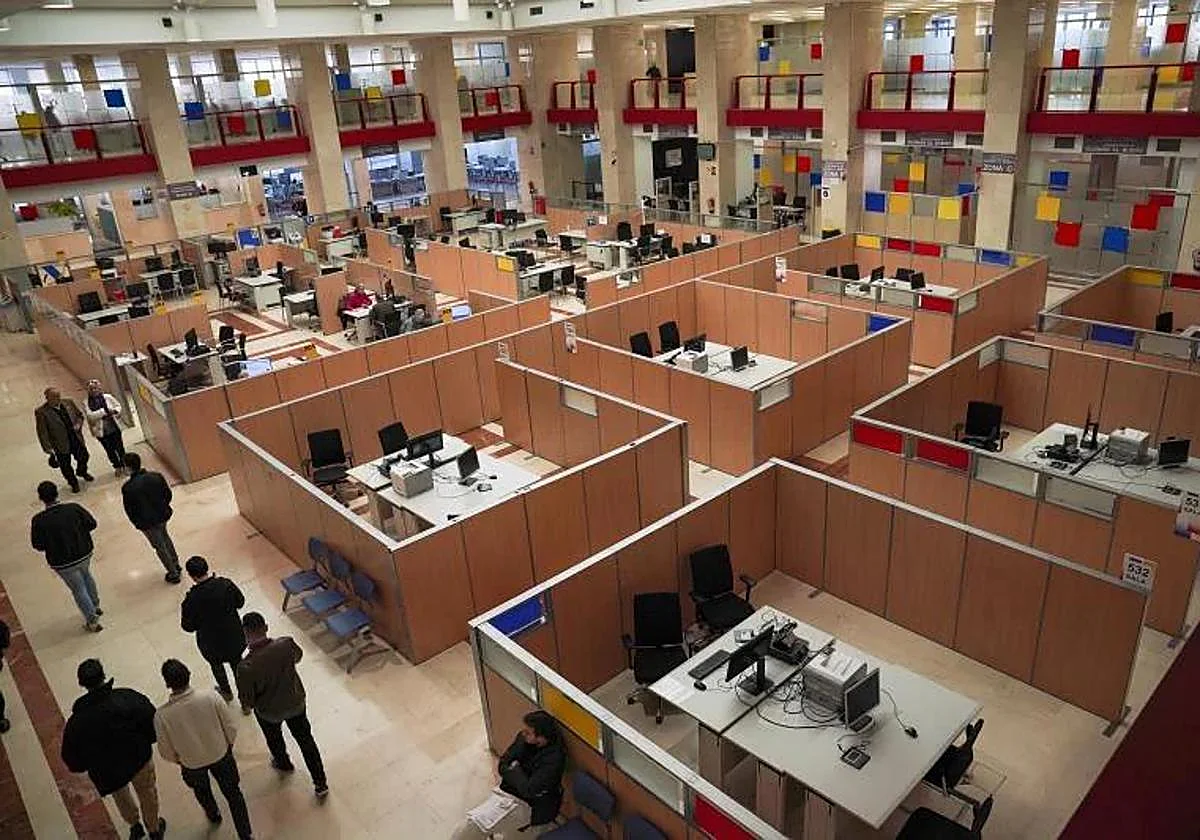
Zoom
Workers of the general state administration. Virginia Carrasco Employment A 35-hour working week for civil servants in Spain will become a reality at start of next yearThe Civil Service and the major staff unions have reached an agreement that unlocks two pending commitments, including the implementation of teleworking
Madrid
Thursday, 18 December 2025, 20:29
The Ministry for Digital Transformation and the Civil Service reached an agreement with the main trade unions representing public workers (CSIF, UGT and Comisiones Obreras) on Wednesday to advance the implementation of the 35-hour working week and the regulation of remote work in the general state administration. The agreement, which will be applied from next year onwards, includes relevant nuances: it will not have an immediate impact nor will it encompass all public employees.
With regard to the reduction of working hours, the agreement foresees that the 35-hour working week will come into force from February, although UGT says that the compromise reached provides for its implementation without further delay. This interpretation is based on what was discussed during the meeting on the pending issues of the framework agreement for a 21st-century administration, as well as on the new framework agreement on working conditions, recently signed by CCOO, UGT and CSIF.
If implemented with the current terms, the measure will represent a historic change in the general state administration: for the first time, its employees, with the exception of the armed forces and the state security forces and corps, will have a 35-hour working week. However, the effective application of the reduction will depend on the final negotiations with the different ministerial departments to be held in the first weeks of 2026, which will have to specify how this reorganisation of working time will be implemented.
At present, state public employees work 37.5 hours a week. The reduction now agreed fulfils a historical demand, repeatedly raised since the 90s. This working week was eliminated in 2012 as a result of the cuts caused by the financial crisis - a decision that affected all public administrations and remained in force until the approval of the 2018 general budget. Since then, different administrations have progressively recovered or implemented the 35-hour working week.
Negotiations are not limited to the reduction of working hours. Remote work is another pending demand, which once again took centre stage at the last meeting of the commission held in 2025. According to the trade unions, its regulation and implementation will become a reality in the coming months, although key aspects remain to be defined. Its regulatory and organisational development will require more time, as well as new rounds of negotiations.
This agreement also includes eliminating the replacement rate, hiring more people than the posts left vacant by retirees, which will contribute to reinforcing staff in saturated bodies such as the Sepe or social security and reduce temporary hiring, which now exceeds 30%, twice as much as in private companies.
Wage increase
The Ministry of Public Administration has also confirmed that the staff of the general state administration will see a salary increase of 2.5% reflected in the December payroll, in addition to the outstanding amounts corresponding to the previous months of the year. Minister Óscar López has said that this payment will also be made in most of the regions in Spain before the end of the year. However, some, such as Madrid, Cantabria and Galicia, have opted to delay it until January - a decision that has also been taken by many local councils. The CSIF union said that many local authorities have already closed the December payments and do not have computer systems that allow them to manage an additional payment in such a short time.
The pay agreement reached for public employees provides for a cumulative increase of 11.4% over the period from 2025 to 2028. The first increase of 2.5% will be applied retroactively from January this year. In 2026, an increase of 1.5% is foreseen, to which an additional 0.5% could be added depending on the development of the CPI, which would be settled later in 2027. A further increase of 4.5% has been set for the same year, while in 2028 the process will be completed with an increase of 2%. All of these revisions will enable the recovery of around 2.9% of the purchasing power lost and will involve an outlay of more than 22 billion euros for the public coffers.
Although salary improvements will apply to all professional fields in the administration, the economic impact will be unequal depending on the category and level of the post. Judges and inspectors, for example, will receive more than 1,200 euros. On the other hand, a worker in group C1 will receive around 700 euros, according to data provided by CSIF.