Zoom
The Morón military base in Spain. R.C. Politics A common European army? Spain expresses its readiness for one, but in what format?The crises in Iran and Ukraine are pushing for the EU to overcome old differences so member states can establish a military structure outside NATO and thus assist partners in distress, such as Cyprus
Tuesday, 10 March 2026, 18:11
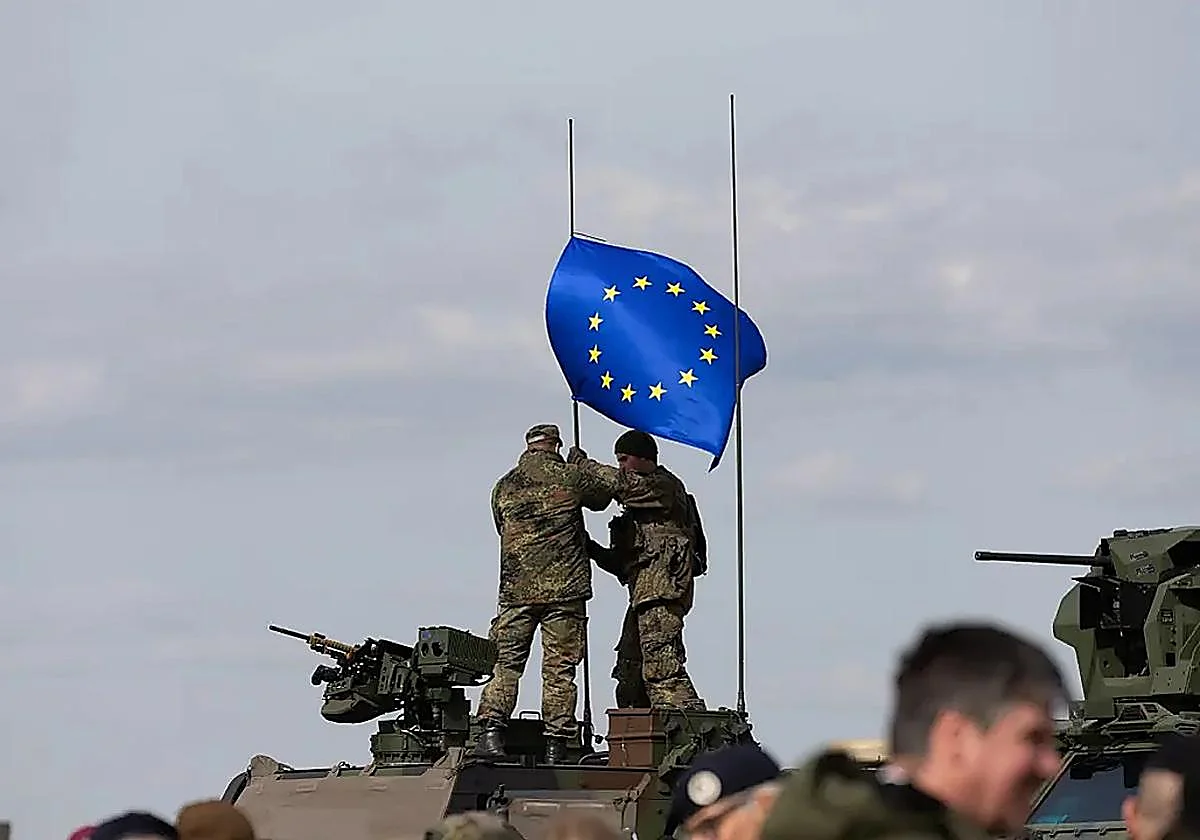
The Spanish government has expressed, both publicly and privately in military forums, its support for the proposal to establish a joint military structure within the European Union.
This support from Spain is particularly noticeable given that the war in Ukraine, now in its fourth year, and the recent escalation of the conflict in the Middle East, following the assassination of Iranian Ayatollah Ali Khamenei in a unilateral operation by the United States and Israel, are urging the EU partners to join forces beyond the protective shield of NATO.
The creation of a common EU army is a debate that resurfaces cyclically in the history of European integration, almost always associated with moments of crisis, international instability or the withdrawal of the US ally. It is not a new concept, as it has been at the political heart of the EU project since its inception. In 1956, the six founding states attempted to create the European Defence Community, but the initiative failed when the French National Assembly - a supporter of strategic sovereignty thanks to its nuclear deterrence - refused to ratify the agreement.
The deep doubts among the 27 EU member states regarding the type of army to be created, the scope of such a structure and the distribution of leadership are recurring themes in this debate. Key questions include whether it would be a military force exclusively for EU countries or whether it would also encompass the UK and Norway. The position of neutral states further complicates the possibility of reaching a consensus, but the repercussions of the Iranian war in the Eastern Mediterranean have significantly heightened partner concerns and given considerable traction to the concept of setting up a shared military structure.
The Iranian Shahed drone that hit the British Royal Air Force base in Cyprus early Monday morning, causing no injuries, prompted an immediate response from France and Greece. They deployed a defensive air and naval force, spearheaded by the aircraft carrier Charles de Gaulle. Spain joined this surveillance and protection deployment on Thursday with the frigate Cristobal Colon, the Spanish Navy's most technologically advanced ship.
Amid Spain's ongoing dispute with the US administration over the refusal to allow the use of the Rota and Morón air bases in Operation Epic Fury in Iran, the Ministry of Defence, headed by Margarita Robles, justified this deployment based on its commitment "to the defence of the European Union and its eastern border", since Cyprus is not a NATO member. This announcement came just one day after the Spanish government "categorically" denied having agreed to cooperate with the US, as the White House had claimed, and after Prime Minister Pedro Sánchez reiterated his 'no to war' stance and demanded the activation of diplomacy in defence of international law.
Four models under examination
For the creation of a military structure within the EU, which Spain supports and would be willing to lead, four models are being studied, according to ministerial sources consulted.
The first consists of a single army with intergovernmental operations, where governments would maintain significant control, even while merging their armed forces. The second option is an integrated army under the direction of European institutions, which would require a transfer of sovereignty from member states.
The third option envisages a non-uniform system, also intergovernmental in nature, similar to the EU's existing 'battlegroups' (rapid response battalions), in which member states voluntarily contribute troops and resources for specific rescue, relief or surveillance missions. Although these groups of up to 5,000 personnel have been fully operational since 2025 and could intervene within days, they have not yet been deployed in real crises such as those in Ukraine or Greenland. The final possibility envisages a non-uniform army under fully European command. This model would require the creation of new forces from scratch and would also be under the control of EU institutions.
The most sensitive issue for the European Union, in any case, is the debate on preserving the sovereignty of member states and the preference for the protection provided by NATO. That said, NATO's strategic value has begun to be reevaluated in light of Donald Trump's recent statements and the acknowledged subservience of NATO Secretary General Mark Rutte.
On 27 January, an incident occurred that served as a wake-up call. During a meeting of the European Parliament's Foreign Affairs, Security and Defence Committee, Rutte questioned the possibility of the EU being able to defend itself on its own, as it would entail a duplication of capabilities with NATO. "If anyone believes that the EU can defend itself without the United States, let them keep dreaming," he stated. These words did not go unnoticed in several EU capitals. "The fact that we Europeans hold our future in our own hands is a must, also from a security perspective", responded José Manuel Albares (Spain's Foreign Minister) on French public radio.
Albares reiterated that the solution does not lie in transforming the EU into an aggressive power, but rather in ensuring that deterrence and defence capabilities are under European control: the most recent example being the naval air force campaign in Cyprus. Similarly, Albares openly defended the feasibility of a European army. "Of course it's possible. The EU has sufficient means, industrial capabilities and operational experience to move in that direction," he asserted. This stance was echoed by his French counterpart, Jean-Noël Barrot: "Europeans can and must take charge of their own security. Even the United States agrees. It is the European pillar of NATO."
Also responding to Rutte, Barrot expressed the widespread view within the EU that strengthening the EU's defence capabilities is not incompatible with the Atlantic Alliance's protective shield. This position is also shared by the Spanish government.