3 min read
A Day of Flight Testing at NASA ArmstrongTeresa Whiting
NASA Armstrong Public Affairs Specialist
Jun 30, 2026 ArticleContents
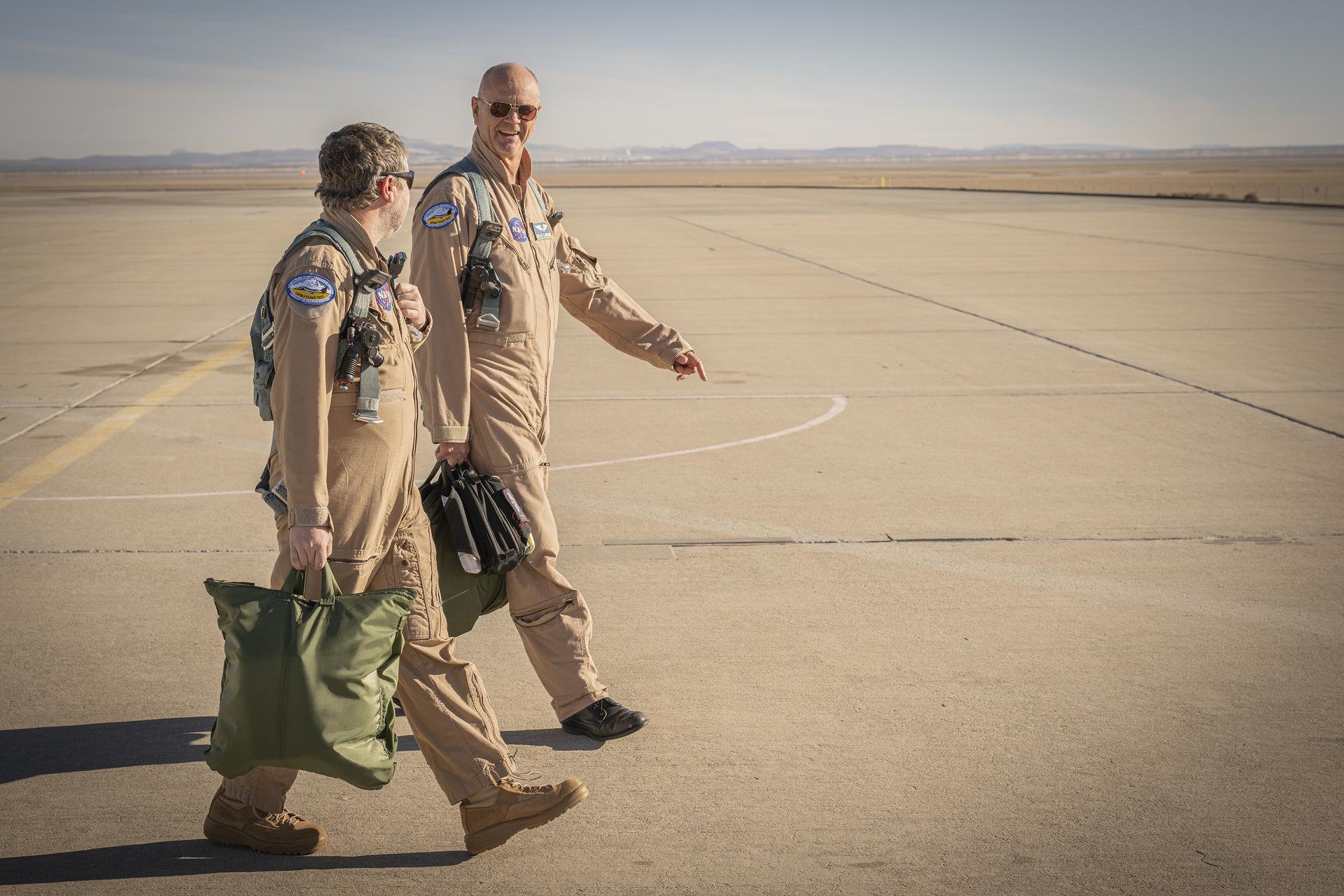
- NASA flight test engineer A.J. Jaffe and pilot Nils Larson walk on the ramp before a flight Tuesday, Jan. 13, 2026, at NASA’s Armstrong Flight Research Center in Edwards, California. The two support the agency’s Crossflow Attenuated Natural Laminar Flow (CATNLF) project, which aims to lower fuel costs for future commercial aircraft by testing a scale-model wing designed to improve laminar flow. NASA/Christopher LC Clark
Flight testing is a team sport. For nearly 80 years, teams at NASA’s Armstrong Flight Research Center in Edwards, California, have used flight testing to push the limits of aerodynamics and advance aviation.
Earlier this year, NASA’s Crossflow Attenuated Natural Laminar Flow (CATNLF) initiative tested a wing concept that would maximize the smooth flow of air known as laminar flow, which could lower fuel costs for future airliners. During flight testing, researchers strapped a scale-model CATNLF wing to the bottom of a NASA F-15 aircraft.
Here’s what a day of CATNLF flight testing looked like.
NASA ground crew prepares the agency’s F-15 research aircraft and Cross Flow Attenuated Natural Laminar Flow (CATNLF) test article ahead of its first high-speed taxi test on Tuesday, Jan. 12, 2026, at NASA’s Armstrong Flight Research Center in Edwards, California. The CATNLF design aims to reduce drag on wing surfaces to improve efficiency and, in turn, reduce fuel burn. NASA/Christopher LC Clark5 a.m. — Aircraft staging
Ground crews ready the aircraft for the mission. If the operation involves a chase plane — a second aircraft to monitor the test flight — it would also be prepared, along with its crew.
6 a.m. — Crew brief
Pilots, engineers, maintenance techs, project leads, researchers, photographers, and videographers meet to review the flight’s goals, weather reports, and final details.
NASA researchers Mike Frederick, right, and Michelle Banchy, left, along with Ashante Jordan and intern Phillip Nguyen, sit in a control room and prepare for a flight test Thursday, Jan. 29, 2026, at NASA’s Armstrong Flight Research Center in Edwards, California. The agency’s Crossflow Attenuated Natural Laminar Flow (CATNLF) project aims to lower fuel costs for future commercial aircraft by testing a scale-model wing designed to improve laminar flow. NASA/Christopher LC Clark6:30 a.m. — Control room checks, air crew suit-up
Researchers head to the control room to complete day-of checks, confirming all communications, displays, and instruments are functioning.
Pilots suit up in life support, including custom‑fit pressure suits, harnesses, helmets, and masks. If a photographer, videographer, or flight test engineer will be in the aircraft’s back seat, they do the same.
6:45 a.m. — Air crew steps, control room preparations
The pilot completes preflight checks with the crew chief and technicians for the aircraft’s electrical systems. The pilot and the crew chief sign a flight preparedness report confirming the aircraft is ready to fly.
Inside the control room, the team prepares to monitor the flight using the same set of test cards, a step-by-step plan for the flight.
7 a.m. — Pilot secured in jet
The pilot and backseat crew member climb into their seats, strap in, and secure any gear they’ve brought for the test. The pilot completes preflight ground checks.
7:15 a.m. — Aircraft taxi
The pilot communicates with the control tower and taxis to the runway. Control room teams at NASA Armstrong monitor the aircraft via radio.
7:30 a.m. — Takeoff
The pilot accelerates down the runway and, at the proper speed, pulls back on the stick to take off. Once airborne, the pilot coordinates with air traffic control at Edwards Air Force Base and the NASA Armstrong control room while flying to the designated test area.
A F-15 aircraft owned by NASA’s Armstrong Flight Research Center in Edwards, California, flies above a mountain range on Tuesday, April 21, 2026. The agency’s Crossflow Attenuated Natural Laminar Flow (CATNLF) test article is attached to the bottom of this F-15. This project aims to lower fuel costs for future commercial aircraft by testing a scale-model wing designed to improve laminar flow. NASA/Jim Ross7:30 to 8:30 a.m. — Flight
At the test location, the team coordinates with the pilot on altitude, speed, and maneuvers. The test conductor relays each task, and the pilot completes them one-by-one. The pilot and control room monitor the performance of the hardware, instruments, aircraft, or software throughout the sequence. After completing the test points, the pilot returns to base.
8:45 a.m. — Landing, towing
The pilot lands and taxis to the ramp at NASA Armstrong, where the crew chief meets the jet. After the pilot exits, the aircraft is towed into the hangar for maintenance.
9:30 a.m. — Crew debrief
The pilot, project team, and mission controlstaff return to the briefing room tocapture lessons learned and document items for follow-up.
10 a.m. — Data download, second flight prep
Teams download flight data for analysis. If two flights are scheduled, preparations begin immediately for the second.
Four NASA employees walk toward a hangar after a flight Thursday, Feb. 4, 2026, at NASA’s Armstrong Flight Research Center in Edwards, California. The team supports the agency’s Crossflow Attenuated Natural Laminar Flow (CATNLF) project, which aims to lower fuel costs for future commercial aircraft by testing a scale-model wing designed to improve laminar flow. NASA/Christopher LC ClarkShare
Details
Last Updated Jun 30, 2026 EditorDede DiniusContactTeresa Whitingteresa.whiting@nasa.govLocationArmstrong Flight Research CenterRelated Terms
Explore More
5 min readNASA’s Newest Wind Tunnel Builds on Legacy of Innovation
Article 23 hours ago 3 min readThis is How NASA Flight Tests New Technology
Article 1 week ago 9 min readARMD Research Solicitations (Updated June 23)
Article 1 week ago Keep ExploringDiscover More Topics From NASA
Armstrong Flight Research Center
Aircraft Flown at Armstrong
Quesst: The Aircraft
Aeronautics