Feature
A journey into the heart of Malaga AirportOn this unique visit, we discover everything from the so-called 'bunker' - home to the 'brain' of these facilities - to the 14-kilometre-long underground 'conveyor belt' system for processing luggage
Añádenos en GoogleMalaga
29/06/2026 a las 14:49h.We arrived at Malaga Airport - the gateway for almost 70 per cent of tourists arriving in Andalucía by air- without luggage. We observed a level of activity reminiscent of a major city that never sleeps, through which up to 100,000 passengers pass each day, where nearly 700 aircraft operate on the runways daily, and where 500 companies and some 12,000 professionals work, around 500 of whom are employed by airport operator Aena.
The passengers' journey through the airport must be swift, comfortable and hassle-free. All operations must be synchronised. But how is this hub managed - the very heart that pumps tourists to the Costa del Sol and the first and last point of contact with the destination for those arriving with high expectations and those departing with a treasure trove of memories? SUR has ventured into the heart of these facilities to discover the vital organs and key components that drive the machinery of Spain's fourth-largest airport, which handled nearly 27 million passengers in 2025.
(Daniel Maldonado)The experience began first thing in the morning with a visit to the morning meeting - which no media outlet has ever attended before - at which the fourteen heads of the various departments, together with the airport director, Pedro Bendala, review the previous day's events and set out the forecasts for the day ahead.
- One of the 3,172 conveyor belts that guarantee that the suitcase reaches the plane on time. (Salvador Salas) María Engie, with a colleague, in the SATE room, from where the luggage transport system is controlled. (Salvador Salas) From this room the airport operations are coordinated and followed in real time. (Salvador Salas)
The area known as the 'bunker' - accessed via doors bearing no signage - is a large room with several offshoots, filled with columns of cables that keep the airport running. The chill in the room is the first impression, followed by the feeling of being in a gloomy, high-security environment.
"This is the data network that connects the whole airport," explains Delgado, speaking with passion for her work. She adds that this vault houses all the airport's servers, which is why it has a high-security, fire-resistant door, fitted with a panic-release mechanism and protection against smoke, burglary and water. There is little at Malaga Airport that does not depend on one of the servers housed in this centre, arranged in large columns.
The airport has 15.8 kilometres of underground tunnels open to the public
The figures illustrate the scale of this 'catacomb', which comprises 188 cabling centres; 262 kilometres of fibre optic cable; around 700 SIPA points (passenger information screens); 141 virtual Linux servers; over 2,000 cameras throughout the airport; and between 18,000 and 24,000 wifi users connected each day.
This centre houses 9,000 active sockets or data connection points. From here, for example, the centre controls the access card readers for the various areas used by the nearly 12,000 staff members and provides support for systems enabling communication among air traffic controllers, who are key personnel in aircraft ground operations.
All of this is carried out with a particular focus on preventing cyber-attacks and innovating day on day to gradually implement artificial intelligence in the automation of internal processes that aid the performance of specific tasks. "It's a never-ending process of learning," explains Mari Carmen Delgado, emphasising that this centre is a true benchmark in communication systems.
- José Luis Vidrié, in the room from where the airport maintenance is managed. (Salvador Salas) Screens showing the underground network for the movement of luggage. (Salvador Salas) Guiding an aeroplace to its parking place. (Salvador Salas) María Ángeles Ayala deals with an incident on the plane that arrives late. Firefighters at one of the two stations at the airport. . (Salvador Salas)
In the airside area - that is, once through security, where the strictness of the checks means that a member of the SUR team is selected for a more thorough random check, which, of course, is carried out - it is noted that passenger traffic increases as the day progresses. At today's meeting, it was announced that "by nine o'clock this morning, they had achieved 100 per cent punctuality, compared to the average of 97 per cent".
They also stated that 565 flights are scheduled and 98,000 passengers are expected, of whom 2,400 will be waiting for their flights in the VIP lounge. Car park occupancy stands at between 65 and 75 per cent.
They also reported incidents such as the transfer of a pregnant woman to hospital and the provision of assistance to a passenger suffering from dizziness and nausea. In addition, they provided details such as the opening of the authorities' lounge on two occasions, a blockage in some toilets, and the updating of internal systems and programmes.
The airport has a security system comprising more than 2,000 cameras
Following this meeting and bearing in mind the key points of the day, the tour through the heart of the airport stops off at the Operations Centre, from where airport operations are coordinated and monitored in real time, alongside the management of the information required for the safe and orderly conduct of aircraft movements.
Ana Rincón, head of the Operations division, points out that it is "the central hub for operational integration, facilitating the preparation, information and monitoring of day-to-day operations to support decision-making". In other words, they decide on aircraft movements on the ground and passenger flows, and allocate the necessary resources according to operational requirements.
"The main function is to anticipate any problems that may arise and organise, for example, where each aircraft is parked. We have to work like a well-oiled machine to ensure there is no friction and that the transit of up to 100,000 passengers a day is as quick and comfortable as possible," says Rincón, while a colleague reassigns the disembarkation point for passengers on a delayed flight. To this end, a team of professionals keeps a close eye on the large panels and screens that take centre stage in this control room, where, among other tasks, boarding gates are allocated at a facility which, in the first four months of the year, set record figures in its more than 100-year history with 7.7 million passengers, an increase of 7.4 per cent, and 53,877 flights, an increase of 4.8 per cent.
- Multi-faith prayer room at the airport. (Salvador Salas) The service for people with reduced mobility deals with an average of 1,249 passengers a day. (Salvador Salas) Passenger information service members with Gemma Yela. (Salvador Salas) Laura Rosales Hernández, in charge of the commercial division, outside the VIP lounge. (Salvador Salas) Malaga airport directors in the meeting room with the control tower in the background. (Salvador Salas)
In the same room, but at the other end of this area, another team is responsible for keeping all the airport's services running smoothly. Reports come in that a lift in the car park has no power or that a conveyor belt has stopped. These are just a few examples of the tasks they deal with on a daily basis. José Luis Vidrié Pinto, head of the Engineering and Maintenance Division, explains that there are two centres: one on the airside and another that manages terminal and road services.
"Our job is to ensure everything is operational, from air conditioning to the runway lighting system and air navigation," he explains, adding that everything must be running perfectly, from unblocking toilets or dealing with leaks or faults in any of the 113 lifts quickly and in real time, to managing the 62 transformer stations or ensuring that, on the day of the major power cut, the airport did not run out of power, while maintaining operations without incident.
The centre also controls the 15.8 kilometres of underground galleries, the 4,931 runway lighting units - of which 2,325 use LED technology - as well as the 281 floodlights fitted with 2,000-watt halogen bulbs, plus 71 LED floodlights rated at 1,270 watts, mounted on lighting towers on aircraft parking aprons.
"The power cut was a real test. It was the only facility in the province where the power didn't go out because we have our own systems to ensure normal operations," he says, explaining that every day "they carry out 35 corrective and preventative work orders, which amounts to around a thousand a month". Vidrié has been working at the airport since 2009, when he joined the facility as part of the Malaga Plan.
And no such unique experience would be complete without a visit to one of the most unusual facilities - one that arouses a great deal of curiosity precisely because it is responsible for handling luggage, that precious possession for passengers, for whom collecting their bags is one of the main concerns of the journey.
María Martínez, from Engie, offers reassurance that "all suitcases are controlled. There are 70 baggage screening gates, and each one is fitted with a tag that is unique worldwide for 48 hours" through the Automated Baggage Handling System (SATE).
The airport's baggage-handling facilities cover an area equivalent to six football pitches
The baggage handling facilities at Malaga Airport cover an area equivalent to six football pitches, some 44,000 square metres. Within this underground space lies a sort of 'motorway' network where 3,172 conveyor belts criss-cross to ensure that luggage reaches the right aircraft on time.
"We have 14 kilometres of conveyor belts running from the 174 check-in desks spread across the two terminals, which handle up to 26,400 pieces of luggage per hour," explains Martínez, adding that the airport has an automated storage facility for 400 pieces of luggage.
She emphasises, unable to hide her enthusiasm for her work, that the SATE is structured around four security levels, with the most suspicious items of luggage reaching the final one. This is because checked-in suitcases are also subjected to an exhaustive screening process, in which they are sifted through a complex system that moves the conveyor belts vertically.
Thus, if a piece of luggage is diverted to the final level, it means the system has detected something at all the previous stages; in other words, it may be dangerous. Monitoring of this luggage is carried out by 26 EDS (Explosive Detection System) inspection units and 14 Dual View X-ray units.
Luggage flows ceaselessly along this network of conveyor belts, with a monthly record of 766,885 outgoing items set in August 2025, and an all-time high of 27,326 per day on 10 August. In 2025, more than six million pieces of luggage were handled. María Martínez shares another unique and curious record: the 670 suitcases loaded onto a flight to Dubai made it the aircraft that has carried the most luggage in the history of the SATE.
On this unprecedented tour of the control areas at Malaga Airport, which boasts 107 years of history, SUR is accompanied by Pilar Cejudo, one of the six executives who take charge when the director is not on site.
She explains that the aim each day is for operations to run "safely and smoothly", and for that to happen, it is essential that coordination across all departments "works 100 per cent. This is a major city that requires everything to run like clockwork." To this end, she explains that a week in advance, they already know the volume of passengers due to pass through and the number of flights scheduled to operate.
From there, the organisation of the entire operation begins, with the different departments working in a coordinated manner. "Everything is monitored. Today, for example, we know that between 8am and 9am, 4,100 passengers per hour will be moving through the airport, which is a very high figure. Or that from 9am to 12 noon, the volume will be around 3,400. And that there will be 565 movements on the runways," she explains, adding that they also manage the VIP lounge and emergency plans.
"The airport control centre is the forward command post," says Cejudo, who has been with Aena since 1987 and describes the day of the IT outage as "one of the critical moments". She adds that on the day of this special trip, "we'll have the first peak period from 8am to 9am, with 543 aircraft movements".
Last year, more than 3.5 million coffees were served in the airport's food and drink area
We pause on this tour in the VIP lounge with Pilar Cejudo and Laura Rosales Hernández, head of the Commercial Division. There, Hernández explains that around 2,500 passengers a day enjoy this 2,000-square-metre lounge.
"It's a service that's increasingly in demand, where passengers can eat and drink while waiting for their flights, for a fee of 48 euros per person aged eleven or over," she notes. She explains that on 5 April, a record 2,712 passengers were recorded in these facilities, through which 627,581 travellers passed in 2025. "This is an oasis of calm," she says.
Rosales, who is in charge of the 26 catering outlets and 41 shops that make up the airport's retail offering, cites some interesting figures, such as the fact that 3,509,109 coffees were served at the airport last year. She also oversees the airport's seven car parks, which have a total of 8,500 spaces and were used by 3,848,338 vehicles in 2025. And the car hire area, which houses eight self-drive car hire companies, saw more than 625,000 contracts signed last year. Laura Rosales reveals that a tender has recently been launched for around 7,000 square metres, comprising 22 of the 27 catering outlets.
"We want new brands and refurbished premises. In the case of catering outlets, they are replaced every eight years, and shops every five. That's the most exciting part of this job," she says as we make our way through the ever-expanding retail area where travellers can unwind a little before meeting up with Gemma Yela, head of the Airport Services Division, who oversees services for people with reduced mobility, passenger assistance, medical services, cleaning and signage.
Yela shows us these lesser-known areas, through which the airport aims to make passing through its facilities as comfortable as possible. One of the must-see stops is the breastfeeding room, where one couple is peacefully putting their baby to sleep, adjusting the lighting in the room, while another couple relaxes alongside some young children who are keeping themselves entertained in the play area. The room even has a child-friendly toilet.
The next stop is at the interesting multi-faith prayer room, designed so that any traveller can pray to their God, whatever their faith, before travelling.
Vehicles transporting passengers with reduced mobility frequently pass by along the route, and she explains that one simply needs to request the service, as no documentation regarding their condition is required.
She states that 1.5 per cent of passengers require this service and that the record day for such assistance was 15 October 2025, with 1,249 travellers. Yela adds that they are pioneers in services for people with autism spectrum disorder.
"We work with all the associations to make the airport more than just accessible," she says as she heads towards the passenger information desk, because not everyone finds it easy to understand how the airport works before setting off on a journey or upon arriving from holiday.
Meanwhile, she points out one of the 26 drinking fountains available at the airport and one of the 122 mobile phone chargers, which are in high demand.
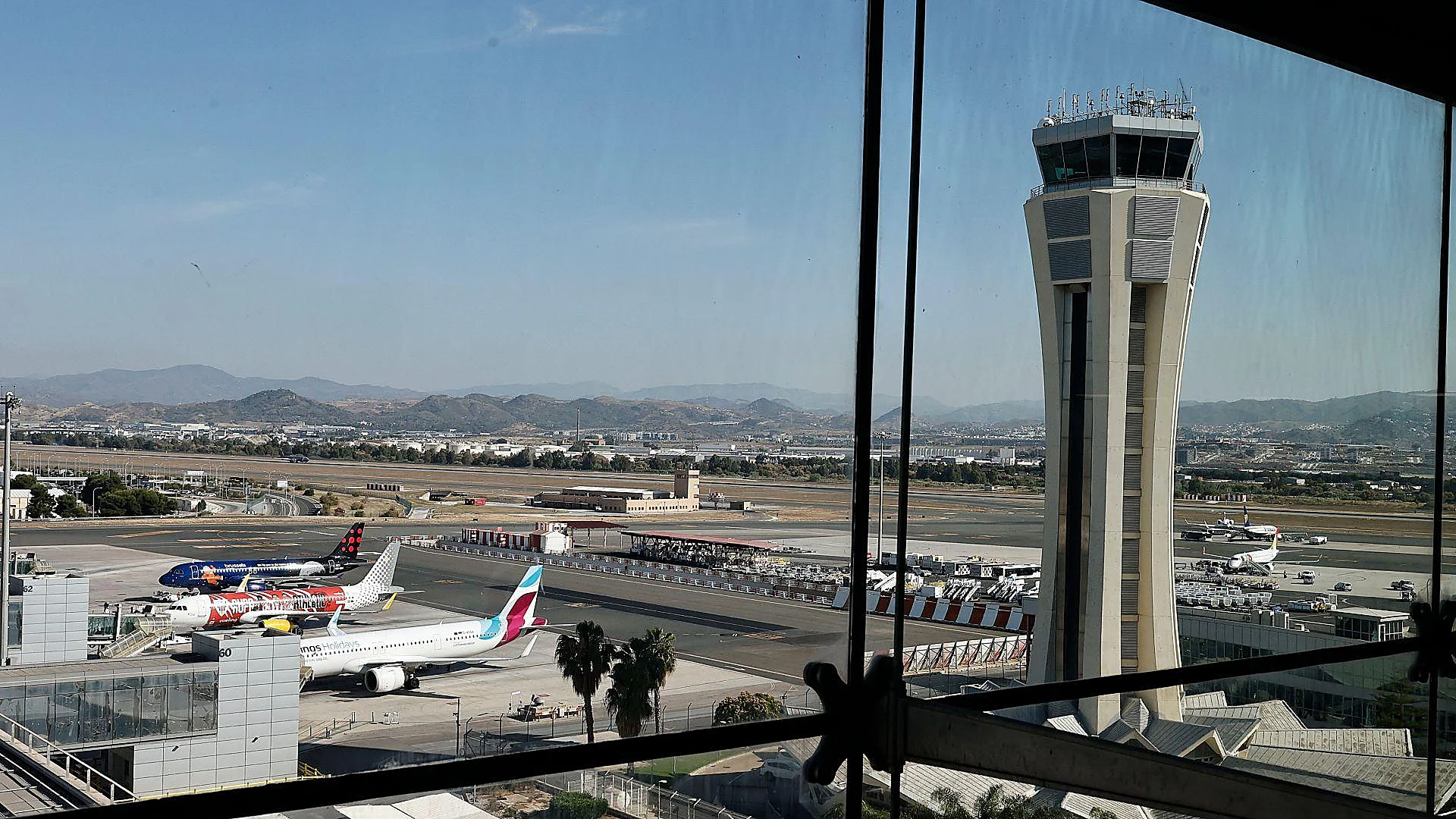
Through the windows, you can see a flurry of activity on the tracks, where aircraft marshallers, track inspectors, aviation ground handlers and firefighters assigned to the two stations carry out key tasks, responding to every incident when the alarms sound.
The tour ends next to another of the airport's landmarks, a vertical garden, beneath which the entire team responsible for running these facilities gathers for a group photo - almost a farewell to the director, who is moving to a new post in Madrid on 1 July - and which exudes that spirit of teamwork.