In The Frame
A mysterious stranger who raised eyebrowsJill Newman-Rogers: The animal lover travelled through Andalucía on horseback in 1962, immersing herself in local culture, before opening the first horse rescue centre in Malaga province
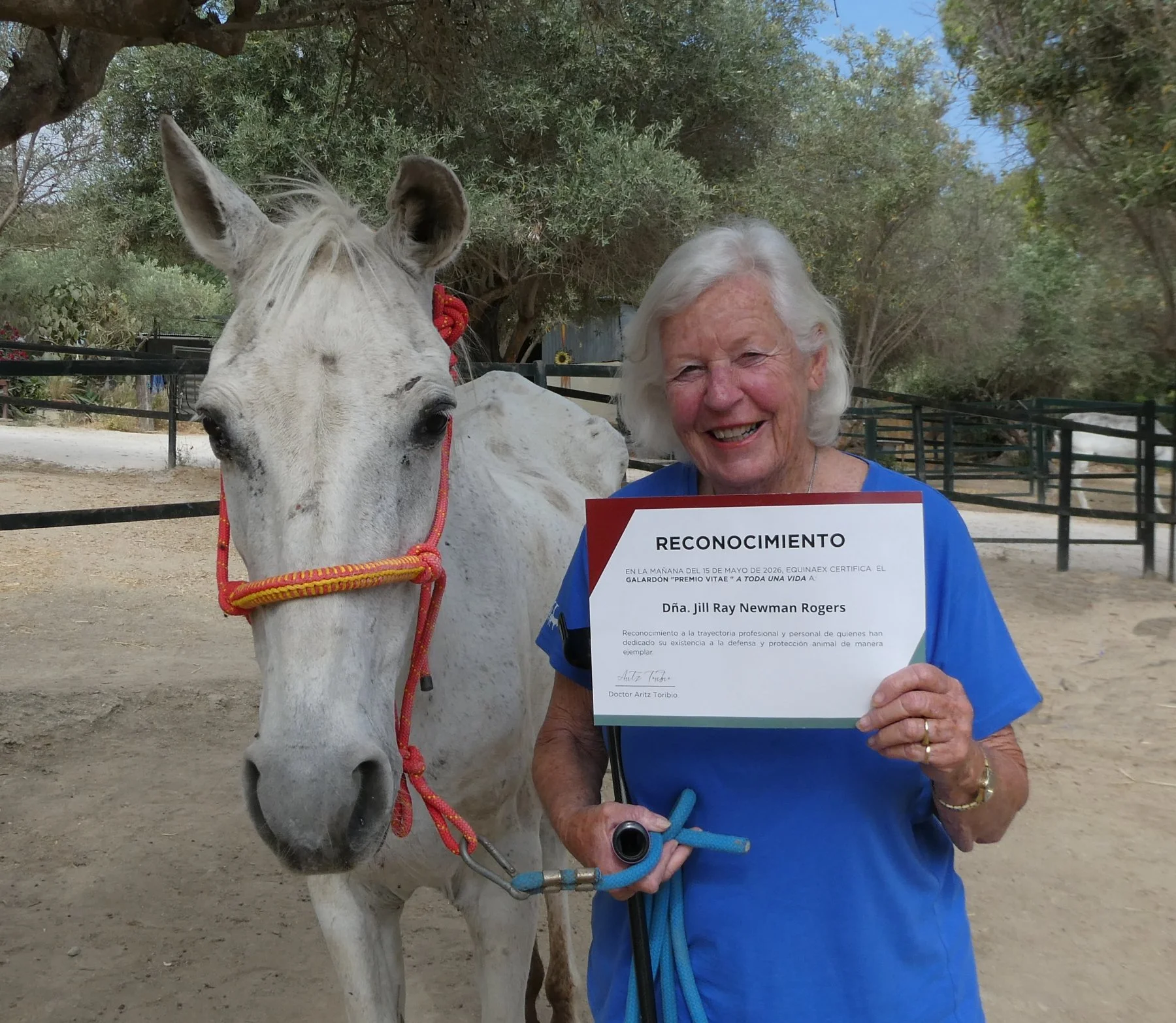
Añádenos en Google Jill Newman-Rogers with one of her beloved horses and the certificate of commendation for animal rights. (SUR)Tony Bryant
12/06/2026 a las 02:00h.Since the early 1960s, a substantial number of British expatriates have chosen to settle permanently on the Costa del Sol, establishing the region as their long-term home. Some relocate to enjoy their retirement in the region's favourable climate and relaxed lifestyle. Among them are individuals who, in addition to embracing life on the coast, devote their time and energy to supporting worthy causes, making a positive difference to the lives of both people and animals.
One of these is Jill Newman-Rogers, the founder and president of the Andalusian Rescue Centre for Horses (Arch) in Alhaurín el Grande, who arrived on the Costa del Sol in 1962 at the age of 21.
After receiving a modest inheritance that allowed her to leave her London flat, Jill embarked on a journey through southern Spain, driven by romantic ideals of horseback riding across Andalucía, encountering charismatic bandits and retracing the paths of renowned adventurers she had once read about in her father's books.
“I didn't want to work with a dog charity because I knew I would want to take them all home”
The former secretary arrived in what she describes as a “heavily Catholic, macho country” that seemed untouched by the spirit of the swinging sixties. Black-clad widows regarded her with suspicion as a single woman, and some locals totally misjudged her character. Undeterred, she embraced her independence and immersed herself in Spanish culture - learning the language, exploring the cuisine and enjoying secluded routes that wound through the vibrant countryside dotted with whitewashed villages.
In A Spanish Tapestry, published on Amazon in 2013, Jill reflects on her early experiences in her newly adopted home. The book recounts both the positive aspects of her experiences and some of the more challenging encounters she faced, such as being labelled a “whore” for choosing to travel alone across Andalucía - something that would have been unimaginable under the Franco regime.
“You must remember that this was Franco's era. The most important people ruling the towns were the head of police, the priest and, sometimes, the vet. This was a time when they were still shooting people, even in Alhaurín. Although it was a culture shock, it was a very liberating time,” Jill tells SUR in English.
Born in Dorking, Surrey in 1941, Jill developed her passion for horses at a very young age. However, she says that she doesn't actually feel that she is from anywhere, seeing as she is what she calls a “war baby”.
“My mother just travelled all over England to places where there weren't any bombs, wherever she felt safe. After the war, we used to go to the south of England for holidays, and I used to help give donkey rides on the beach. I also worked for the master of the Cambridgeshire hunt for a couple of years. I was very unpopular because the horses were too strong for me and I often fell off,” the devoted animal lover explains.
A passion for horses
Jill's passion for horses would play an important role in her life on the Costa del Sol because, after living here for many years, she realised that there was a need to set up a horse rescue centre.
“I wanted to work with a charity. I didn't want to work with a dog charity because I knew I would want to take them all home. I began working for a horse charity, but wasn't happy with the way it was run, so three friends and myself set up Arch in 2009. One of the big problems at the time was that horses were still sent to meat factories. Most of the horses we took in had been involved in flooding. Then we took in some blind donkeys, and sort of moved on from there,” she says.
Rescue mission
Arch, mainly financed by donations and its charity shop in Alhaurín el Grande, has since transformed the lives of countless horses, ponies and donkeys. Its mission is to rescue equines who have been abused, neglected or abandoned - “animals who have no one else to fight for their well-being”.
“Most of our rescues come through Seprona. Some are also brought in through the Local Police. Inevitably some of the older animals, or those with special needs, stay with us for a long time, but the centre is not a retirement home or a sanctuary: we try to find suitable homes for all our rescue animals,” Jill explains.
Although now an octogenarian, Jill, described by volunteers as “a remarkable woman”, still works at the rescue centre six days a week, even though she has had three hip replacement operations. Her determination to help equines has not faltered over the years and her work has recently been recognised by the Spanish ministry of interior, which granted the charity public utility status. This is a special legal recognition granted to certain non-profit associations whose activities are considered to serve the general public interest rather than primarily benefiting their members.
Jill has also just received a certificate of commendation at a convention in Granada on animal rights and the new animal laws to mark “a life dedicated to horses”.
“Rescue is only part of our story. Once animals arrive at the centre, we work with Seprona, local equine vets, and with our animal rights lawyer, Aritz Toribio, to take owners to court. This is a costly, frustrating and long-drawn-out process. New animal cruelty legislation has been slow to filter through to judges and public prosecutors, but there have been some successful cases recently which give us hope that we may eventually win the fight for justice for equines,” she concludes.