Social media
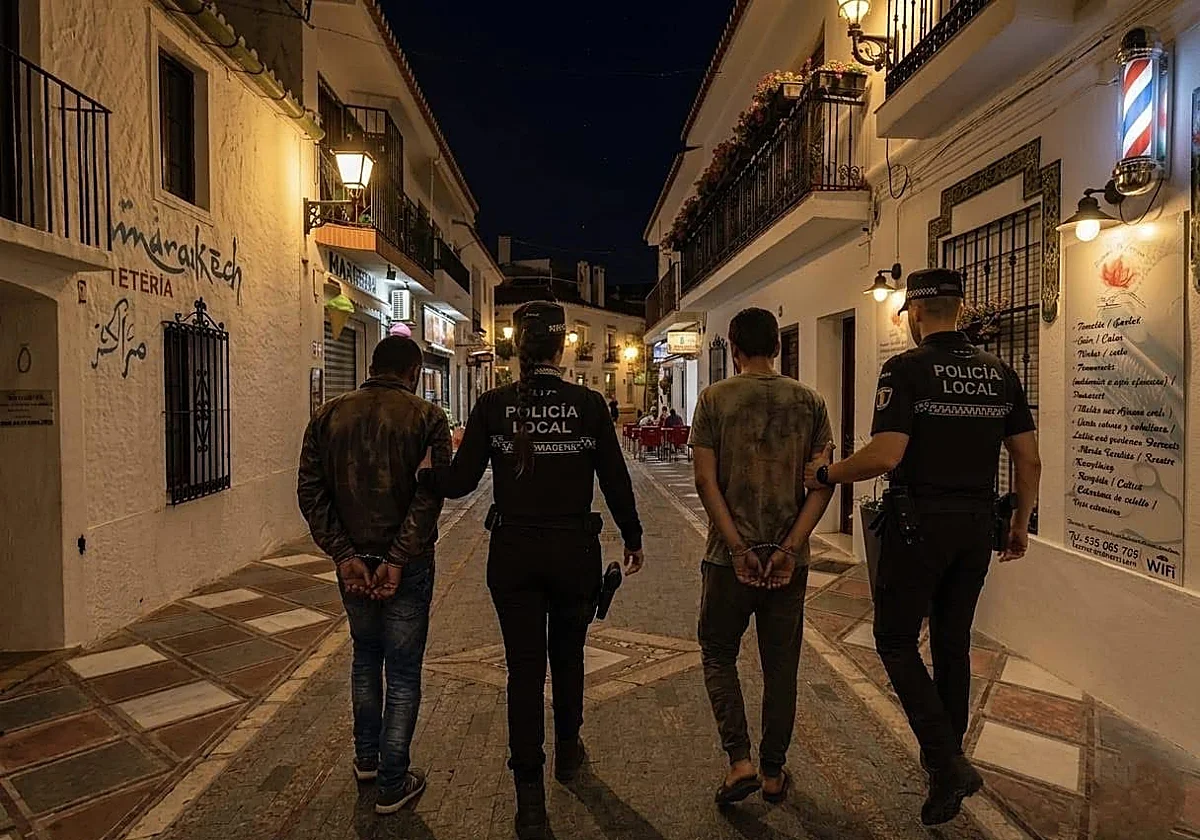
AI misuse? Benalmádena police tried generating a photo of two alleged burglars being arrested and got it wrongThe Local Police force has admitted using a fabricated image following the controversy caused by what it incorrectly portrays
The AI-generated image released by Benalmádena Local Police.Benalmádena
28/04/2026 a las 16:48h.The news was first reported by SUR: a spate of burglaries in homes in the town centre of Benalmádena Pueblo had sown fear among residents , who were talking of nothing else.
Security bars, security systems, alarms... the residents, including those who had already been victims of a burglary, were considering adopting such measures due to the insecurity stirred up by these break-ins.
Most of these burglaries occurred on weekends or when the owners were away. The Local and National Police mounted a joint operation that included police checkpoints at key access points to the old town and increased patrols, including some in unmarked cars and officers in plainclothes.
The epilogue came last Saturday. Benalmádena town hall, through its usual media channels, announced the arrest of two men as the alleged perpetrators of these break-ins. The announcement consisted of a brief text and a link to the town hall's official profile page, which in turn shared a post from Benalmádena Local Police's official profile.
That post included a photo showing two Local Police officers with two detainees on a street in Benalmádena old town. All the media outlets published that photo, assuming it corresponded to the facts. However, this was not the case: the photo had been created using an artificial intelligence (AI) tool, as acknowledged by the Local Police themselves in response to a local resident's query on the matter: "The photograph was created with AI because we weren't going to publish the image of two detainees."
The image shows the name of a now-defunct business, the Marrakech tea room, and the individuals have physical features consistent with North African nationals, despite the fact that the real detainees are Spanish.
The image shows the names of two businesses that are no longer in business: a hair salon and the Marrakech tea room (written in Latin and Arabic script).
Also, the individuals in the image have physical features and details in their clothing compatible with North African nationals, such as being dark-skinned and one of them is wearing flip-flops with jeans.
The information released did not specify the nationality of those arrested, but, as SUR has learned from police sources, the arrested individuals are actually Spanish. The two men arrested are residents of Benalmádena Pueblo and share a house with three other men.
Of these five people, only two have been arrested, but at least three are believed to be from Malaga province: one from Benalmádena and the other two from Almogía and Pizarra.
What parameters were used to generate that image? How could it produce that result? The Local Police claim that what they asked the AI tool for was an "image of two police officers with their backs to the camera accompanying two detainees in a picturesque spot in Benalmádena Pueblo".
The image was generated from a photo of a tea room that closed about ten years ago.
This version from the police seems hard to believe. When creating an image using a generative AI tool, one can start from scratch or use an existing image as a base for the AI to add whatever we want. If we remove the people, the photo represents that stretch of Calle Real as it once was. However, that was some time ago.
The locals consulted estimate that the tea room has been closed for at least ten years. On social media, the most recent image found by SUR dates back to 2015 and, on Google Maps, there is a photo of Calle Real from October 2017 showing the hairdresser's as still there, but no tea room.
Did the AI tool generate the image from a photograph that is over ten years old? Did it choose that stretch of Calle Real with a tea room that disappeared a decade ago as a "picturesque spot" instead of the Plaza de la Niña in Benalmádena?
Telling the difference...
The detailed analysis raises even more questions about what the AI tool was asked to do. In the concocted image, both detainees have blood on their hands, even though the arrests were made without the use of force by police officers. Did AI generate the blood detail off its own bat? Also, did AI choose to show the officers as coming from the Local Police over the National Police?
The image has flaws in graphic details that correspond to what is known as 'inpainting', a phenomenon resulting from the still-emerging generative AI, which can have difficulty maintaining the integrity of text.
The rest of the image details, such as the buildings and the floor, are real, as are the hair salon sign with its barber's pole alongside (the easily recognisable blue, red and white coloured tube) and the colours and font of the words "tea room" and "Marrakech".
What is not faithful to the reality of what it once was seems to further suggest that the base probably is a chosen photo, because it contains some minor modifications, the clearest being that "Marrakech" is missing an "r" (although there are other changes as well). The modifications may be due to what is known as 'inpainting', a phenomenon resulting from the still-emerging generative AI, which can have difficulty maintaining the integrity of the text because it doesn't interpret text as something that cannot be touched and ends up reconstructing the pixels in that area.
Beyond the controversy surrounding this photo, SUR has learned that the National Police - who have taken charge of this investigation - were not informed that the town hall was going to make the arrests public. They only found out when the media published this announcement.