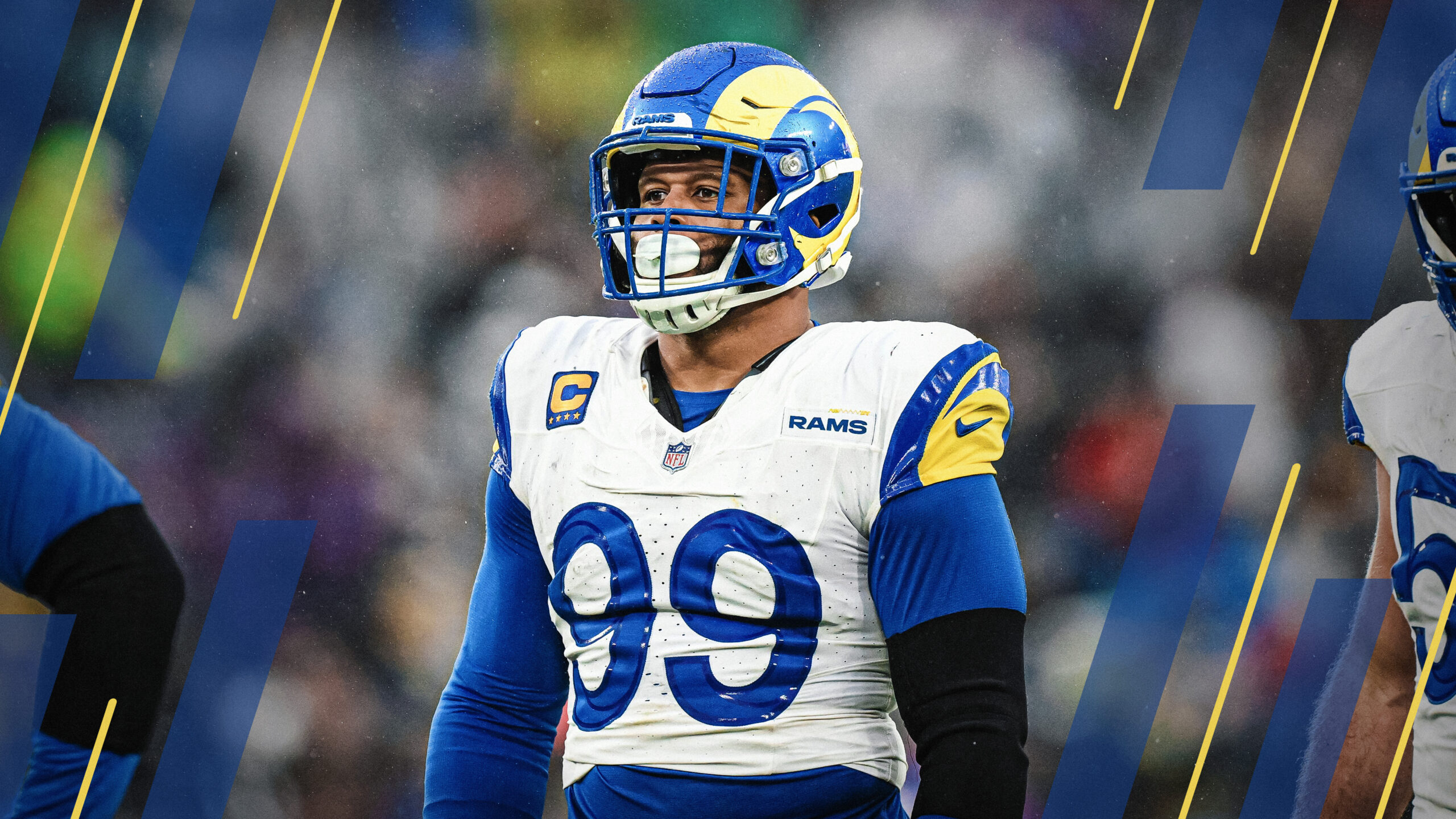
- Aaron Donald leads the All-PFF defense: Donald has the strongest case to be the best player at his position all time, not to mention of anyone from the last 20 seasons.
- Find the other All-PFF teams: Check out the All-PFF team landing page to find other All-PFF teams.
As part of PFF's celebration of 20 years of NFL data, we've built an All-Star team for every franchise, highlighting the best players at each position from the PFF era. This final installment looks at the entire league, making an All-PFF first and second team.
PFF's database dates back to the 2006 NFL season, providing a unique lens for evaluating and comparing players across eras. More details on the methodology used to construct these rosters are available at the bottom of the page.
Offense
QB
First-Team: Tom Brady
Second-Team: Peyton Manning
Most consider Tom Brady the greatest quarterback of all time, and he was also the best quarterback in this methodology. Brady was the top quarterback of the last 20 seasons at avoiding mistakes. His 2.0% turnover-worthy play rate was the lowest of the 101 quarterbacks with at least 1,000 dropbacks.
There have only been five seasons where a quarterback had a turnover-worthy throw rate under 1.5% on 400 or more dropbacks, and Brady owns three of them. His 5.2% big-time throw rate also ranks among the top 20.
Peyton Manning was remarkably close to Brady, with the gap between them notably smaller than the chasm between Manning and everyone else. If the PFF era spanned a few more seasons, it’s possible Manning would have ended on top.
It’s unlikely that any of Brady’s seasons from 2000 to 2005 were any of the top five of his career, while Manning’s 2004 is widely regarded as one of the best quarterback campaigns of all time. Manning was also a first-team All-Pro in 2005, and hardly missed out on a sixth MVP.
Behind Manning were Aaron Rodgers and Drew Brees, followed by a gap, and then Patrick Mahomes was just ahead of Josh Allen. It’s worth noting that Mahomes and Allen are at a disadvantage for having shorter careers during the PFF era to this point, compared to some quarterbacks who played for most of the window.
RB
First Team: Derrick Henry
Second Team: Adrian Peterson
The top running back spot was a three-man race between Derrick Henry, Adrian Peterson and Christian McCaffrey. McCaffrey fell out of the top three in part due to his longevity. He missed most of three seasons due to various injuries and wasn’t a full-time player in his rookie year. That only leaves five seasons where McCaffrey recorded over 1,100 scrimmage yards, so those were his five included campaigns.
Henry and Peterson both had more good seasons to pick from. If this team had a specific third-down or receiving back, McCaffrey would have been the clear choice.
In the battle between Henry and Peterson, Peterson received more help from his offensive line at 1.6 yards before contact per carry. Notably, Henry had more yards after contact per carry at 3.6 to 3.0, a higher avoided tackle rate, a higher first down rate and much fewer fumbles.
Henry’s 4.9 yards per carry and 3.6 yards after contact per carry both lead all 28 running backs with at least 1,600 attempts. As a receiver, Henry generated more yards per route run and a higher PFF receiving grade, as well as a higher pass-blocking efficiency and PFF pass-blocking grade.
The other running backs that were close to making the team were Josh Jacobs and Marshawn Lynch. The only current Hall of Fame running backs from the PFF era were Edgerrin James and LaDainian Tomlinson, and both backs spent most of their great seasons before 2006.
Explore PFF Fantasy Tools
See projected points and full stat lines across PPR, Half PPR, Standard, DFS, IDP, and BestBall formats. Import your league to view projections tailored to your exact scoring settings. Fantasy Football Projections Projected points and full stat lines across every major scoring format—or sync your league to see projections built for your exact settings. (opens in new tab) Overall and position draft rankings by scoring type. We combine PFF grades, strength of schedule, and teammate quality to model upside and downside—among the most accurate in Fantasy Pros’ annual ranking competition over the last five years. Fantasy Rankings Season-long draft rankings by position and scoring type—powered by PFF grades, strength of schedule, and teammate context to capture upside and downside. (opens in new tab) Customizable, printable cheat sheets for PPR, Half PPR, Standard, 2QB, IDP, Dynasty, and Rookie leagues. Players are tiered by position from our draft rankings, with ADP from popular fantasy platforms factored in. Fantasy Draft Cheat Sheet Printable, customizable cheat sheets for PPR, Half PPR, Standard, 2QB, IDP, Dynasty, and Rookie leagues—players tiered by position using our rankings and ADP. (opens in new tab) Sync your fantasy league to unlock the Live Draft Assistant and custom Lineup Optimizers—real-time pick suggestions, waiver wire targets, and sit/start recommendations built for your scoring formats and roster rules. Fantasy League Sync Connect your fantasy league to unlock the Live Draft Assistant and custom lineup tools—real-time picks, waiver targets, and sit/start advice for your scoring and roster rules. (opens in new tab) Subscribe For Full Access (opens in new tab)WR
First Team: Julio Jones
First Team: Antonio Brown
First Team Slot: DeAndre Hopkins
Second Team: Davante Adams
Second Team: Calvin Johnson
Second Team Slot: Tyreek Hill
The wide receiver race was incredibly competitive. When people discuss the all-time great wideouts, players like Randy Moss, Marvin Harrison and Terrell Owens are in the conversation. But all three started their careers in the 1990s, and each receiver posted no more than three 1,000-yard seasons in the PFF era.
Julio Jones stands out from the group, as his 2.53 yards per route run were the most by the 57 receivers with at least 4,000 routes, and he accomplished this while tallying the second-most receiving yards. Antonio Brown maintained the highest target rate of those 57 receivers and posted the second-highest rate of receiving a +1.0 grade or better.
Some will be surprised that Hall of Fame wide receiver Calvin Johnson only made the second team. But when comparing Johnson’s third-best season to Jones's and Brown’s third- or fourth-best, Johnson begins to fall behind.
Larry Fitzgerald misses the cut despite compiling the most receiving yards over the last 20 years, because this team values peak play. Fitzgerald was consistently great over a longer period of time than the names on this list, but he didn’t record a single season with over 1,500 receiving yards. The six receivers who made the list each reached that mark at least twice.
Along with Fitzgerald, Brandon Marshall, Justin Jefferson, Andre Johnson, Amon-Ra St. Brown, Michael Thomas, Reggie Wayne and Ja’Marr Chase weren’t far off from being selected. It’s particularly impressive for Jefferson, St. Brown and Chase to even be considered: We’re comparing the best five seasons of players, and each of these receivers has only played five full seasons.
TE
First Team: Travis Kelce
First Team: George Kittle
Second Team: Rob Gronkowski
Second Team: Tony Gonzalez
The four tight ends listed here should be no surprise, as all four are in the discussion for best tight end of all time.
The position of the two Chiefs is unsurprising. When including the playoffs, Kelce has generated 375 explosive plays, which is 60 more than any other tight end. He’s avoided 189 tackles, which is 73 more than the next tight end. Others have been slightly more efficient on a per-play basis, but Kelce’s volume trumps that. Gonzalez’s spot as the fourth tight end also shouldn’t be shocking considering his age-20 seasons were before the PFF era, including four of his six first-team All-Pro nods.
Many might be amazed that Kittle is ahead of Gronkowski. While Gronkowski has registered more yards, Kittle has accrued more yards after the catch. Kittle’s 2.27 yards per route run are the most for the 33 tight ends with at least 3,000 routes, followed by Gronkowski at second at 2.20. Also, Kittle has the highest rate of earning a +1.5 PFF receiving grade or better.
Both Kittle and Gronkowski rank among the top-10 tight ends in PFF run-blocking grade among those with at least 1,500 run blocks. The fact that Kittle has fewer than half the penalties of Gronkowski also slightly helps give him the lead.
The only other tight ends that were anywhere close to these four were Jason Witten and Mark Andrews.
Read more
Read moreKansas City Chiefs All-PFF Team: The best players of the past 20 years
By Nathan Jahnke
(opens in new tab) →LT
First Team: Trent Williams
Second Team: Joe Thomas
Joe Thomas is the best pass-protecting left tackle of the last 20 years, and Trent Williams is the best run-blocker. Pass-blocking is more important for a left tackle. Thomas was a great run-blocker and Williams a great pass-protector, but the gap in their run-blocking was bigger than the gap in their pass protection, enough to give Williams the nod.
Thomas allowed pressure on 4.0% of his pass plays, third-best among 48 qualified left tackles, while Williams was ninth at 5.0% of his passing snaps. That means roughly one in every three games, Williams will allow one more pressure than Thomas.
In the run game, Williams received a +1.0 grade on 1.9% of his run blocks, which was the best for left tackles, while Thomas was at 0.7%. On +0.5 grades, Williams stood second-best at 13.6%, while Thomas posted a 9.7%. Williams also owns two of the six +1.5-graded run blocks by a left tackle.
The gap is somewhat closed because Thomas is in the top five in avoiding negative blocks, with only a 7.0% negative block rate compared to Williams's 10.2%, but positive blocks help the run game more than negative blocks hurt. For every one play, Thomas outperformed Williams in pass protection; Williams would be better in the run game by two plays.
The closest left tackles were Jordan Mailata, who is following in Williams' footsteps as a dominant run-blocker and good pass protector. Andrew Whitworth and Joe Staley also excelled in pass protection.
LG
First Team: Evan Mathis
Second Team: Joel Bitonio
Mathis takes the top spot for his dominance in the run game. He received a positive grade on 20.2% of his run blocks. The next-closest is 18.7% by Logan Mankins, while 14.0% is typical of a long-term left guard.
Mathis not only leads in achieving positive grades, but also in avoiding negative ones. His 7.4% negative grade rate was the lowest, with Quenton Nelson being next at 9.4%. For context, 11.7% is typical of long-time left guards.
That means Mathis received a positive grade 12.8% more often than a negative grade, while only two guards are within half that rate. If this team focused more on longevity, Mathis wouldn’t have had a chance, but the concentration on top-five seasons allows Mathis to come out on top.
Mankins, Nelson and Joel Bitonio were the other left guards in consideration, as they all played 8,000 or more snaps and earned at least a career 85.0 overall PFF grade. Bitonio was the best pass protector in the group, and while others sustained greatness in run-blocking over a longer period, Bitonio was the highest-graded run-blocking left guard from 2018 to 2022.
Unlock PFF Premium StatsPFF Premium Stats gives you access to every player grade and advanced statistic. Analyze performance from every angle with powerful filters, situational splits and position-specific metrics that go far beyond the box score.
NFL Premium Stats (opens in new tab)College Premium Stats (opens in new tab)C
First Team: Jason Kelce
Second Team: Creed Humphrey
The gap between Jason Kelce and Creed Humphrey in this methodology was the smallest between any two players at the same position who made the list, or between someone who qualified and someone who didn’t. There were no other centers that were close enough to make the first or second team.
Nick Mangold and Chris Myers have career grades similar to Kelce and Humphrey, but the latter two have higher peaks. There have been 28 instances of a center receiving an 88.0-season grade or higher while playing 800 or more snaps. Kelce boasts five of those seasons; Humphrey and Mangold have four; and Myers has netted three. Alex Mack and Jeff Saturday were the only ones with two.
In general, centers graded notably better from 2006-2015 than from 2016-2025 due to a combination of grading methodology and changes in league tendencies over time. Those season adjustments move Humphrey ahead of Mangold and Myers.
RG
First Team: Chris Lindstrom
Second Team: Zack Martin
The battle for the four right guard spots was between Chris Lindstrom, Zack Martin, Marshal Yanda and Brandon Brooks. Those were the four right guards with at least 6,000 snaps and a 91.0 overall grade or better.
Lindstrom takes the top spot for securing the best peak of any right guard. There have been four seasons where a guard posted at least a 94.0 overall grade, and Lindstrom is responsible for two. Similar to centers, guard grades have trended down over time, making Lindstrom’s two seasons even more impressive.
The gap between Martin and Yanda was narrow. Martin had the better peak seasons, while Yanda had better longevity and would have been the selection if we looked at the top eight seasons or longer. This methodology puts Martin on top.
RT
First Team: Penei Sewell
Second Team: Lane Johnson
The story at right tackle is similar to that of left tackle. Lane Johnson is the highest-graded right tackle in pass protection at 86.1 and has been excellent in run-blocking; his 92.8 grade is second-best. However, Penei Sewell owns the best run-block grade at 97.6 and ranks sixth in pass protection at 80.4.
Sewell has compiled a positive run-block grade on 17.2% of his run blocks, with Kaleb McGary as the only one close at 15.3%. Consider that the third-best is 13.2%, and Johnson sits at 12.0%. Sewell has been most impressive by receiving +1.0-graded run blocks at a 1.9% rate, while Johnson has been at a 0.4%.
This selection might be slightly more controversial considering the sample sizes. Johnson has played 168 regular-season games compared to Sewell’s 83. The only other right tackle that was close to these two was Ryan Ramczyk.
Defense
DL
First Team: Aaron Donald
First Team: J.J. Watt
Second Team: Cameron Heyward
Second Team: Chris Jones
Aaron Donald was the top defensive player at any position in this methodology. His career 97.3 defense grade was 3.4 higher than that of any other defensive tackle, and he played more than the next four defensive tackles. Donald’s 15.4% pressure percentage was the best for all interior defenders.
J.J. Watt was another obvious choice, with a 14.0% pressure percentage in the years he was classified as an interior defender. He was the one player on this list who could have made sense at two different positions. Placing him at defensive tackle allowed the best eight players to make the defensive line. Coincidentally, the player who made the team by placing Watt on the inside was his brother, T.J. Watt.
Cameron Heyward, Chris Jones and Geno Atkins were the three other interior defenders with a PFF defensive grade above 92.5, regardless of sample size. They also all played over 7,000 defensive snaps. Atkins had the best individual season of the three in 2012, but Heyward and Jones both posted stronger multi-season peaks.
NT
First Team: Dexter Lawrence II
Second Team: Damon Harrison
While some teams have used more 4-3 defenses and others more 3-4, this team opted for two nose tackles. Players often stay at nose tackle for their entire career, while any good SAM linebacker can often move to off-ball linebacker or edge rusher full-time.
Dexter Lawrence II and Damon Harrison are the two players with overall PFF grades above a 92.0 on over 1,000 snaps while lined up at nose tackle. They have identical 92.4 grades and have played over 2,000 snaps at nose tackle.
The two reached that grade in different ways. Nose tackles don’t typically have much success as a pass-rusher, but Lawrence has been excellent. He boasts a 15.5% pass-rush win rate while lined up at nose tackle, and the 10 other players with over 1,000 nose tackle snaps range from 2.6%-8.5%. Lawrence was also very good against the run, and his well-rounded play gives him the top spot.
Harrison was our highest-graded defensive tackle against the run — not just at nose tackle. Harrison achieved a run stop on 13.9% of his run plays, which is over 2% more than any other defensive tackle.
If this were a real football team, we would take each player at their peak, and Harrison would receive more playing time for his run-stopping. Neither player would likely be on the field in passing situations given the quality of our defensive tackles.
Lawrence's Career PFF Grades
EDGE
First Team: Myles Garrett
First Team: Khalil Mack
Second Team: Von Miller
Second Team: T.J. Watt
This team features the top two edge rushers of the first decade of PFF, and the best two from the last decade. These are the four edge defenders with at least 6,000 snaps and a 93.0 overall PFF grade or better.
Garrett has been the best pass-rusher of the group. He has a 21.4% pass-rush win rate, which is 3% higher than any other rusher with at least 2,000 snaps.
The battle between Khalil Mack and Von Miller was close, but Mack’s longevity helped him take the last spot. Miller’s 2012 season was the best of either player. Yet Miller has registered just one notable campaign in the last six years, while Mack has generated at least a 90.0 overall grade on over 600 snaps in two of his last three seasons.
Brandon Graham, Cameron Wake, DeMarcus Lawrence and DeMarcus Ware were all close to the two second-team spots. Micah Parsons, Nick Bosa, Aidan Hutchinson and Will Anderson Jr. are all off to excellent starts to their career, but just haven’t played enough healthy seasons to be truly considered.
LB
First Team: Bobby Wagner
First Team: Luke Kuechly
Second Team: Lavonte David
Second Team: Patrick Willis
There are 10 off-ball linebackers with an 89.0 overall PFF grade or better on at least 6,000 snaps. The gaps between them are relatively small, with their peak seasons being the deciding factor for which linebackers make the list
Luke Kuechly posted a 93.6 overall grade in 2015, the best mark for any linebacker in a season. Bobby Wagner produced a 91.7 grade in 2018 and a 91.4 grade in 2017, ranking second and third, respectively. If this list looked at the top six or seven seasons instead of the top five, then Willis would be the No. 1 linebacker.
Grades for linebackers have generally declined since 2019, in part because their job has become more difficult. Lavonte David owns a top-four grade over these past seven seasons, even though he hasn’t gotten the awards he deserves during that time. The fact that David has had two peaks, one from 2017-2022 and another in 2013 — when he generated the third-best grade among linebackers — helped him make this team.
Fred Warner and Demario Davis were the two other linebackers very close to being selected. Ray Lewis was also in that conversation, which is remarkable because the PFF era only covers Lewis from ages 31-37. His two Defensive Player of the Year awards and five of his seven first-team All Pros occurred before 2006.
Read more
Read moreRanking the highest-graded position groups in PFF history
By Bradley Locker
(opens in new tab) →CB
First Team: Richard Sherman
First Team: Darrelle Revis
First Team Slot: Chris Harris Jr.
Second Team: Casey Hayward
Second Team: Champ Bailey
Second Team Slot: Charles Woodson
The cornerbacks were straightforward to put together. Richard Sherman, Darrelle Revis and Chris Harris Jr. all played their entire career during the PFF era. Champ Bailey and Charles Woodson are Hall of Famers, but roughly half of their best seasons in terms of All-Pro and Pro Bowl selections occurred before the window, putting them at a disadvantage.
Sherman allowed 0.78 yards per coverage snap, which was 0.15 lower than any of the 52 other cornerbacks to suit up on at least 4,000 snaps. Revis was second at 0.93 and was the only cornerback of the group to generate one pass breakup for every four receptions allowed. Casey Hayward was third in that metric at 18.5%.
Harris was the obvious choice in the slot. His 3,485 coverage snaps while lined up in the slot are the most for all cornerbacks. His 92.7 PFF coverage grade is the best from that group, and his 0.94 yards per coverage snap also ranks first among those with at least 2,000 snaps.
Charles Tillman, Antoine Winfield and Jalen Ramsey were all very close to making the second team.
S
First Team: Eric Weddle
First Team: Harrison Smith
Second Team: Devin McCourty
Second Team: Kerry Rhodes
The safety position might be the most controversial with the exclusion of Ed Reed and Troy Polamalu. They would have been the two third-team players had this article included a third team.
They, like several other 2000s All-Decade Team members, were hurt by some of their best seasons coming from before the PFF era. Ed Reed won Defensive Player of the Year in 2004, where his 358 interception yards from that season still rank second all-time. Two of Polamalu’s six All-Pro seasons occurred prior to 2006, including the two years where he recorded the most tackles.
Eric Weddle, Harrison Smith and Devin McCourty are three of the five safeties with over 12,000 snaps during the PFF era and three of the five with grades above 90.0. All three own grades above 92.0 in both run defense and coverage. Pass-rushing helped differentiate the three, as Weddle and Smith blitzed much more than McCourty and were more successful on a per-play basis.
Kerry Rhodes was elevated by his 2007 season, where his 93.1 PFF run-defense grade was the best for any safety in a season. While Polamalu, Reed and Brian Dawkins won all the safety awards in the late 2000s, Rhodes was the highest-graded safety from 2006-08, with Polamalu in second and Reed in third.
Against the run, Reed had the lowest rate of negative grades during that three-year stretch at 1.6%, while Rhodes was second at 2.1%. Yet Rhodes earned nearly double the positive grade rate, with roughly twice as many stops and tackles for loss. In coverage, Reed and Rhodes produced an identical 0.39 yards per coverage snap. Reed tallied more interceptions, but Rhodes forced more incompletions. Rhodes also only missed three tackles in coverage, compared to 21 by Reed.
Methodology
Selections were based on normalized PFF grades adjusted by season. To balance peak performance and longevity, only a player's five best seasons with a franchise from 2006-25 were considered. Any season with an overall PFF grade below 60.0 was excluded, ensuring that strong years helped a player's case while weaker seasons were not held against him. Postseason play was included, though all seasons were capped at a 16-game equivalent to maintain consistency across eras. At each position, the player with the highest score under this methodology earned the spot.
Each team consists of 12 offensive and 12 defensive players. Because 11 personnel and nickel defense were the league's most common alignments over the past two decades, those personnel groupings served as the foundation for every roster. Teams received either a second tight end or a fullback depending on whether they used more 12- or 21-personnel. Defensively, teams received either a third interior defender or a third linebacker depending on whether they primarily operated from a 3-4 or 4-3 front.
Players who logged significant snaps at multiple positions during their tenure with a franchise were eligible at either spot. In most cases, those players were assigned to the position where they provided the greatest value, though their versatility occasionally influenced the final roster construction.
Unlike some All-Pro teams that group offensive linemen by position type, these rosters were built according to where players actually lined up. If a team's two best tackles both played exclusively on the left side, only the top left tackle was selected. One of the three wide receivers and one of the five defensive backs was also required to have significant slot experience. In a 4-3 defense, one linebacker needed experience at the SAM linebacker position, while in a 3-4 defense, one defensive tackle needed experience at nose tackle.
When multiple players are listed at the same position, the first name represents the top selection. Players designated as slot wide receiver, slot cornerback, nose tackle or SAM linebacker were selected specifically for those roles rather than as the third-best player within their broader position group.