Zoom
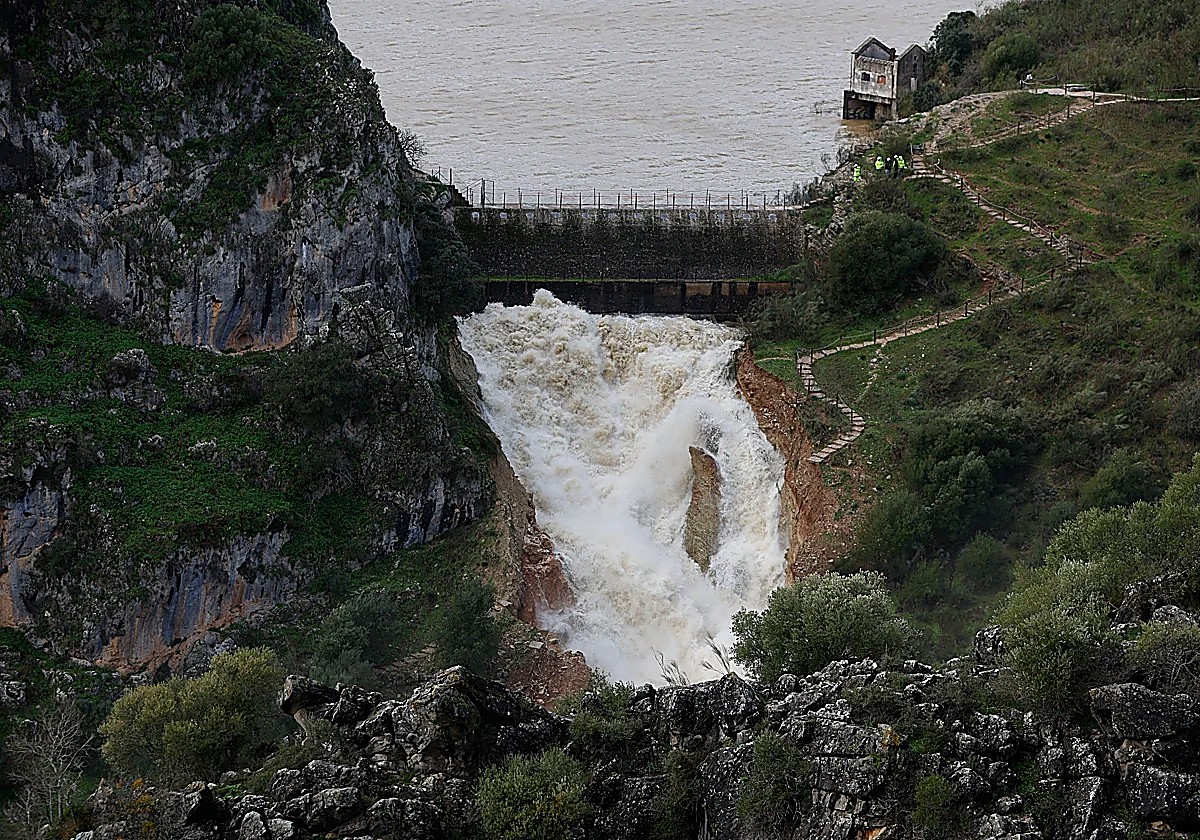
The Montejaque dam in Malaga province releasing water this winter. Salvador Salas Infrastructure Andalusian regional government to install bottom drains at Montejaque dam to avoid it reaching max capacityEngineers are calling for the protection of this unique infrastructure, which has been operating at half capacity since this winter
Chus Heredia
Monday, 20 April 2026, 12:43
The Montejaque dam near Ronda (Malaga province) reached its highest level ever recorded on 13 February this year. The water level stood at just 22 centimetres below the crest. Authorities had to evacuate the population of several villages downstream (Benaoján, Cortes and Jimera stations) due to the risk of floods. Finally, the siphon spillways performed their duty, 100 years after their construction.
Now, the regional government and Endesa (owner of the dam) are seeking ways to prevent the situation from happening again. They are currently studying opening one or more bottom outlets in the dam wall.
The dam's historical importance
"The solutions involve maintaining the dam due to its historical significance and opening the drains to allow water to flow through the riverbed without causing damage. Although it has not been operational, it has mitigated flooding for the last 100 years," technical sources from the regional government tell SUR.
Endesa states that the concession is currently undergoing an administrative termination process. "Endesa is working in close and ongoing coordination with the Andalusian Mediterranean river basin authority, within the framework of each body's responsibilities. The objective of this joint effort is to analyse and implement the most appropriate solutions in the short and medium term, particularly those focused on ensuring the safety of the infrastructure and its surroundings and preparing the dam for potential floods resulting from heavy rainstorms," Endesa sources say.
According to data from Endesa, the subsoil is so heavily saturated that it is absorbing water more slowly than usual. The water level is still 43 metres below the dam's limit (the level above the riverbed is 74 metres and 84 metres above the foundations).
The dam's design has received praise a century after its construction. It was a triumph of engineering and a serious mistake in terms of geology, as the reservoir was built on porous ground that made it impossible to store large quantities of water and prevented the infrastructure from fulfilling its purpose: to generate electricity.
Master engineering
It is a vaulted, double-curved wall, which is anchored to the two hills (Tavizna and Taviznilla) by means of abutments. The dam is very slender at the top - three metres, compared to 17 above the foundations. Its average thickness is 6.7 metres. It was built in 36 weeks, in 24-hour shifts. It was the work of Swiss engineer Henri Edwuard Gruner, who had gained experience back home.
Failures in the geological calculations, however, have left the dam unable to hold water in a stable and safe manner, despite attempts to seal it, even from inside the Cueva del Gato.
Historic water release
On 13 February, the eight kilometres of galleries in the Hundidero-Gato cave complex acted as a flood control system. Although the Guadiaro flowed down towards Estación de Benaoján, Jimera de Líbar and Cortes de la Frontera, there were no incidents.
Engineers' proposal
Given these much-praised technical features, the association of civil engineers of Andalucía, Ceuta and Melilla has proposed to highlight the significance of the Montejaque dam. In the document, it calls for signage and enhancement measures for this landmark of Malaga's engineering heritage, which was once the tallest arch dam in Europe.
Related story