Zoom
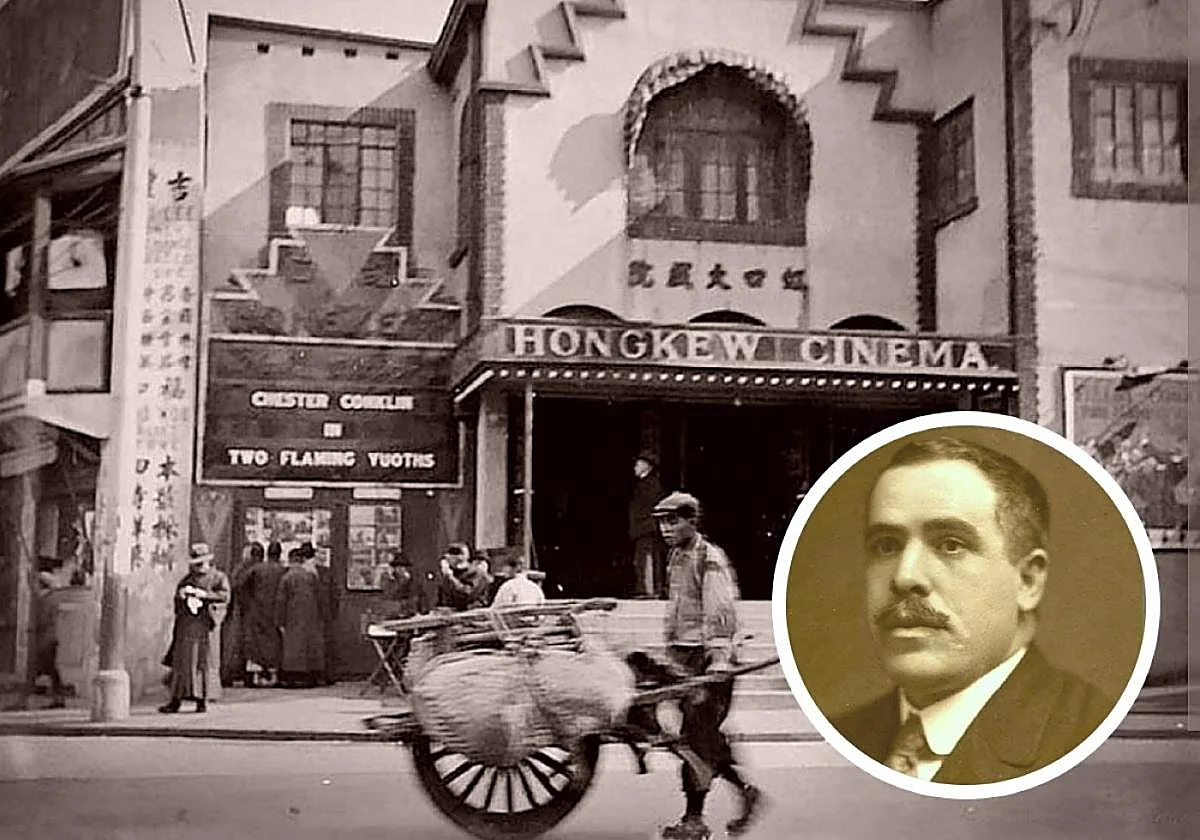
The Hongkew cinema and Antonio Ramos Espejo (inset). SUR Andalusian Influencers Around the World Antonio Ramos Espejo. A film pioneer in the Far EastThe entrepreneur from Alhama de Granada played a significant role in establishing relations with China
Alekk M. Saanders
Thursday, 2 April 2026, 11:17
Antonio Ramos Espejo is little known, although he was a pioneer of commercial cinema in Spain and Asia. He contributed to the birth of cinematography in China in the early decades of the 20th century, for which he was nicknamed the Emperor of Cinema there.
The 'emperor's' journey began in Andalucía, on the border of the provinces of Malaga and Granada. Antonio Ramos Espejo was born in Alhama de Granada on 5 November 1875. Asia came into Antonio's life when he enlisted in the military in 1896. He was sent to the Philippines, which was a Spanish colony at the time and where there were uprisings in favour of independence.
The Philippines also awakened Antonio's entrepreneurial spirit. During his stay in Manila, the Andalusian earned some money teaching soldiers to read and later opened a brewery with a Catalan. However, his passion was cinema. In 1895, Antonio purchased a Lumière film camera and in the Philippines he shot several films with street scenes - Fiesta en Quiapo and Panorama de Manila.
Move to China
Later, with his savings, Antonio Ramos ordered a projector and several films. He was responsible for the first film screenings in the Philippines. Together with the Augustinian missionaries, he travelled to indigenous villages, showing the Lumière brothers' film La Passion. However, Antonio did not achieve the desired financial success and in 1903 decided to move to China.
With the help of Augustinian Prior Gaudensio Castrillo, Antonio Ramos Espejo screened several films in Shanghai. It was in this cosmopolitan city that he established his first cinema. The 250-seat Hongkew Cinema opened to the public on 22 December 1908 and is considered the first commercial cinema in mainland China dedicated exclusively to showing films.
Incidentally, Spanish architect Abelardo Lafuente, who also settled in China, designed most of Ramos' cinemas, as well as his neo-Mudejar-style villa, where he lived with his Ukrainian wife, Rosa Nazurovskaya, whom he married in Shanghai, and their son.
In 1909 Antonio Ramos Espejo opened the Victoria cinema and in 1914 the Olympic cinema. He became a director himself and later a producer for the Ramos Amusement Corporation. His silent films, the drama Vengeful Tide and the comedy The Foolish Policeman, were subtitled in Mandarin Chinese.
Director and producer
In 1921, Antonio Ramos Espejo's cinemas premiered Charles Chaplin's silent comedy-drama The Kid, which led to a court case on charges of smuggling, as it was an illegal copy. There were also problems with a film, which was censored for scenes of nudity.
Additionally, the Chinese were not very interested in Western films, especially American ones. Therefore, Antonio Ramos became a director himself and later a producer for the Ramos Amusement Corporation.
Incidentally, his silent films, the drama Vengeful Tide and the comedy The Foolish Policeman, were titled in Mandarin Chinese. So, Antonio was able to promote cinema in China before the mass arrival of Hollywood in the 1920s.
Fleeing communism
By 1921, when the Communist Party of China was founded in Shanghai, Antonio Ramos Espejo had managed to amass a fortune. At the end of 1927, fleeing communism, he decided to lease his cinemas and return to Spain. Antonio settled in Madrid, where in 1930 he founded the Rialto cinema on Gran Vía.
In 1932, Antonio Ramos Espejo went to Shanghai to sell his cinemas, which had previously been managed by the Augustinian Recollects. All his cinemas passed to the so-called 'fathers of Chinese cinema', Zhang Shichuan and Zheng Zhengqiu.
Antonio Ramos died in Madrid in 1944 at the age of 69, leaving his mark on history as the initiator of the film industry in the Philippines, the founder of the first cinemas in China and a film distribution magnate in Madrid.