Zoom
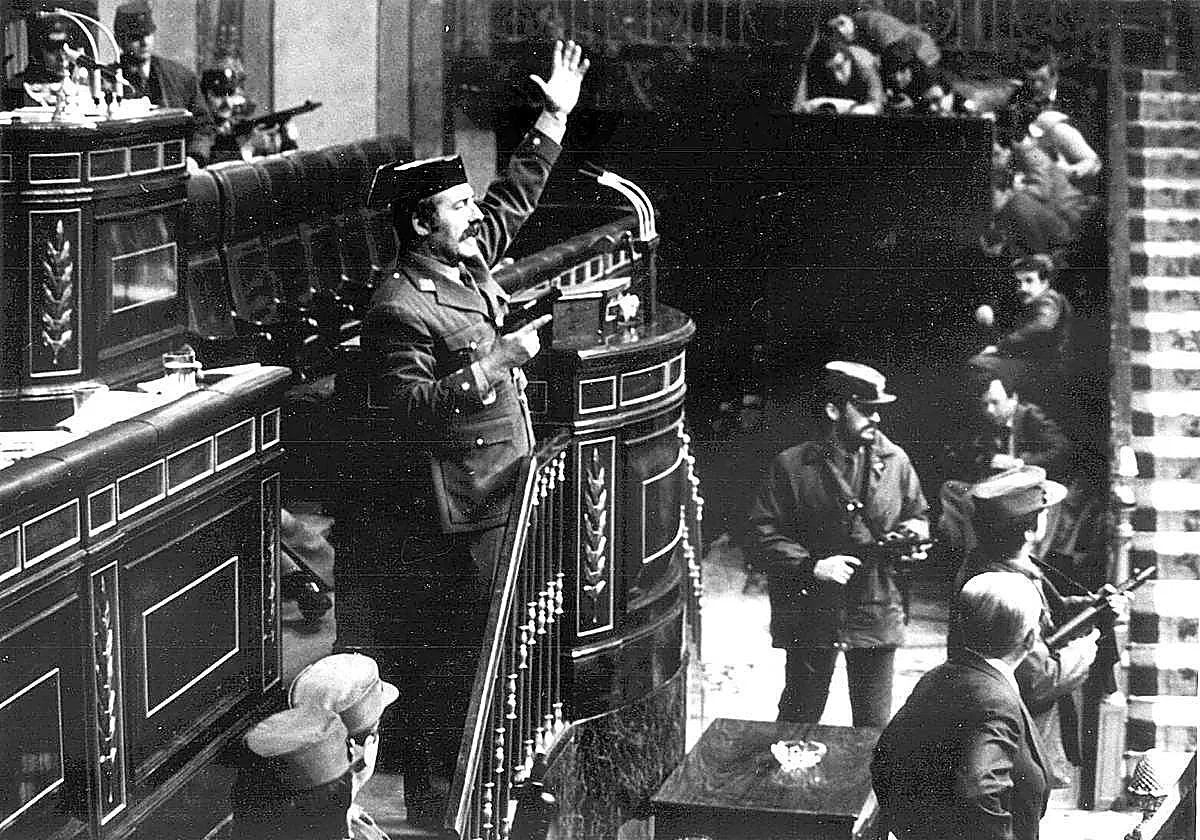
Tejero, pistol in hand, during the assault on Congreso in 1981. EFE Spain Antonio Tejero, key player of the failed coup of 1981 in Spain, dies aged 93The former lieutenant colonel of the Guardia Civil, born and resident in Malaga, died in Valencia, where one of his daughters lives, on the same day that the government declassified the documents of the coup
Malaga
Wednesday, 25 February 2026, 19:37 | Updated 19:49h.
The former lieutenant colonel of the Guardia Civil, Antonio Tejero Molina, one of the most prominent figures of the coup of 23 February 1981, died on Wednesday 25 February at the age of 93, according to sources consulted. His death comes on the same day that Spain declassified confidential documents regarding the attempt to overthrow the government.
Tejero Molina died in Valencia, where one of his daughters lives, although he is closely linked to Malaga. He was born in 1932 in Alhaurín el Grande, where he served as a Guardia Civil officer. He returned to Malaga province in 1996, after his release from prison, and lived in Torre del Mar with his wife, Carmen Díez Pereira, who died in November 2022.
Antonio Tejero Molina was admitted to hospital last October when his state of health worsened and during those days he was accompanied by his family. According to sources, Antonio Tejero Molina died in the company of all his children, having received the last sacraments and the blessing of Pope Leo XIV.
The figure of Antonio Tejero Molina is inextricably linked to the country's recent history as one of the visible heads of the attempted coup of 23 February 1981 when he stormed, together with other Guardia Civil officers, the Spanish Congreso, where he held MPs and the government hostage until 10am the following day.
Pistol in hand and 'Everybody freeze'
Internationally known is the image of Tejero captured by television cameras and photographers, entering the chamber and going up to the speaker's gallery pistol in hand while the call for the vote for the investiture of Leopoldo Calvo Sotelo (UCD) as prime minister was being made.
Also famous is the phrase he uttered that Monday, "Quieto todo el mundo. Todos al suelo" ("Everybody freeze. Everybody get down"), as well as the shots he fired at the ceiling of the Congreso, the impacts of which still remain as a silent witness to an evening that brought Spain's worst nightmares to life in the incipient beginnings of democracy.
After the coup failed, Tejero Molina was sentenced in 1983 by a military court to 30 years in prison for military rebellion with the aggravating circumstance of reoffending - in 1978 he was involved in 'Operation Galaxia', a coup that was disabled and which aimed to take the Moncloa Palace in order to abort the nascent democracy.
The same sentence was imposed on another of the two ringleaders of the 23 February coup, Lieutenant General Jaime Milans del Bosch and General Alfonso Armada. Tejero spent time in various prisons until he was released in 1996. He was also expelled from the Guardia Civil.
Sentenced in 1983 to 30 years in prison for military rebellion with the aggravating circumstance of reoffending, he was released on parole in 1996
During his time in prison he studied Geography and History, learned languages, wrote his memoirs and developed his passion for painting.
After his release from prison, he hardly made any public statements or appearances, taking refuge in his family and his retirement in Malaga. He was present in 2019 in Mingorrubio (Madrid) after Franco's exhumation from the Valley of the Fallen, along with those who gathered there to protest against the transfer of the dictator's remains. That same year he was also the subject of a tribute in a Malaga restaurant where there were shouts of "Viva Franco".
University professor Roberto Muñoz Bolaños, in an investigation into Tejero Molina, defines him as follows: "He represents the essence of a military model forged in Franco's regime, characterised by having assumed all the values that informed the uprising of 18 July 1936. These values were the superiority of the military over the civilian, contempt for democracy and liberalism, a centralist and Castilian concept of Spain and the consideration of the defeated in the civil conflict as 'enemies', lacking any legitimacy in their ideas. It was these values that led him first to rebel against the nascent democracy, and later to revolt against it, seeking its destruction."