Beaches
Asian seaweed returns to the beaches of Granada province's Costa tropicalExperts explain that July and August are the months when this invasive species reproduces most actively and Salobreña and Castillo de Baños town halls are carrying out clean-up work
Añádenos en GoogleMJ Arrebola
Granada
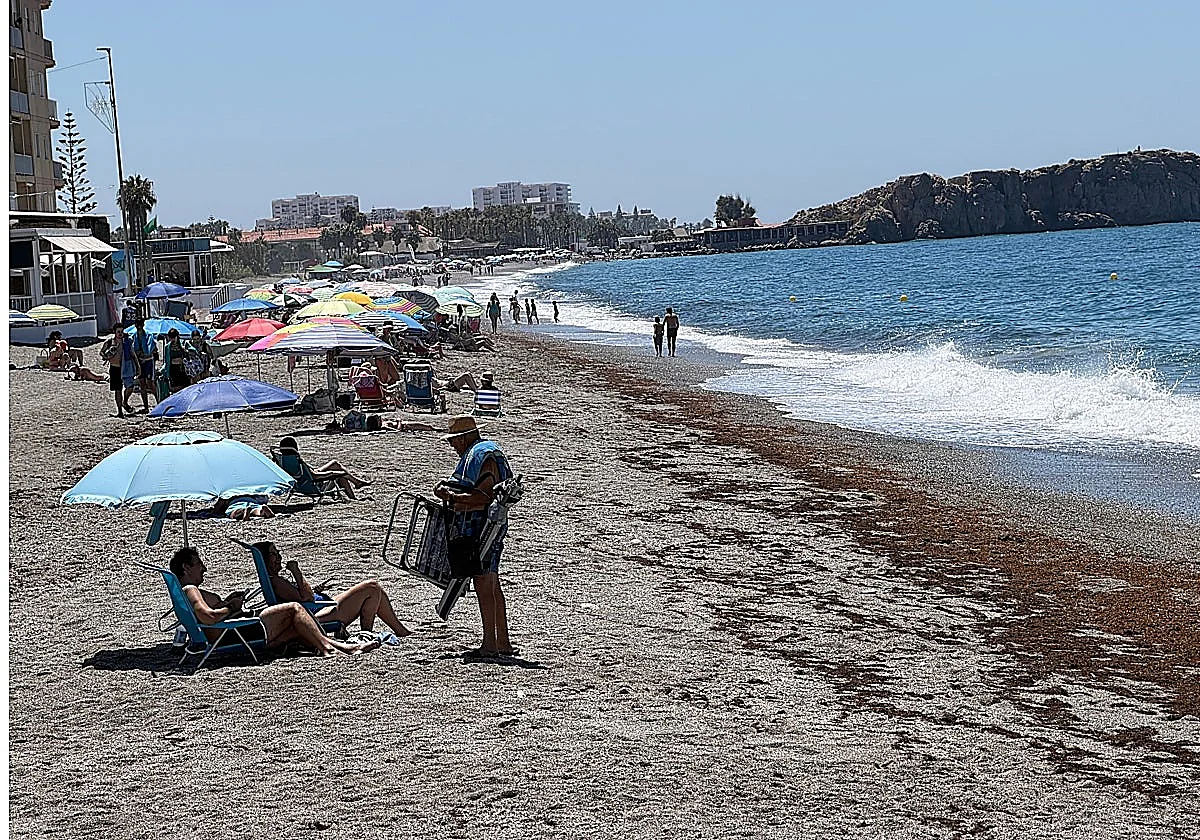
14/07/2026 a las 15:56h.Summer has only just begun and Granada province's Costa Tropical is already facing a problem that recurs year after year, particularly when the hot ... weather arrives. The tides have washed up Asian seaweed on the beaches of Castillo de Baños, in Polopos-La Mamola and La Guardia, in Salobreña – seaweed that has been a familiar sight to beachgoers every summer for years.
Piles of dark, damp seaweed heap up on the sand as council workers work tirelessly to clear it away before the foul smell and insects turn the area into a no-go area. “The beach has been covered in invasive seaweed,” explained the mayor of Polopos-La Mamola, Matías González, who attributes this latest build-up to a westerly wind.
Rugulopteryx okamurae is an invasive species that has found the Mediterranean and the Spanish Atlantic to be the perfect habitat for unchecked expansion. Fishermen first began finding it tangled in their nets in 2019 and since then its presence has continued to grow.
This year, Salobreña town hall had to carry out a clean-up in March, before Easter and again in May. The councillor for beaches, Luis Cano, explains that the first westerly winds of the summer have once again caused seaweed to accumulate in the La Guardia area, specifically at the far end of the beach, next to the wall of a former sugar factory. He said that following episodes of westerly or easterly winds, the presence of seaweed on that stretch is "very noticeable", while in other parts of the same beach, such as the stretch between the lifeguard post and the rock, there is hardly any.
Currents and tides
Experts explain that this phenomenon worsens just as the summer months arrive. Julio de la Rosa, director of the Aula del Mar at the University of Granada and one of the scientists who most closely monitors the evolution of this species, explains that the algae are currently in their period of peak reproductive activity. From July onwards, he explained, its reproductive mechanisms are in full swing, triggering a surge in biomass production and, as a result, the build-ups that are eventually washed ashore by currents and tides.
De la Rosa insists that the seaweed is present on the seabed all year round and can settle on any type of seabed or marine community, but it is precisely in July and August that its growth surges, making it much more visible and more prevalent on the beaches. It can also appear at other times of the year, such as February, March or April, although in smaller quantities.
According to experts, it poses a threat to the marine ecosystem as it is a species that has no natural predators outside its native habitat in Asia; it grows unchecked, gradually displacing the native algae in the area and taking over the space previously occupied by other species.
When the algae die and decompose, they also produce a large amount of organic matter that pollutes the water and reduces the oxygen levels in the marine environment. This lack of oxygen and light harms other species, such as small invertebrates that live in symbiosis with native algae, and more sensitive ecosystems such as orange corals, gorgonians and Posidonia seagrass beds.
Constantly expanding
This invasive species first appeared in Spain a decade ago. According to experts, it was first detected in 2016 in Ceuta, where it was initially mistaken for a native species. It soon became clear that, in fact, it was an exotic species originating from Asia, and since then it has continued to spread: first across the Strait of Gibraltar, then to Malaga and, later, to the coast of Granada, as well as the Chafarinas Islands and the Macaronesian archipelago.
In 2025, the seaweed was also detected off the coasts of Galicia and Cantabria, confirming that it now covers a large part of Spain’s Atlantic and Mediterranean coastlines. According to experts, all the evidence suggests that the species has not yet reached the limits of its spread, so it is likely to continue appearing in new coastal areas in the coming years.
Year after year, the task of removing this invasive seaweed falls to the coastal town halls which must fund the clean-up work carried out by municipal workers at the height of the tourist season, when the beaches are full. “The stench from the decomposing seaweed and the insects it attracts is a nuisance. Measures must be taken now for the sake of all the local authorities,” said Matías González.
In Salobreña, the town hall allows the seaweed to dry out a little before removing it, as it is heavier straight out of the water and much more difficult to handle. Previously, a tractor was used to collect it, but this had a drawback: it buried some of the seaweed under the sand instead of removing it completely. Now they combine manual collection with the tractor, with the aim of leaving the sand as clean and smooth as possible for beachgoers.