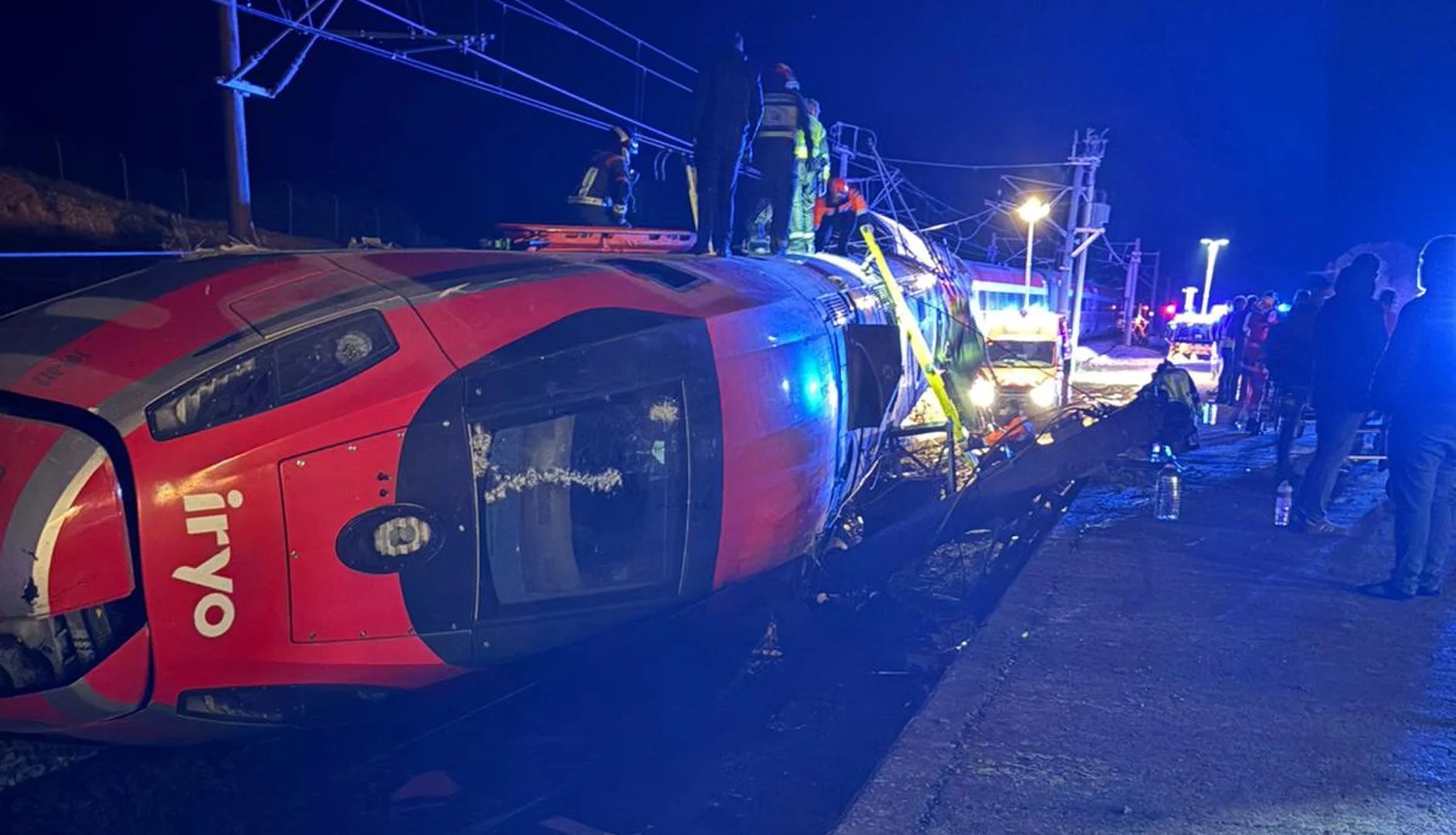
The accident happened at Adamuz station and rail travel between Andalucía and Madrid has been suspended
Paco Griñán / Isabel Méndez / Almudena Nogués
Málaga
Monday, 19 January 2026, 14:00
A high-speed train travelling between Malaga and Madrid derailed on Sunday evening in the station of Adamuz in Cordoba province, killing at least 39 people, according to the latest figures. More than 150 people have been injured, 30 of them serious or very serious.
The accident happened when carriages 6,7 and 8 of the Iryo 6189 train derailed at around 7.45pm as the train entered Adamuz station, invading the opposite track and colliding with an Alvia 2384 travelling between Madrid and Huelva with around 100 passengers on board. The first train had left Malaga at 6.40pm.
Shortly before midnight, Andalusian regional minister for health and director of the regional emergency plan Antonio Sanz told the press that "part of one of the trains had fallen down a four-metre slope", which further complicates access to the site.
Rescue services continue working at the scene. All the injured and the rest of the passengers were evacuated from the scene on Sunday night. This is the worst rail accident in Spain since an Alvia train derailed near Santiago de Compostela in 2013, killing 80.
During the night teams have been working to establish the cause of the accident. "These are very heavy vehicles, at the moment the wreckage is very difficult to move. It will need heavy machinery," said the president of the Junta de Andalucíá, Juanma Moreno.
Spain's transport minister Óscar Puente did not confirm the number of dead on Sunday night but described the accident as "serious", saying the "impact was terrible" between the two trains travelling in opposite directions, "throwing the front two carriages of the Huelva train from the track". He said that as yet the causes of the accident were unknown but it is "tremendously strange" as the Iryo train wass "practically new", just four years old, and the track was "completely renewed".
"At this point the renovation work was completed in May and 700 million euros has been spent on the Seville-Madrid line," he said.
According to Puente, the Alvia to Huelva suffered the worst damage "specifically the two front carriages, where 37 people were travelling in the first and 16 in the second." The driver is among the dead.
According to witnesses, the train appeared to be shaking and vibrating just prior to the collision.
The last two carriages of the Iryo train, which left Malaga at 6.40pm, were most affected, particularly the one at the end of the train, which overturned on the track. The train was carrying around 300 passengers.
Emergency services were at the scene with five mobile ICUs, a logistical support vehicle and four emergency critical care units (ECU). The accident has led to the suspension of all train communications between Andalucía and Madrid. Transport minister Óscar Puente has travelled to the scene. The president of the Junta de Andalucía, Juanma Moreno, has said on social media that the regional government is "very concerned by the serious rail accident in Cordoba province and keeping up to date with the news of people affected".
A field hospital has been set up at the scene, in Adamuz station. Andalucía's network of blood transfusion centres has begun redistributing blood supplies to Cordoba and Jaén. The hospitals of Andújar (Jaén) and Virgen del Rocío in Seville have also been placed on alert, with staff and resources on standby and permanent coordination in place in case patients need to be transferred.
Adif and Renfe have also opened assistance points for the families of the affected passengers at stations in Madrid Puerta de Atocha, Seville, Cordoba, Malaga and Huelva. The Madrid regional government has offered its hospitals and emergency medical teams to Andalusian authorities.
According to eyewitnesses, the accident was preceded by a strong jolt and violent shaking. The two rear carriages of the Iryo train travelling from Malaga were affected, particularly the final carriage, which overturned and came to rest on the track. Firefighters said the impact between the Huelva-bound train and the Malaga service had turned the damaged carriages into a tangled mass of metal, severely hampering rescue efforts.
Rescue teams assisted numerous injured passengers by accessing the Iryo carriage from above, where the exit doors were positioned after the crash. Initially, crew members from unaffected carriages were forced to smash windows with emergency hammers to allow passengers to escape. Several victims remained trapped in the derailed carriages.
The exact cause of the accident is still unknown. The transport minister has said that "the rear units of the Iryo train travelling towards Madrid derailed, with those carriages invading the opposite track, which at that moment was being used by a Renfe train heading to Huelva". "The impact was devastating, causing the first two units of the Renfe train to be thrown off the rails," Puente explained.
Head of the provincial fire brigade Francisco Carmona has confirmed that many of the injured were suffering from bruising and fractures, "including some open fractures". "The major problem is that the carriages are twisted, making the rescue operation extremely complex," he said.
Salvador Jiménez, an RTVE journalist who was travelling on the Malaga train, has described the moments of the accident. "We felt a huge jolt, a very sudden movement. Suddenly all the trays, glasses and even the windows were flying around," he said. According to Jiménez's account, after that the train staff "asked if there were any medical professionals who could go to carriage five to help".
"After the derailment, we were told to remain seated. Then the staff took the emergency hammers and started breaking windows and opening doors so people could get out," the journalsit said. Hundreds of passengers remained at the Adamuz halt, many visibly distressed, glued to their phones and injured, until emergency services began transferring them to a municipal hall set up as an emergency shelter.
Many local residents helped in whatever way they could. Some helped transfer the injured in their own vehicles, while others went to the scene and the emergency shelter to provide blankets and food.
A football match between Cordoba and Malaga was under way at the Nuevo Arcángel stadium shortly after the accident (9pm). More than a thousand Malaga supporters were in attendance, along with a large local crowd. Messages were broadcast over the stadium speaker system and sent to spectators' mobile phones urging them not to congest the A-4 motorway after the match, as it was being used as a key evacuation route for the injured to Cordoba's main hospital.
The deadliest precedent involving a train from Malaga is the Angrois disaster near Santiago de Compostela on 24 July 2013, when an Alvia train travelling from Madrid to Ferrol derailed on the A Grandeira curve, around three kilometres from Santiago station. Unlike the crash on Sunday night, the 2013 incident did not involve a high-speed service. Of the 224 people on board, 144 were injured and 80 lost their lives.
An emergency telephone line has been set up for relatives of passengers - 900101020.