Zoom
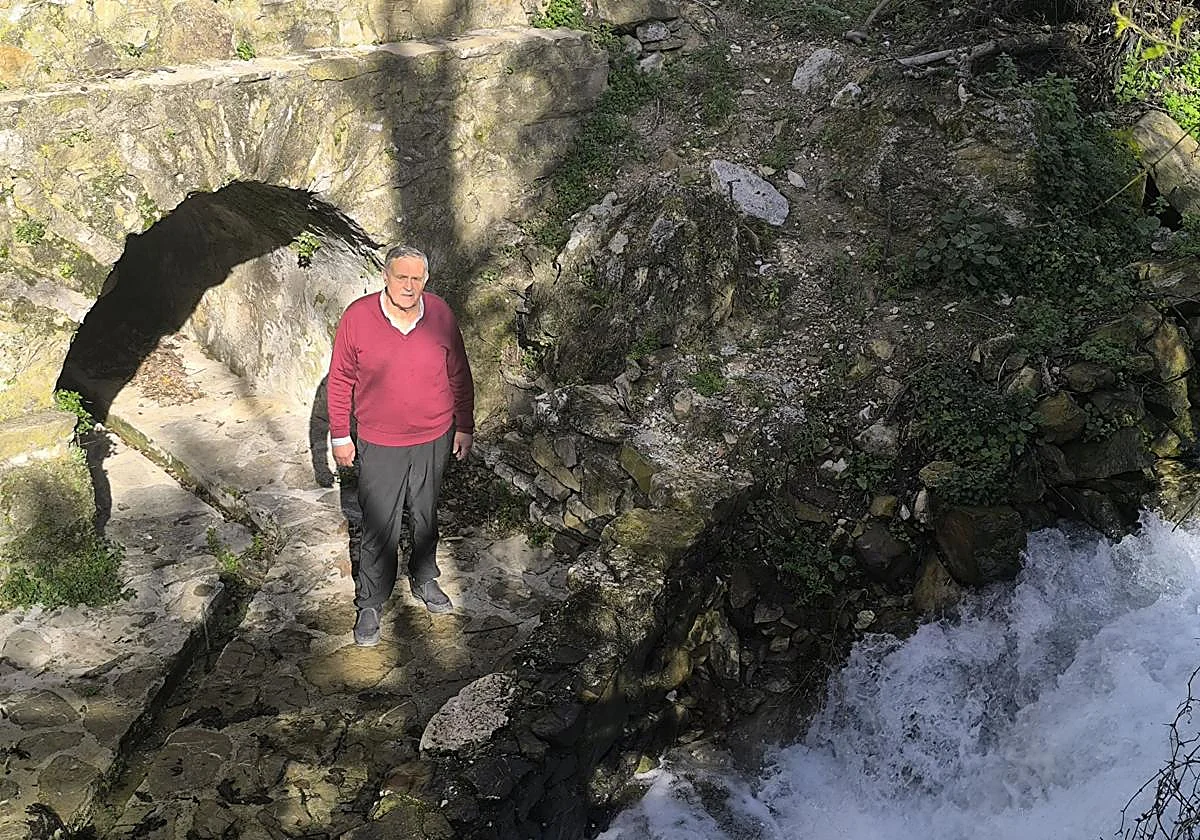
Paco Camacho next to the San Antón mill. History Axarquía family saves historic water mill from ruinThe seventeenth-century San Antón mill in Periana restored through private dedication to Malaga's industrial heritage
Málaga
Wednesday, 25 February 2026, 15:04 | Updated 15:11h.
Just a few metres from where the river Guaro in Periana is flowing in full force after the series of storms that has hit Malaga province so far this year, a building that was on the verge of disappearing is still standing.
It was not due to a flood or the passing of time, but abandonment and lack of interest in old buildings. Today it is popularly known as 'Molino de Frías', but its original name, which appears in the papers found among old transactions and documents almost destroyed by damp, is another: 'Molino de San Antón' (Saint Anthony's mill).
It is still there thanks to decades of patient, meticulous work and above all, determination by two brothers, Paco and Dionisio Camacho, together with their wives, Purificación and Remedios. In the summer of 1997 they decided to buy what many considered a ruin with no future. They did so without public funding, without subsidies, without support from the authorities. Only with the conviction that something had to be saved.
Abandoned historical buildings
The brothers were witnessing old inns, stations, oil mills and other historical buildings that were falling down in many villages, as modernity and the lack of interest in the past took over. They feared that the mill could be next.
What they found when they opened its doors was a dilapidated building, with rotting beams, damaged ceilings and weakened walls. But beneath that layer of neglect there was still a solid structure, with original mud on its walls and whitewashed stone as it was first built. Documents suggest it dates back to the seventeenth century, although Paco is convinced that it could be even earlier, due to some of the construction that he considers to be older. They decided to respect that origin.
The restoration was complex. A watermill is not just any building. The millstones cannot be moved "even three centimetres", explains Paco. They must be perfectly aligned with the roller and the hydraulic system. To do this, parts had to be dismantled, levelled and the millstones put back exactly in their original position.
The operation to restore the Molino de San Antón is a living lesson in traditional engineering. The water from the river Guaro is channelled through an irrigation channel to an elevated pool. From there it falls through an eight-metre-high bucket. The pressure generated by thousands of litres of water moves the roller, which transmits the force to the stones of the flour mill. It all depends on gravity, height and the exact calculation of the flow rate. No motors, no electricity. Just water and precision.
Stones from France
The stones also tell their own story. They are not the usual limestone of the area, but flint from France. They were made in the prestigious La Ferté factory in the Marne region and arrived by ship into the port of Malaga. From there, the train and then carts transported them the site near the river, through which muleteers from Zafarraya travelled loaded with wheat. These hard stones, more resistant than the local ones, reduced maintenance and increased efficiency.
Until the mid-twentieth century Periana had a dozen mills. The Guaro and other rivers and streams fed a staggered system of mills that converted water into flour and sustenance. The San Antón mill was one of the last to operate and closed in 1962.
In 1945, in anticipation of the decline of cereals the mill also incorporated an oil mill. There, with animal traction, the olives were crushed and the oil was pressed in a chapel press that is still preserved. This double life - flour and olive oil - is one of the singularities preserved in this building, which could well be a museum.
But the value of the mill is not only technical. It is also symbolic. The small niche inside recalls its original dedication: San Antón. For years it was empty. The Camacho family recovered it after finding references among old papers that referred to flour sales and accounts of the mill since at least 1915. Each mill had its saint. It was its name and its identity. However, the previous owners of the Camacho family called it after their surname, the Frías mill.
Future
Today, in addition to the two mills, this building also conserves tools and utensils with decades or even centuries of history. From tools and threshing implements for tilling the land to a crate of the first Victoria beers.
In 1929, a journalist from La Unión Mercantil, Francisco Pacheco Ruiz, passed through the area and wrote about it in a chronicle entitled 'Málaga-Periana'. He described those "archaic mills of meagre yield" fed by the Guaro. It has taken almost a century for another report to stop at the same spot on the map. Between visits, the mill survived thanks to the memory of those who worked it and, later, to the determination of those who decided not to let it fall.
For years, Paco opened its doors without charging admission. Schoolchildren, cultural groups, foreign visitors and even cruise ship passengers have passed through. He didn't do it for business, but out of conviction: "So that people see that heritage is worth preserving", he sums up. In 2024, health problems forced him to close to the public. The immediate future is a family affair. The goal is clear: to preserve it as it is.
The San Antón mill is not an Asset of Cultural Interest (BIC). It has no special protection or administrative backing, but it is an essential piece of the heritage of La Axarquía. It is a testimony of how water shaped the territory, organised the economy and gave shape to the villages.
All around it, the Guaro continues its course. The same river that has moved these stones for centuries. The same one that rises almost next door and that still, when it descends with force, reminds us that everything began there with water. Thanks to four people - two brothers and their wives - that sound is not only past. It is present.