Gardening in southern Spain
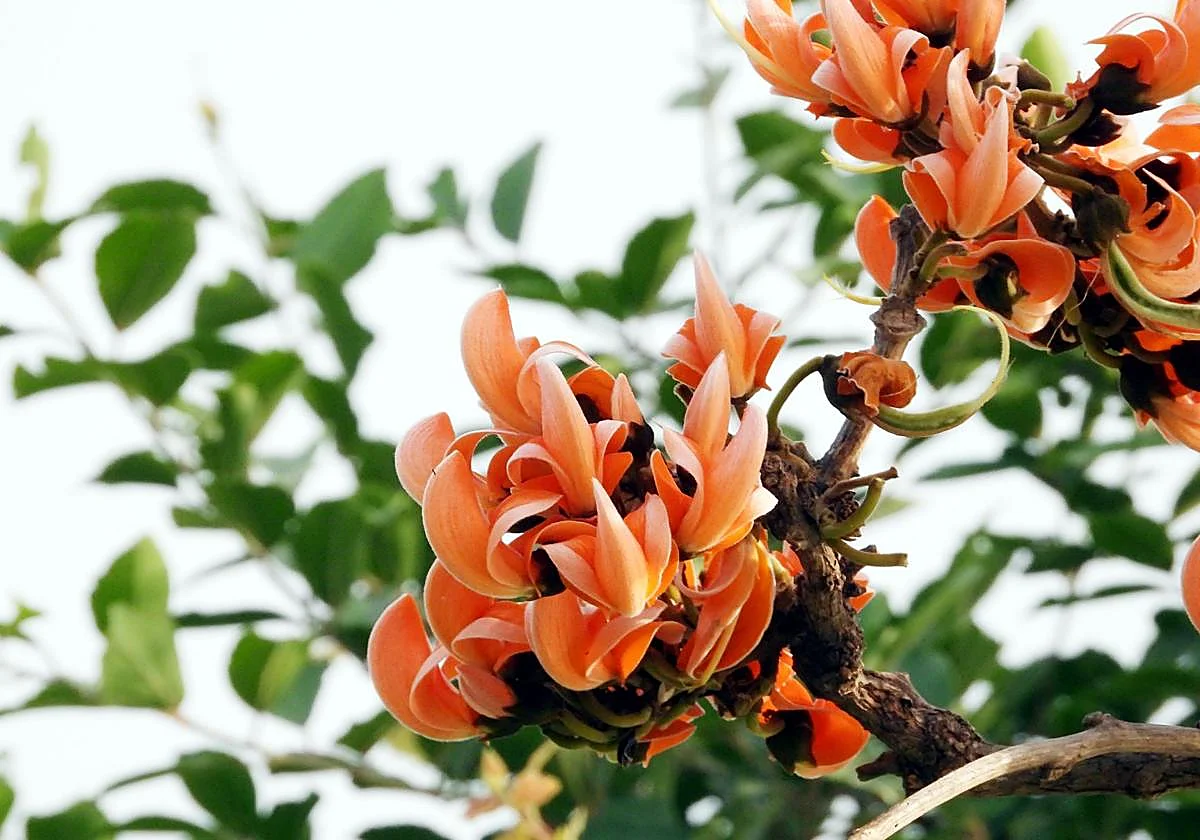
Butea monospermaButea monosperma, commonly called flame of the forest or palash, is a medium-sized deciduous tree belonging to the Fabaceae bean family
Añádenos en Google Butea monosperma. (Wikimedia)Denise Bush
12/06/2026 a las 02:00h.Butea monosperma, commonly called flame of the forest or palash, is a medium-sized deciduous tree belonging to the Fabaceae bean family.
Native to the tropical and subtropical regions of the Indian subcontinent and Southeast Asia, it is found in India, Sri Lanka, Nepal, Vietnam, Malaysia, Bangladesh, Laos, Cambodia, Indonesia, Pakistan and Thailand. Though typically a medium-height tree, it can sometimes reach heights exceeding twenty metres in ideal environments. It is characterised by its grey bark, crooked, irregular branches and large, three-lobed leaves. These leaves drop during the dry season, making way for new bronze-coloured foliage that forms once flowering is over.
Usually grown in full sun, it will also thrive in partial shade.
Palash is a popular garden tree for its striking reddish-orange flowers which are pollinated by birds. Its fibrous root system is excellent for fixing soil, which helps prevent erosion, and the tree can also be trained to grow as a dense hedge. Like many members of the Fabaceae family, it naturally fixes nitrogen in the soil.
After flowering, flat seed pods develop, measuring around 15-20cm in length. These pods are green when young and mature into an off-white or light brown colour and are light weight; the wind can carry them short distances. The flat, oval-shaped brown seeds inside the pods are about 2.5cm long.
Butea monosperma can be grown as a windbreak as it can withstand strong winds. It is also drought-tolerant once established.
Besides its stunning appearance, Butea monosperma is used in many traditional ways. The timber is used to build wells as it is very slow to rot when submerged in water.
In many regions, the flowers are harvested to produce a traditional natural dye that is used extensively during Holi, the Hindu festival of colours. The tree features prominently in rituals and is highly regarded in Ayurveda, where it is considered to be one of the most beneficial trees for human health. It is given the title of Brahmavriksha, meaning a divine tree.
Every part of the flame of the forest is used in traditional medicine. The brightly coloured flowers are commonly used to reduce swellings and an infusion made from them is given as a drink to treat kidney and urinary conditions. The seeds possess documented antibacterial properties and are used to treat infections, while juice extracted from the roots is used as eye drops for eye irritation or taken as a remedy to help relieve the frequency of epileptic seizures.