Opera
Carlos Álvarez and the art of rebellion: a return to the New York opera to sing in SpanishThe Malaga native champions Hispanic culture in the heart of the US on his return to the iconic Manhattan stage 20 years later
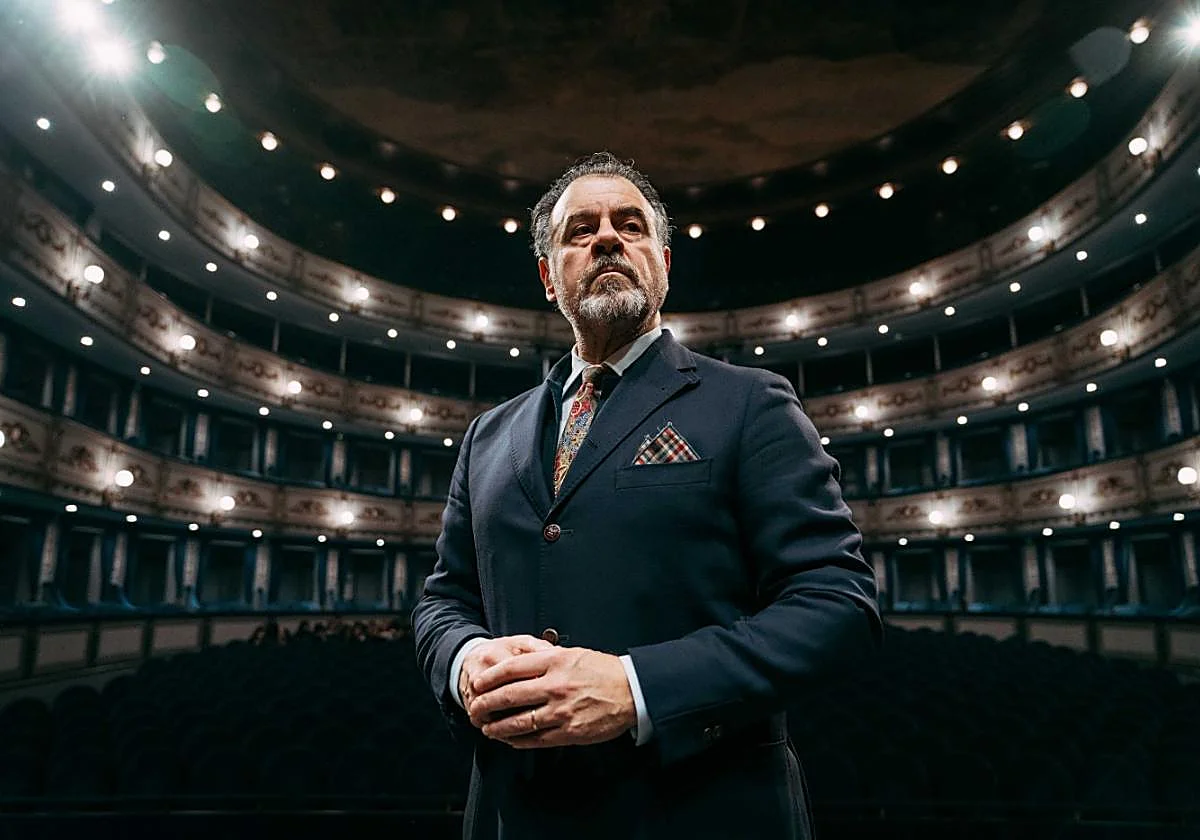
Carlos Álvarez in the Teatro Cervantes before he travels to the Metropolitan Opera House in New York. (. DANIEL MALDONADO)Regina Sotorrío
30/04/2026 a las 15:04h.We meet at a place that feels like home, the stage of the Teatro Cervantes. In a few months, he will perform on these boards again, but today another return motivates this talk, one that has been 20 years in the making.
"It seems incredible, it is a very long time; 20 years is the lifetime of many people," reflects Carlos Álvarez. The Malaga baritone is at the moment reuniting with the Metropolitan Opera House in New York, one of the great temples of opera, two decades after the performance that reaffirmed him as one of the most relevant baritones on the international scene.
He does so after two failed attempts, one due to a vocal cord injury and another due to the pandemic, and with a project that thrills him: a contemporary opera sung in Spanish. It is an act of rebellion at a moment in US history where everything Hispanic is viewed with suspicion.
The Malaga native will be the Mexican painter Diego Rivera in El Último Sueño de Frida y Diego, a portrait with a touch of magical realism of the passionate and turbulent relationship between both artists. The production closes the Metropolitan season which runs from 14 May until 5 June, and can also be followed from Malaga: on 30 May it will be broadcast live in Yelmo cinemas.
This interview takes place a few days before Carlos Álvarez catches the flight to New York - where he is already located for rehearsals - on a day when newspapers report the consequences of the closure of the Strait of Hormuz and the new joint bombings by the US and Israel on Iran. And Álvarez, who never dodges any issue however thorny it may be, is not oblivious to this reality.
Álvarez in character as Diego Rivera. (MET)"Politically I am against what is happening. I would not like it at all and would reject the idea of having to go to New York, unless it were for work," he states bluntly. And even more so if it involves work like this.
The opera is composed by Gabriela Frank, an American of Hispanic origin, with a libretto by Pulitzer Prize winner Nilo Cruz, also with Hispanic roots. "It really is going to be a vindication. Today, for Spanish to once again become a language recognised by the US administration, as a language in which people can communicate, would be very important again," he analyses. For Álvarez, valuing Mexican and Hispanic culture at a time when it is being reviled is a significant achievement. "In fact, I believe that at the Metropolitan they did not realise what they were doing." He says the opera premiered three years ago in San Diego and San Francisco, and then "the situation was not the current one. I don't know if it will cause them problems".
"The Metropolitan, which is a private cultural institution and has no public funds for its operation, has to explain to its board why certain operas are chosen. And I would like to talk to Peter Gelb to find out what the reason was," he says.
The last time he stepped onto the Metropolitan stage he was 39. "I'm going to turn 60 now, and the truth is that, as our fellow citizen Antonio (Banderas) says, I'm ready to move in, without a doubt. What the passage of time does give me is the opportunity to acquire experience regarding things that are important and those that are not," he notes.
With this way of understanding life and the trade, Carlos Álvarez denies feeling this return two decades later as unfinished business. "I have no unfinished business. That stays as a mark and one has to heal that wound, and for me it is not a wound. Life's circumstances cannot become wounds, because if they scar badly, they are festering, and it is like a constant return to something that did you harm. I believe not, one must turn the page," he argues. After that Rigoletto of 2006, which he remembers as a "catharsis" (he was recently separated "and I was going to hide in that distance, which they say is oblivion" performing a character with a great dramatic burden on the other side of the world), he returned four years later.
But he never made it onto the stage. In 2010 he was rehearsing Attila under the direction of Riccardo Muti when, shortly before the premiere, his vocal cord injury "reappeared", forcing him to put his career on standby.
"There is a moment of enormous uncertainty, no doubt." But it was not the first time it had happened to him. "And I downplayed it a lot." Experience helped him and, above all, what Muti and Peter Gelb, general director of the Metropolitan, told him: "Go home, get well and come back, we will wait for you." And they did.
Ten years later he again had a date in New York with a double bill that, he confesses, he really looked forward to: on one hand a Simon Bocanegra and, on the other, what would probably be his last Bohème' because they usually look for younger profiles.
The flight that would take him to the US to begin rehearsals was scheduled for March 2020. A date etched in memory. "Just two days before, a gentleman named Trump closed US airspace and we could no longer fly, something for which I am enormously grateful. It is possibly the only thing I will thank this man for in my life," says Álvarez, remembering the pandemic that frustrated that reunion with the Metropolitan.
But there or here, the essentials do not change. "I would not be capable of putting on one attitude at the Teatro Cervantes and having a different one at the Metropolitan." In December, Carlos Álvarez will return to the Malaga stage with Ópera Estudio, the educational project with which he gives a break to young singers. This time, after the absolute premiere of El Gitano por Amor, he will join a cast of young voices in Don Procopio, a youthful work by Georges Bizet (4 and 6 December). For Álvarez, it is part of his duty as a professional and as a person.
"It is what I have experienced regarding my elders on stage, watching them, sharing life and work with them.
"It has been how I have learned to have an attitude on stage and face my work in a serious and very conscious way (...) I feel obliged to do it."