Zoom
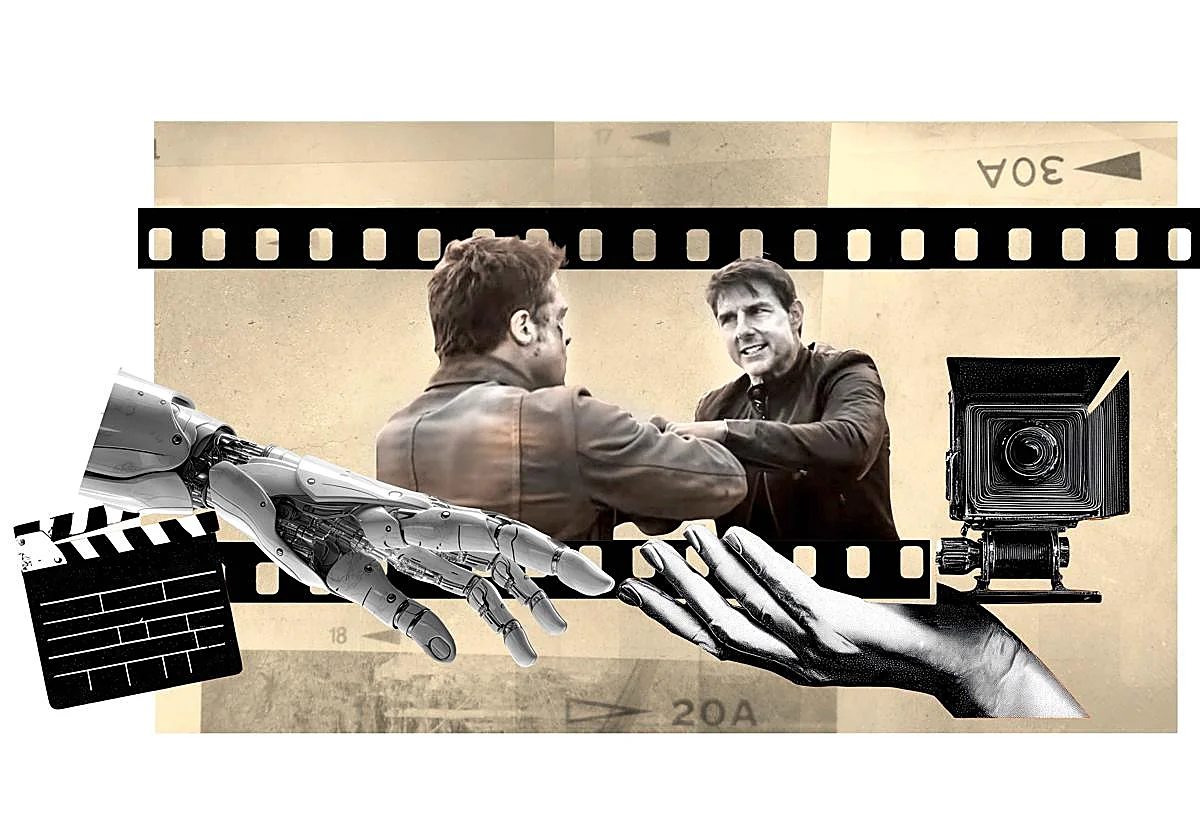
J.R.C. Art and culture Cinema vs artificial intelligence: suspicion, resignation and Malaga's role in the debateBrad Pitt fights Tom Cruise, without Brad Pitt or Tom Cruise - what are the global challenges for cinema in 2026?
Monday, 16 March 2026, 12:46 | Updated 13:11h.
Imagine for a moment that you're a film producer and you need a powerful scene for your next movie, one that will draw millions of viewers to theatres worldwide. How do you do it? Where do you put that scene?
According to Matt Damon, who recently talked to podcaster Joe Rogan, the increasing use of mobile phones while watching a film is altering Netflix scripts and many producers aim to get people "to stay" with an action-packed scene "in the first five minutes of the film".
Is that enough to attract an audience that constantly has a phone in hand, ready to fight boredom with distractions? No, so the producer frames a sunset with skyscrapers in the background and an apocalyptic scene in the foreground. More? Two handsome men appear among corpses on the ground and launch into an impressive choreography of punches and kicks.
The fighters constantly shift from medium shot to close-up at a speed proportional to their jiu-jitsu movements. Is that enough? No, to make a box office impact, you need two real stars, like Brad Pitt and Tom Cruise.
Cinema in 2026 faces a dual challenge: the recovery of pre-pandemic audience levels and the competition from digital platforms, addressed through improved technology and community-focused programming.
Irish director Ruairi Robinson did more than just imagine it. He commissioned Seedance 2.0, an AI-powered video generation tool, to create it. All he needed was two lines of prompt, a couple of instructions. The result was a spectacular, highly realistic 15-second sequence, which he posted on X on 11 February, garnering a million views and sending shivers down the spines of the all-powerful Hollywood industry.
What is Seedance 2.0 and why does Hollywood fear it?
Seedance 2.0 is an AI-powered video generation tool developed by the Chinese giant ByteDance (the creators of TikTok).
The Experiment: With just two lines of prompt, Irish director Ruairi Robinson created a hyper-realistic 15-second sequence of Pitt and Cruise fighting zombies and robots.
The Backlash: The Motion Picture Association (MPA) - representing Disney, Netflix, and Warner Bros. - issued a stern warning, accusing ByteDance of unauthorised use of copyrighted works and threatening millions of American jobs.
He didn't stop there and created variations where Brad Pitt fights a ninja and Tom Cruise a zombie. In another, Cruise and Pitt join forces to take down a robot.
Behind Seedance 2.0 is the Chinese company ByteDance, known worldwide for developing the video platform TikTok. The Motion Picture Association (MPA), which includes Netflix, Paramount Pictures, Prime Video & Amazon, MGM Studios, Sony Pictures, Universal Studios, The Walt Disney Studios and Warner Bros., immediately issued a statement denouncing Seedance 2.0 for "large-scale unauthorised use of works protected by US copyright", noting that "ByteDance is ignoring well-established copyright law that protects the rights of creators and supports millions of jobs in the US".
The human element: Goya Awards and the Malaga Film Festival
Given this uncertain landscape for filmmakers, the Malaga Film Festival's red carpet seemed oblivious to the potential impact of AI on the industry. Last week, the debate centred on the presence of influencers at the festival. Something is obviously changing, however. Last year, the organisers allowed Texas, Turkey, a documentary made entirely with AI, to participate in the official short film competition.
This year the Villa del Mar lab once again explored the potential uses of technology in film, with talks and workshops focusing on AI storytelling and how to create in the era of algorithms.
"Films that come out of festivals have a seal of approval, which is why we [Malaga Film Festival] are so necessary, with or without AI," director Juan Antonio Vigar told SUR before the start of this year's event. "The question is whether AI will end up replacing people in writing stories, acting... All of that remains to be seen," Vigar stated.
The latest Goya Awards added a new requirement to their list of terms and conditions: only "works whose creation and artistic and technical development are led by identifiable individuals" could be eligible. "Recognition of human authorship constitutes an essential principle of these rules and must prevail even when technological tools or artificial intelligence systems are used during the production process."
Film festivals featuring AI have already emerged in New York, São Paulo, Nice, Valencia, Barcelona, Mallorca. It's clear we are at the beginning of something, but what is it?
How are Malaga-based production companies using AI?
LenonFilms is a Malaga-based audiovisual production company with experience in documentary films and advertising that is now fully committed to the use of AI. Their headquarters are in the Malaga TechPark. "Cinema isn't going to disappear," CEO Emilio J. Fernández says, adding that AI offers "a new tool that will modify processes and immediacy".
On YouTube, LenonFilms has uploaded several short videos showing people walking around Malaga and talking to the camera, only to reveal that they are not real.
Recently, Antonio Banderas told SUR that he had been offered a role in a film where he wouldn't have to act, only lend his likeness so that AI could do the rest. "I think these actors will continue being in the world of film and television, but perhaps their role will be different," Fernández says.
"We create a digital avatar for them to make these films or they act in a studio entirely focused on creating that digital scene (...) I think that's the direction in which things are heading," the LenonFilms director says.
Fernández sees only one risk: quality. "Netflix has to produce I don't know how many series a year, so they see AI and say: 'Damn, well, let's go, it's all easy, boom.' Then we end up swallowing a ton of garbage, you know?" José Antonio Hergueta, producer, screenwriter and director, a two-time Goya nominee says. "It will easily fill spaces that were already produced in an industrial way and that's where it will probably cause a very big shock."
He gives soap operas as an example, which he describes as "formulaic and repetitive" and which could easily be replaced by other things. Although he admits that "it's normal that it scares people", he is not pessimistic.
The future of AI in film: from 'here' to virtual replicas
If you've seen Tom Hanks in Robert Zemeckis's Here (2024) or the series The House of David on Amazon Prime, you should know that these productions use AI with a Malaga seal. "It allows you to create practically anything you want within a single scene," Matías S. Zavia from Freepik says.
"If Brad Pitt decides to grant his image rights to appear in a film, he remains Brad Pitt and receives his salary, even if the film includes AI-generated sequences," Zavia stated, although he acknowledges that AI "can accidentally generate something that is, or could be considered to be, infringing copyright". As a consultant, Freepik offers "legal coverage".
What do actors have to say about this? In November last year, Variety reported that Matthew McConaughey and Michael Caine had teamed up with AI audio company ElevenLabs to create virtual replicas of their voices. Ben Affleck founded Interpositive, an AI post-production company that was recently bought by Netflix.
Leonardo DiCaprio, in contrast, directly opposes AI. "I think anything that's considered true art has to come from a human being," he said in an interview with Time in December last year.
FAQ: The future of cinema in 2026
What are the biggest challenges facing local cinemas in 2026?
The primary challenges are the post-pandemic audience shift and the dominance of digital streaming platforms. Local theatres must now compete by offering high-tech experiences (like 4K/laser projection) and curated, community-focused events that cannot be replicated at home.
How is the cinema industry in Spain adapting to new technology?
Spanish cinemas, particularly in cultural hubs like the Costa del Sol, are integrating multi-functional social spaces and premium viewing formats. Experts suggest that the "Cinestudio" model—combining classic film appreciation with modern facilities—is the most sustainable path forward.
Will physical theatres be replaced by streaming by 2030?
According to industry analysis, physical theatres will not disappear but will evolve into "boutique" cultural experiences. While mass-market blockbusters may lean toward streaming, the demand for communal, high-fidelity viewing remains a unique human necessity.