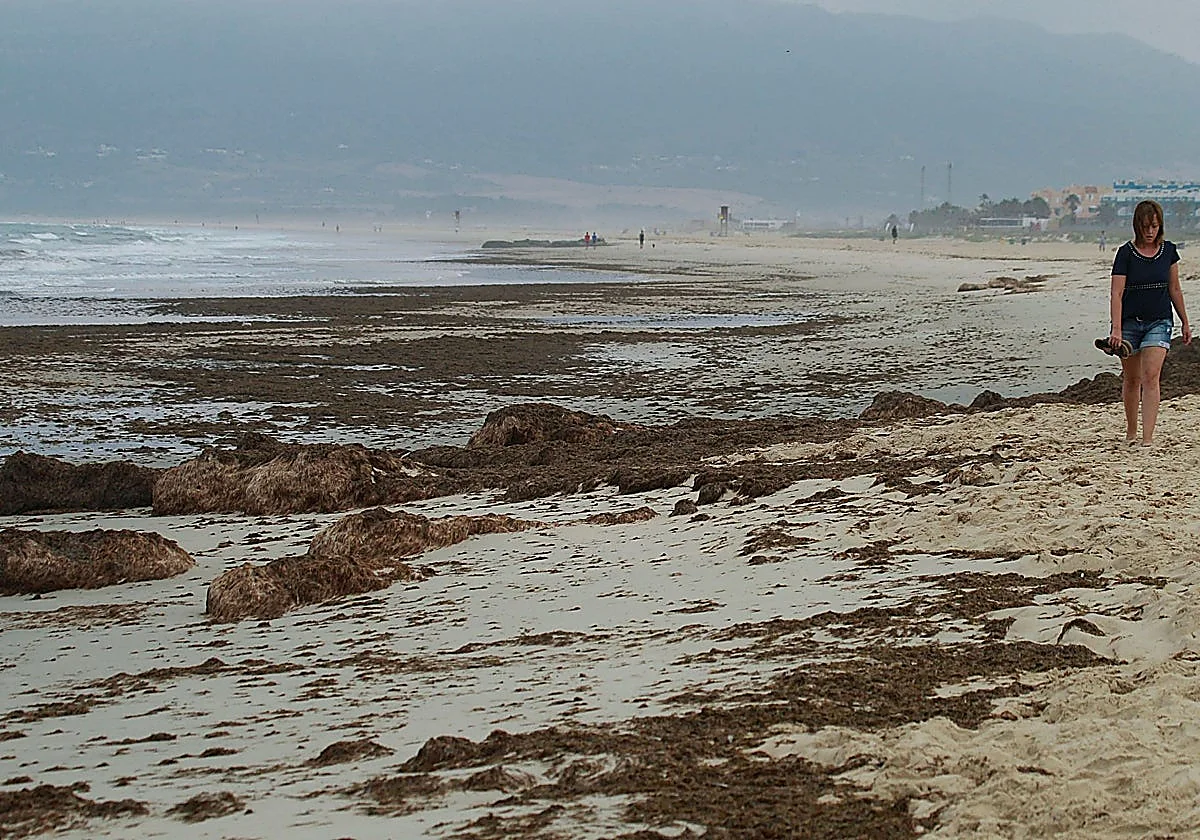
Zoom
Arribazones of 'Rugulopteryx okamurae' on a beach in Tarifa. EFE Environment Citizen science: 'eyes' wanted to monitor the invasion of Asian seaweed on Granada's beachesThe project combines satellite imagery with volunteer observations of the spread of 'Rugulopteryx okamurae' along the Andalusian coastline and anyone interested can take part
Inés Gallastegui
Granada
Monday, 27 April 2026, 18:32
Asian seaweed was first detected in the Strait of Gibraltar in 2015 and ten years later it has colonised the entire Andalusian coastline, as well as several coastal areas of Portugal, France, Italy and northern Africa. The serious environmental and economic damage caused by this invasion, both to fishing and tourism, is concerning the authorities and scientists who are seeking solutions to eliminate it.
Now, the RugOBSS research project has received European funding to develop a system to detect and quantify the algae that has washed up on beaches from space, combining field observations, satellite imagery, machine learning and cloud computing to provide management tools for this environmental crisis.
To certify that what is detected from space is indeed 'Rugulopteryx okamurae' and not something else, the promoters of the project have launched a citizen science campaign to report the findings of upwelling of the seaweed in their respective areas.
"It is important to have a lot of eyes on the beaches," explains María del Mar Roca Mora, an oceanographer at the CSIC's Institute of Marine Sciences of Andalusia, based in Cádiz and leader of the project funded by the Oyster-EuroMarine grants for young researchers, which also involves Maria Joao Lima, from the University of Algarve (Portugal), and Bede Ffinian Rowe Davies, from the University of Montpellier (France).
"Asian seaweed is on everyone's lips, there is concern and it is interesting that people know what is happening and feel involved in finding a solution," explains Mar, who is about to defend her thesis in Aquatic Remote Sensing.
How to help
Anyone interested in collaborating should visit the Rugobbs profile on Instagram, which shows how to identify the Asian seaweed and photograph it on beaches, on rocks and in detail to upload them to the platform Observadores del Mar , within the Invasive Algae project, together with the exact location. The organisers point out that no prior training is required and that anyone interested can take part.
Mar Roca emphasises that all the observations sent in by volunteers will be validated by the scientific team and contrasted with satellite information. The historical record of these images from space, by the way, offers invaluable information on how this exotic species has been spreading along our coasts.
The team makes its own observations in situ, locating and measuring the accumulated algae. "On the beaches of the Mediterranean there are far fewer upwellings, because there are hardly any tides, but that does not mean that the algae is not in the sea," the oceanographer stresses.
Environmental and economic crisis
Rugulopteryx okamurae is native to the coasts of Japan, China, Korea and the Philippines and was first detected in Ceuta eleven years ago, apparently brought by merchant ships. On the Atlantic coast of Andalucía it is a very serious problem, while on the Mediterranean coast, although less abundant, it was detected in the nets by fishermen in 2019 and since then it has not stopped colonising the waters.
Asian algae grows on shallow rocky bottoms at 0.5 to 15 metres, has a thallus of 10 to 20 centimetres with fan-shaped branches and grows uncontrolled outside its original habitat because it lacks predators.
Its environmental effects are devastating because its explosive growth - it reproduces from clones in tiny fragments - displaces native organisms and by reducing oxygen and light as it decomposes, hinders the survival of other species, both invertebrates and fish that live in symbiosis with native algae, corals and other sealife.
In waters with a high density of algae, fishing is reduced and, in addition, nets become clogged and gear is damage and the accumulation on beaches entails a great economic cost for town halls, which must remove them from beaches to avoid the inconvenience they cause to tourists: bad smell, insects and difficulty for swimmers. On Granada province's Costa Tropical the most affected areas are Maro-Cerro Gordo, La Herradura, El Tesorillo de Salobreña, Castell de Ferro and La Mamola.