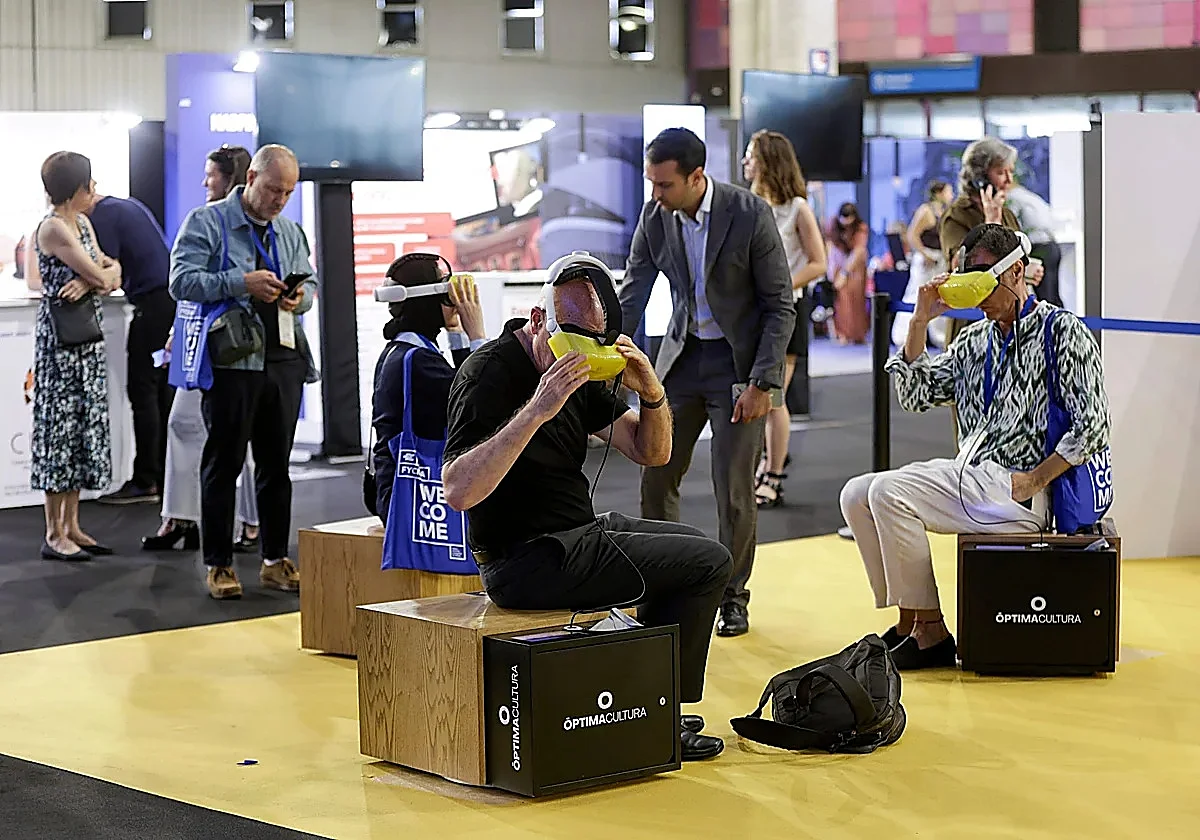
The response at a time when artificial intelligence is on the rise takes many different forms.
Another area of the Fycma featured a large screen that allowed visitors to 'talk' with Frida Kahlo. In another exhibit space, an AI-generated Roman soldier answered questions about the weapons and tactics of the Roman Empire. "Hail!" greeted the AI-generated soldier. "In Rome, the most common weapon was the gladius, a short sword for close combat. We also used the pilum, a type of spear thrown before hand-to-hand combat. For defense, we carried a scutum, a large, curved shield."
The goal of using AI, Newtonlab said, is not to replace the guide or the curator but to enhance the experience.
"Wow!" regional minister of culture Patricia del Pozo said during the opening walk. Alongside reproductions adapted for people with visual impairments, there were immersive audio systems, sound panels without visible speakers and tools designed to adapt cultural content to different sensory abilities.
The Museo Carmen Thyssen Málaga had its own stand. Those who put on virtual reality headsets disappeared for a few minutes from the bustle of the fair to travel back in time with a virtual tour of the subsoil beneath the Villalón palace. The experience allowed visitors to explore ancient Roman Malaca and observe the reconstruction of the fish-salting factory, the dwellings and the nymphaeum found under the museum, which can also be visited in person.
A guitar built from tins of tuna was hanging on one panel, one of the most eye-catching pieces from the Play It Again project, led by Japón Montajes de Arte, which had transformed waste materials into musical instruments. The initiative linked recycling and creativity in a way reminiscent of Malaga-based trompe-l’œil artist Julio Anaya. On the second day, it brought together more than 100 participants in a large percussion session using instruments made from recycled materials.
Craftsmanship had also found its place among screens and sensors. At one stand, visitors paused in front of panels explaining a new European Commission-backed seal designed to protect craft and industrial products linked to specific regions.
While some companies focused on bringing heritage closer to audiences, others stressed the importance of preserving it. At the Gnoss stand, a prominent message read: "Culture is also protected through technology." The company's work focuses on digital preservation, an increasingly important field for museums and institutions safeguarding vast archives of data, images and documents.
Just a few steps away, a darkened room had drawn small groups of visitors. Images of monuments, landscapes and heritage sites filled the walls while representatives from Be Heritage explained how a single tool could document, preserve and promote cultural heritage. The platform aimed to bring together tasks that are usually handled separately.
CM Málaga also made space for contemporary creation with the installation Hilar de vuelta, featuring works by Irene Verdejo, Clara Ballesteros, Eva García, Rafa Garrido, Lourdes María Castillo, Paula Hernández, Elu López and Lucas Selezio de Souza. Visitors moved slowly among suspended dresses, fabrics hanging from the ceiling and drawings traced onto transparent surfaces. Some paused to photograph the details, others stood in silence for a few seconds before continuing their route.
The event showed that the digital transformation of culture no longer limits itself to screens or apps. Technology appeared instead as a tool that allowed visitors to touch a Vermeer painting, speak with AI-generated historical figures, walk through a lost Roman city or preserve cultural archives intended to last for generations. Different solutions, all serving the same ambition: bring culture further and to more people.
Access the broad Malaga and Costa del Sol news index