Zoom
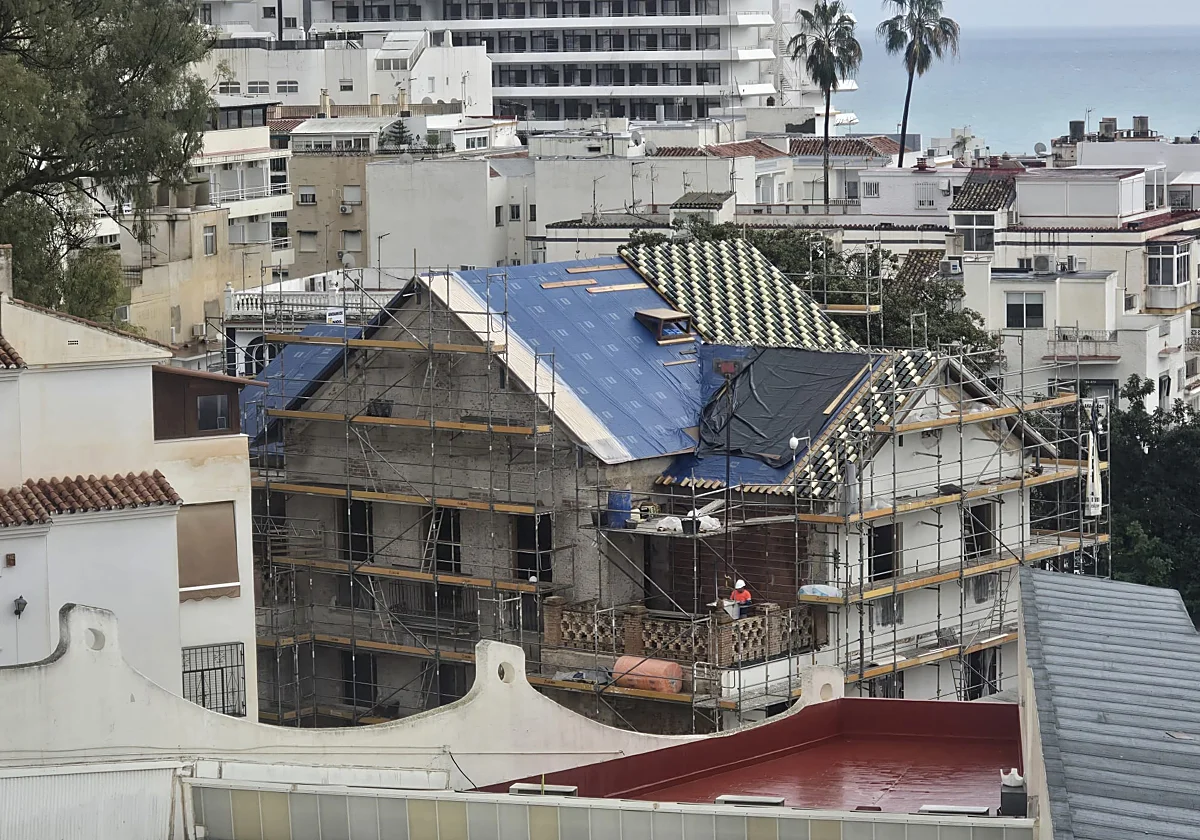
State of the works at the Casa de María Barrabino. SUR Torremolinos Craftsmanship rebuilds roof of the María Barrabino house in TorremolinosThe refurbishment of the building, which is due to be completed in a month's time, is in its final phase and includes the replacement of original elements, such as pieces of the roof and the use of the 19th-century Nolla-type cement tiles
Torremolinos
Tuesday, 3 February 2026, 20:01 | Updated 20:23h.
The restoration of the Casa de María Barrabino, one of the best examples of 19th-century bourgeois architecture in Malaga province, is nearing completion, Torremolinos town hall has confirmed.
The project to refurbish the house designed by the architect Gerónimo Cuervo has cost 2.5 million euros, of which Brussels is providing 65.03 per cent under a Spanish government programme for the rehabilation of public buildings.
The EU funds, however, depend on the work being completed before 26 February 2026, less than a month away.
Municipal sources have said that work is going well and, despite the heavy rain that has hindered progress, they are confident that the project will be completed on schedule.
The project has cost 2.5 million euros, of which Brussels is providing 65 per cent
The EU stipulated that, in order to receive these funds, the work must be completed by 26 February 2026, less than a month from now
One of the most delicate tasks is the treatment of the original materials. For this reason, as Torremolinos town hall points out, "meticulous craftsmanship" is being used on the roof tiles.
The pieces that have been preserved have been recovered one by one, after a "careful process of selection, cleaning and specific treatment" to guarantee their conservation and subsequent reuse.
The unrecoverable tiles have been reproduced by a professional ceramist, who has made exact replicas, faithfully respecting the characteristics of the originals.
Inside the building, all the modifications to the layout have been carried out in accordance with the project, which means that they fully comply with criteria established by the regional ministry of culture. The structural reinforcement of the staircase has been carried out, preserving original protected elements.
Although the house is not considered an Asset of Cultural Interest (BIC), the property is subject to protection set out in the Junta de Andalucía's general list of assets, which, in the specific case of this former property of the Barrabino family, means that the frescoes on the upper floor facing the staircase, and the floor tiles must be respected.
The original murals have been preserved and as much of the Nolla-type cement paving as possible has been recovered and reused, given its uniqueness and value. As part of this work, models of the original interior and exterior mouldings have been extracted and are currently on site and being installed, in order to guarantee fidelity to the original design of the building.
Exterior and interior
As far as the structure of the mansion is concerned, the demolition, foundations, structure and roofing works are practically completed, including insulation and waterproofing, and the current phase of laying the roof tiles is under way. At the same time, work is progressing on the façade and interior cladding. As for the installations, the interior plumbing, drainage and ventilation systems are ready, and the air conditioning and fire protection equipment has already been installed, in accordance with current regulations, as detailed by the town hall.
History
The Barrabino family lived in the villa until 1997. Two decades passed before it was bought by the town hall, during which time the building had suffered great deterioration. In 2019, emergency works were undertaken to prevent further damage and, subsequently, the subsidy for the current project was granted.
The opening of the Casa de María Barrabino to the public will make it possible to provide spaces for social projects and facilities related to urban regeneration or the history of tourism. This bourgeois house is linked, after all, to the origins of Torremolinos as a destination for leisure and relaxation, the essence of the local socio-economic evolution.
2019 Year of the first rehabilitation works
The Barrabino family lived in the villa until 1997. It took two decades before it was bought by the town, during which time the building suffered great deterioration. In 2019, emergency works were undertaken to prevent further damage and, subsequently, the subsidy for the current project was granted
The firm in charge of the refurbishment is CYRA from Granada, which already has experience in Malaga, having been commissioned by the Diocese to restore the Baroque façades Nuestra Señora del Reposo, in Campillos. In addition, among its merits, it has been responsible for the restoration of the cobblestones in the Partal gardens in the Alhambra complex.
Controversy
The project on which this intervention is based was criticised by José Ojeda Martos, a local architect who was one of the three bidders for the contract to carry out the work, which was finally awarded to the studio of Alfonso Valencia. This was the second round of bidding, as there had been a previous tender, in which José Ojeda's proposal was the only one submitted, but the local administration cancelled it, "to include the items which, according to José Ojeda, had to be quantified" in the costs. From then on, Ojeda began a campaign to tell people that the work planned for the mansion would not be respectful of its values.
Bearing in mind these suspicions, during the protocol visit that marked the beginning of these works, the government team insisted on numerous occasions that zeal in the preservation of this local asset would be at the heart of the project.