Zoom
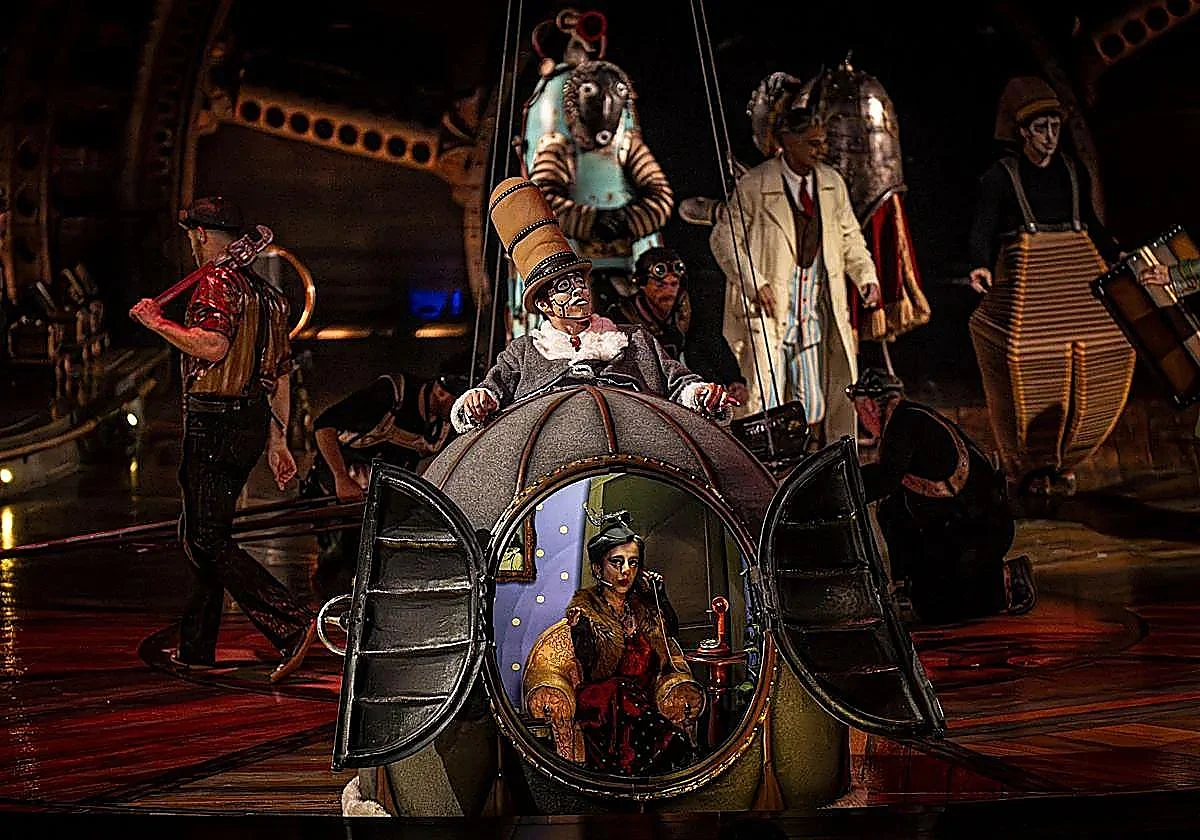
Mr Microcosmos with Mademoiselle Lili inside. Xurde Margaride Entertainment Curiosities of Kurios, the new Cirque du Soleil show coming to MalagaWith more props than ever, a brand new web-jumping number and a striking steampunk aesthetic - the new show is coming to the city in June
Thursday, 2 April 2026, 10:57
There's just an hour till showtime and the kitchen begins to empty. Some clear their plates with their makeup already done and others finish their meal fully dressed as a character from another era.
Decorated with flags from some thirty countries and serving healthy, energising and fresh food, served without fizzy drinks or alcohol, this is not your average canteen. Those eating there will shortly be balancing on a trapeze several metres above the ground, jumping through the air from the shoulders of a colleague or contorting their bodies into impossible positions.
On the other side of the big top, where the audience begin to take their seats, the Cirque du Soleil crew are getting everything ready. This is Kurios, the Canadian company's show currently on tour in Spain, which on 4 June will open on the Malaga fairground. On this occasion they were in Seville.
It is Cirque du Soleil in its purest form: acts that push the boundaries of what is possible, a universe of magical characters, impressive costumes and immersive live music.
But Kurios has its own identity, very different from the Cirque du Soleil shows seen to date in Malaga. In contrast to the fantasy of others, here the retro-futuristic 'steampunk' aesthetic takes centre stage, transporting the spectator to an alternative 19th century, where technology advances at the pace of a steam locomotive and creates strange artefacts.
In this context, an eccentric scientist opens his cabinet of wonders and unleashes his imagination, revealing an extraordinary and unexpected world, creating a very defined narrative thread that does not always exist in other Cirque du Soleil shows.
The music is also unique: cabaret, jazz and vintage sounds take precedence here over the epic tone so characteristic of the Canadian circus. Here are some of the curiosities hidden in Kurios.
More props than ever before
In Kurios, 464 props are used, the highest number used in any Cirque du Soleil show. They are everywhere. Presiding over the stage are two large structures built from gramophone parts, old typewriters, electric light bulbs and turbines salvaged from scrap metal.
There are unique objects, such as the ball carried by Microcosmos, the one that opens the door to the parade of inventions. In its 'belly' lives a small woman, with her armchair and other Victorian objects. It is equipped with its own light and ventilation system and weighs nine kilos; the props team spent 250 hours building it.
In this parallel world there are automatons, such as the immense 340-kilo mechanical hand that serves as a prop for one of the most mesmerising numbers: upon it, four artists create beautiful images with the flexibility of their bodies.
A puppet show in a world turned upside down
In Kurios the surprise, essential to any circus show, is not only in the skills of the artists, which are abundant, but in the way they are presented. Two 'puppets' emerge from a giant music box and perform a routine with four-metre-high somersaults. They play with the change of perspective and the reversal of the ordinary: whether it's an acrobat riding a bike or another one stacking chairs on a table.
Zoom
Mathew TsangAnything is possible, even an invisible circus, including a masterful clown act with an important mechanical component. The attention to even the smallest detail is astonishing, from acts such as yo-yo spinning or finger puppetry, where an artist tells a story with his fingers alone that is then projected in real time onto a hot air balloon.
50 artistes from 21 countries
A total of 50 artistes from 21 countries make up the cast of Kurios. Acrobats, tightrope walkers, contortionists, tumblers and jugglers who make the difficult look easy.
An acrobat jumps on her bicycle suspended in the air and hangs in a variety of positions: holding onto the base of the handlebars or the wheels, by a foot or an arm.
A group of gymnasts reinvent the acro net jump in an unprecedented number: the net is just taut enough to become a trampoline, with the artists controlling the bounce through the pressure applied by their legs. The act results in one of them soaring to the very top of the circus tent.
The classic Banquine is performed with 15 artistes jumping from one performer’s hand to another’s shoulder, crossing each other in the air and creating human pyramids. There are balancing acts on stacked chairs, a ten-metre high balance board, synchronised acrobatics on straps and comic numbers that lighten the moments of maximum tension.
From the Accordeon Man to Méliès' Martians
Zoom
Václav HodinaOver a hundred costumes have been made for this production. Each acrobat's costume has been tailor-made in Montreal to be durable, lightweight and stretchy. They also have a specific aesthetic for each number.
In the Dúo de Cuna or Cradle Duet, the performers appear to be clad in vintage circus costumes, but in reality they are wearing highly intricate fabrics with velvet effects and gold appliqués. In the net jump, they wear fish scales, fins and tails in reference to the way Georges Méliès imagined Martians.
Some of the designs are very elaborate. For the Accordion Man, a character who makes himself big or small as he pleases, one person spent a week sewing the inside of the garment.
Once the show ends, the laundry begins. Every night, two people must wash all the clothes worn by the artists for the last two hours. In total, they travel with 8,000 garments, including accessories, shoes and wigs.
From 4 June till 5 July
Two years after Alegría, the Cirque du Soleil returns to Malaga for a month with Kurios. From 4 June to 5 July, the big top will be erected at the fairground, with tickets already on sale from 49 euros.
One hundred people are needed to get the 2,500-capacity tent on its feet. With an additional seven days spent completing the Cirque du Soleil city, including artists' tents, administrative offices, box office and a team kitchen serving up to 400 meals a day.
Zoom
"You can't relax for a moment"
"Here everyone knows exactly what they have to do," says guitarist Bruno Esteban Pitarch, one of the seven musicians in the Cirque du Soleil orchestra, after the show. A reflection that seems simple, but which holds the key to this mechanism of more than a hundred people working perfectly every night. Because all the pieces are connected. While James González, El Aviador, adds new elements to his unstable balance 10 metres from the stage, Bruno and his companions contain the melody, repeat the musical line or continue the score according to the artist's needs. "You can't relax for a moment, you're under constant pressure the whole time," says the Valencia musician.
A mutual understanding between the musicians and the acrobats is imperative for James to be able to focus completely on the number that keeps the audience on the edge of their seats. On a platform that swings through the air, he climbs onto a balance board that gets complicated at times. "I count getting up and not falling; it's better to know that every time you fall you can get up. And it's normal, there's always a risk, but you learn to have a margin of error," says the Colombian artist, a circus man since birth. He feels confident, but not overconfident. A drop of sweat, a child running out of their seat to go to the toilet or a gust of wind can distract him and cause him to slip.
Bruno Esteban Pitarch and James González speak to us after the show, when there is only one artist left backstage training on bars, with the sound of washing machines in the background. They are still dressed as their characters and wearing the make-up they have applied themselves. "Sometimes you're surprised how many shows you can do without anything going wrong, it's so complicated," exclaims Bruno as James laughs.
They are nomads, but this circus life is nothing like the traditional one. They do not sleep in caravans, but in hotels and flats that they rent in each city. In their cases, with the whole family, wife and children. "Wherever we go, they go. We try to always stay together, it's important," James says. "It helps a lot to have them here with you," adds Bruno. They are not the only ones. There are many children in the Cirque du Soleil community; they have an informal brunch together on weekends and every birthday is celebrated as a group in the big top. The big circus family.