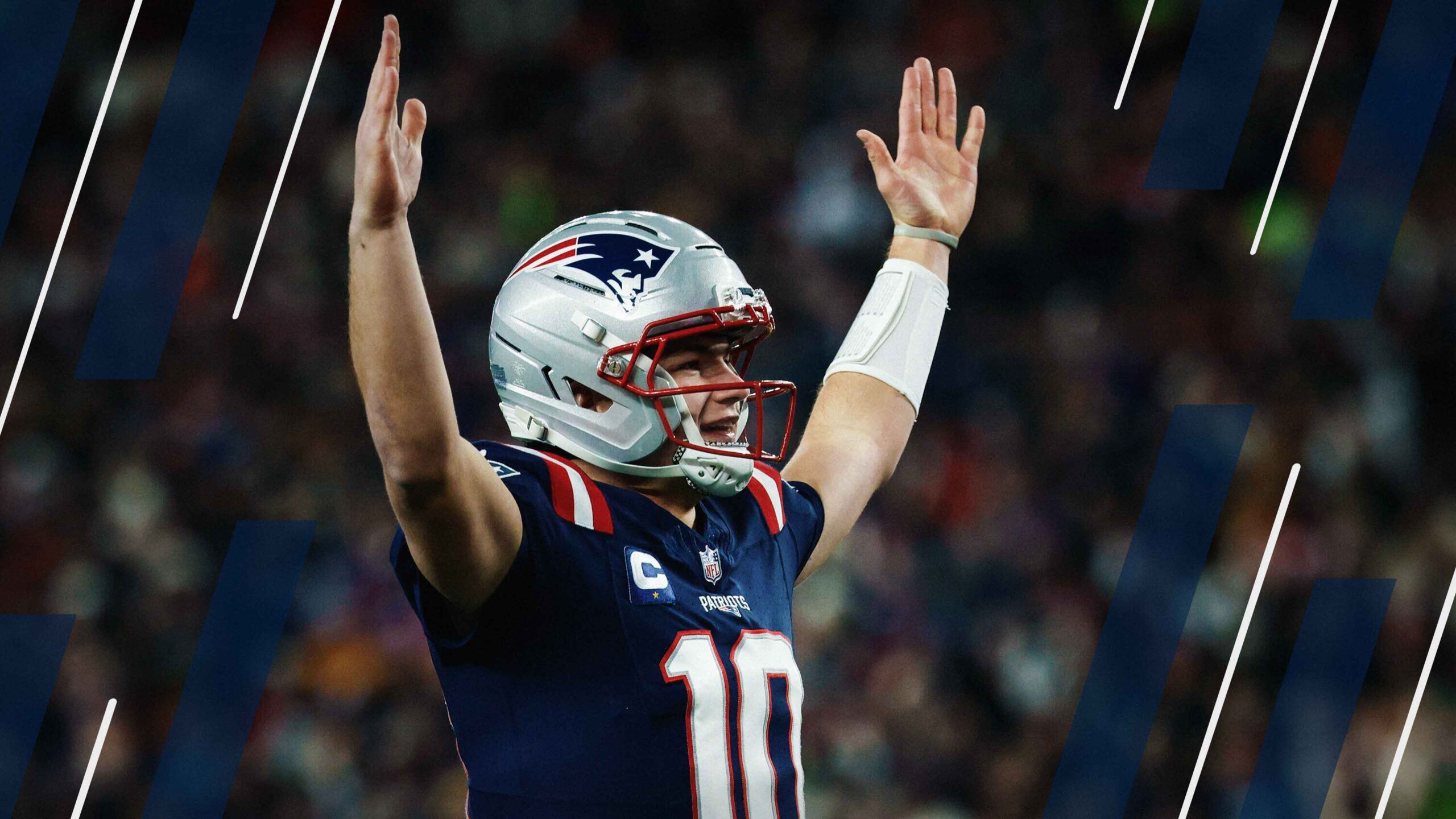
New England Patriots -9.5
As always, we’ll start by examining the team fundamentals and how this matchup is priced, laying the foundation for the rest of our analysis.
Here, a chart courtesy of Timo Riske illustrates team strengths on both sides of the ball, with additional weight given to more recent weeks. Whether using Timo’s work or similar models, the takeaway is consistent: this profiles as a Patriots team with an elite offense and an average defense, while Houston sits closer to league average offensively with one of the NFL’s strongest defenses.
There are fair questions about New England’s schedule strength and how much to trust the raw outputs given their opponents, but getting to Texans -3.5 at home requires a meaningful discount of the Patriots offense relative to what it has actually shown — or an assumption that it will underperform specifically in this matchup.
From a fundamentals standpoint, the Patriots defense may also be better positioned than recent full-season data suggests. Through the first 10 weeks, while Milton Williams and Robert Spillane were healthy, New England ranked top-five in EPA allowed per rush and was similarly strong in rush success rate allowed. During the stretch where those two were sidelined, the run defense cratered — ranking second-worst in rush success rate and fourth-worst in EPA allowed per rush — which dragged down their overall defensive profile.
With both back in the lineup, this projects once again as a strong run-stopping unit — one that should be well-equipped to stymie Houston’s rushing attack and materially improve the Patriots’ outlook in this matchup.
Matchup Angles
Coupled with its strong run defense, New England’s underlying defensive metrics offer real cause for optimism. Over the final two months of the season, the Patriots ranked second in the NFL in disruption rate.
Stroud has also been one of the most disruption-sensitive quarterbacks in the NFL throughout his career, and 2025 has been no exception, as he again sits in the bottom tier of quarterbacks when pressured or disrupted.
That vulnerability is magnified in this matchup against a New England defense that leans heavily on man coverage and should do so even more with All-Pro cornerback Christian Gonzalez available.
In man coverage, talent tends to decide outcomes more cleanly, and without Nico Collins — who accounts for nearly one-third of Houston’s targets and nearly doubles the next Texans receiver in yards per route run — it’s unclear where Stroud would consistently find separation. No other Texans wide receiver graded above average against man coverage, leaving Houston short on answers against tight, talent-driven coverage.
On the other side of the ball, Houston’s defense under DeMeco Ryans has consistently allowed a high rate of deep attempts, facing the fifth-most deep shots in the NFL this season. While the Texans have held up reasonably well on those throws, that performance has not come against a quarterback like Drake Maye, and the matchup raises questions about whether those numbers would hold against a more aggressive downfield passer.
Maye has been the NFL’s most effective deep passer this season, adding well over a point of EPA per deep attempt and sitting in a tier of his own throwing downfield.
That sets him up perfectly against a Texans defense that consistently invites deep shots — an area they often survive against, but one that gives New England a clear path to a ceiling outcome if the Patriots maintain their usual downfield efficiency.
Put it all together, and this matchup aligns cleanly for New England: sustained offensive success that attacks Houston’s defensive tendencies, paired with a Patriots defense whose emergence is still undervalued by the market and whose man-heavy approach directly targets Stroud’s struggles versus disruption and man coverage.