Housing
Data shows that rent prices in Malaga triple in renewal agreements once contracts expireMalaga is the second province in Spain where rents rise the most after a tenancy agreement expires
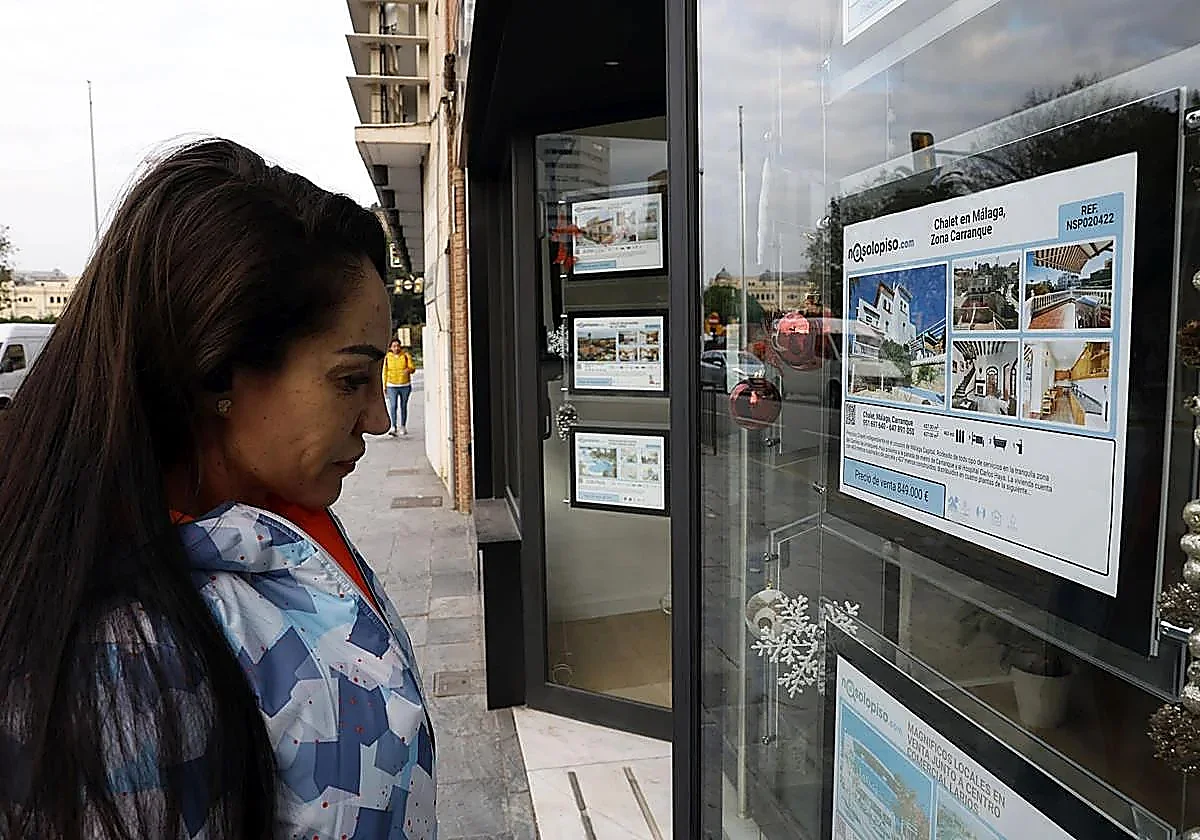
Añádenos en Google A woman looking at real estate advertisements in Malaga. (Ñito Salas)Cristina Vallejo
29/05/2026 Actualizado a las 17:44h.One of a tenant's biggest fears is the expiration of their rental agreement. During the lease term, the annual rent increase is, in most cases, tied to the CPI or, for contracts with a starting date after 26 May 2023, to the Spanish housing rental price index, which is usually slightly below the inflation rate.
When the contract ends, the landlord can adjust the rent. Often, the tenant has to scramble to find a new place to live.
An experimental statistic Spain's national institute of statistics recently published, the rental housing price index, puts figures on how much rents rise annually in existing contracts and how much more expensive new agreements become compared with the contracts they replace.
In Malaga province, rent reviews on existing contracts increased by an average of 3.7% in 2024 (the latest year with available data), while newly signed contracts rose by 11%, three times as much.
That 3.7% increase in existing contracts was the highest recorded since the statistic began in 2021. Temporary government-imposed caps to shield tenants from soaring inflation after Russia's invasion of Ukraine impacted earlier years. Meanwhile, the 11% rise in new contracts in Malaga province was also the sharpest in the past four years and more than double the increase recorded in 2023, when new rents rose by 5.3%.
Related story
- M. C. Callejón
According to Julio Rodríguez, statistician and former president of Banco Hipotecario and Caja Granada, the figures reflect the acceleration in rental prices seen in recent years.
"Between 2015 and 2020 there was moderate price growth, but it later accelerated, partly because of population growth. For 2025, the statistics will probably show a bigger increase than in 2024, although by 2026 the market is likely to start moderating," Rodríguez says.
Jaime Palomera, researcher at Instituto de Investigación Urbana de Barcelona, says the findings are consistent with Spain's current housing regulations. Annual reviews during a tenancy are still largely tied to inflation, whereas rents in new contracts remain unrestricted, except in officially designated "stressed" housing areas. These currently cover only limited parts of Galicia, Catalonia and the Basque Country, where regional governments have imposed caps.
The general trend in Spain
The pattern in Malaga repeats across Spain as a whole, although the figures on the Costa del Sol are more pronounced. Nationwide, annual increases in existing contracts averaged 2.8% in 2024, while rents in new contracts rose by 8.8%. As in Malaga, this was more than double the 4.1% in 2023.
The gap between existing and newly signed contracts is widening. A report trade union Comisiones Obreras (CCOO) published on Friday reaches the same conclusion: "The different change in prices depending on the age of the contract shows that rental price jumps occur when a new agreement is signed."
The union says that while wage increases may help households cope with inflation-linked rises in existing contracts, they fall far short of keeping pace with the prices demanded in new lets.
Valencia recorded the sharpest increase in Spain, with rents in new contracts rising by 12.4%. Malaga followed closely behind at 11%, ahead of Madrid (9.2%), the Balearic Islands (10%), Castellón (10.2%), Alicante (10.3%) and Barcelona (7.4%).
Palomera says his research suggests rental inflation is driven less by population growth than by the impact of tourism and financial investment in housing. Tourist accommodation reduces the supply of long-term homes, pushing prices higher, while domestic and international investors continue to channel money into property.
"That is why it is no surprise that the data shows the biggest increases in provinces where tourism plays a major role," he says.
As for Barcelona, he believes its designation as a "stressed housing area" may partly explain why rents there are rising more slowly. Under local rules, rents are capped either by the level of the previous contract or by benchmarks published by the ministry. However, he warns that official statistics may not fully reflect reality because short-term seasonal contracts (usually lasting up to eleven months) are increasingly common and fall outside the regulations.
Indefinite rental contracts?
Sociologist Javier Gil recently spoke in favour of indefinite rental contracts. Palomera agrees, pointing out that countries such as Germany, Austria, Denmark, Sweden and France all have large rental markets based on this system.
He says indefinite contracts give tenants stability and security while still allowing landlords to recover properties if they need them for personal use, close family members or a sale. Gil says that such a model would stop tenants losing their homes simply because landlords want to re-let them at a much higher price.
Julio Rodríguez believes indefinite agreements would be particularly suitable for social housing, although he says they could also be introduced gradually into the wider rental market.
The national institute of statistics calculates its figures using data from Spain's tax agency (AEAT), based on annual income tax returns that declare rental income from residential properties used as permanent homes. The statistics aim to measure annual changes in long-term residential rents and therefore exclude holiday lets and other short-term accommodation.