Zoom
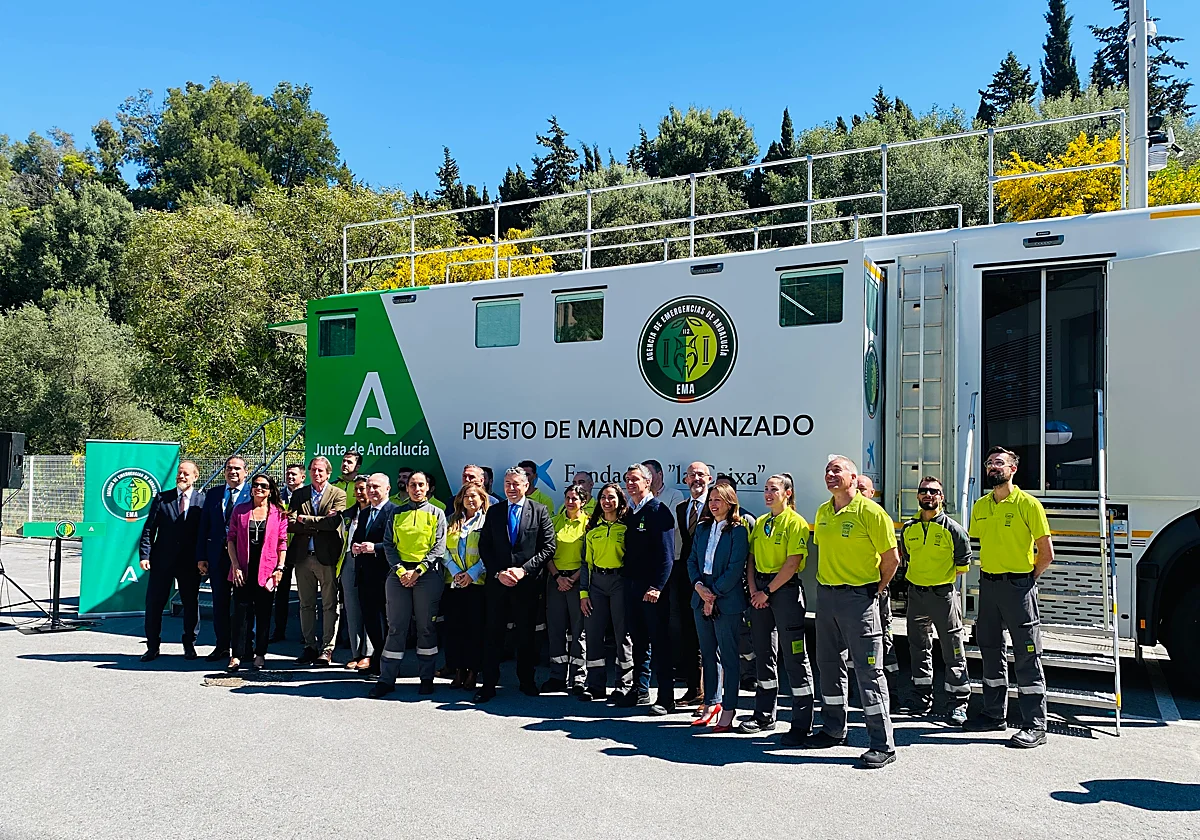
The inauguration of the new Advanced Command Post of the Coastal Base of the Andalusian Emergency Group. E.Pérez-Romera. Emergency response Europe's 'most advanced mobile emergency hub' debuts in BenahavísRegional minister Antonio Sanz inaugurated the new Advanced Command Post, a state-of-the-art "life-saving" centre designed for rapid field deployment
Benahavís
Thursday, 19 March 2026, 13:02 | Updated 13:57h.
Andalucía has officially unveiled what is considered Europe's most advanced mobile emergency coordination centre, according to the Junta.
During the inauguration at the GREA (Andalusian Emergency Group) coastal base, regional minister Antonio Sanz emphasised that the new facility "will allow lives to be saved through superior technology, coordination, and response capacity".
Developed by the Andalusian company Iturri and funded by the La Caixa Foundation, the Advanced Command Post (PMA) has been specifically engineered by the Andalusian Emergency Agency to address increasingly complex disaster scenarios.
Sanz noted that the recent months have been particularly demanding due to both natural and technological risks, which necessitates a high degree of anticipation, planning, and the application of advanced technology to the decision-making process.
He emphasised that the unit is much more than a specialised truck, representing instead a new capability to protect lives and better coordinate the teams tasked with public safety.
The design prioritises the ability to move strategic coordination directly to the field, ensuring that emergency management does not have to rely on fixed infrastructure during a crisis.
The vehicle functions as a fully integrated coordination centre capable of operating autonomously for extended periods in remote areas.
Built on a high-capacity chassis, the unit measures over eleven metres in length and four metres in height and features a hydraulic lateral expansion system that widens the structure to 4.5 metres to create a high-performance workspace.
The interior is divided into two distinct zones: an operations room equipped with integrated workstations and large-format screens for real-time cartography and meteorological data, and a strategic coordination room designed for high-level meetings and video conferencing with external authorities.
A defining feature of the PMA is its multi-band communications system, which integrates various operational networks - such as health emergencies, fire services, and security forces - into a single environment. This ensures connectivity via data networks and satellite even in areas without conventional coverage.
The vehicle is further equipped with telescopic masts, high-definition cameras, and its own weather station to provide a comprehensive real-time overview of any incident.
Designed to withstand extreme situations, the PMA remains operational in adverse conditions without external supplies thanks to its own electrical generators and uninterruptible power systems.
It also includes automatic stabilisation technology for rapid deployment on difficult terrain and LED perimeter lighting for night-time interventions. Beyond its technical specifications, the vehicle focuses on the welfare of the professionals inside, offering thermal and acoustic insulation, advanced air conditioning, and full accessibility for those with reduced mobility.
Sanz concluded that by improving the working conditions for emergency teams at critical moments, the centre directly contributes to a more effective and life-saving response on the ground.