- Malachi Fields offers elite physical upside: Measuring in the 90th percentile for height (6-foot-5) and weight (218 pounds), the Notre Dame product is a “traits-first” prospect. While his college production was limited, his 38-inch vertical jump and change-of-direction tracking data make him a high-ceiling target for dynasty managers in the third round.
- 2026 NFL Draft season is here: Try the best-in-class PFF Mock Draft Simulator and learn about 2026's top prospects while trading and drafting for your favorite NFL team.
The NFL draft is a day away. It’s pretty clear which skill players will be selected on Day 1 or early on Day 2 of the NFL Draft, but there are several players who will be drafted later that can make an impact in fantasy football, either in 2026 or beyond.
Here are three running backs, three wide receivers and a tight end expected to go in the third round of dynasty rookie drafts or later who have a chance to factor into rotations as rookies and potentially have fantasy value in their first few years of the league.
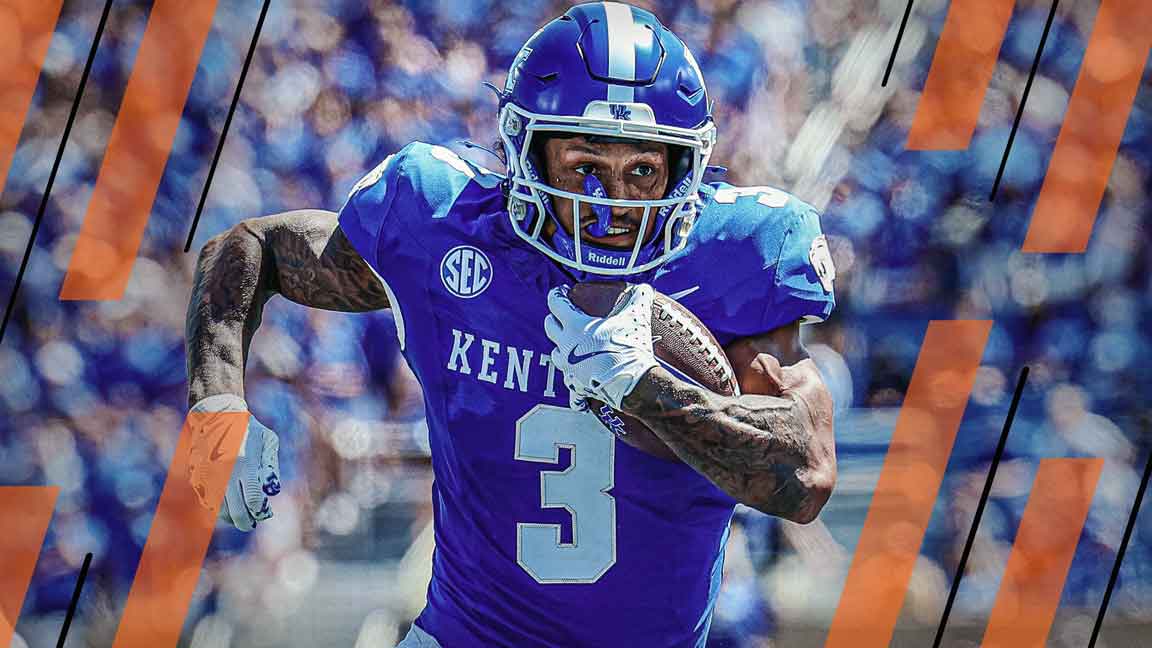
RB Seth McGowan,Kentucky
McGowan is a well-rounded running back with the potential to be an NFL starter. While several running backs in this class have unique sizes that might push them into a two-down or a third-down role, McGowan has the size of an every-down running back.
Kentucky’s offense held back his raw protection. His 1.6 yards before contact per carry was third-lowest of the top 20 running backs of the class, but his 0.26 avoided tackles per carry were tied for third-best behind Jeremiyah Love and Jonah Coleman.
While McGowan’s speed isn’t elite, his acceleration and change of direction are exceptional, according to tracking data.
Our draft guide notes some bad misses in pass protection and ball security issues. He also didn’t seem dynamic after the catch, which reflected in his receiving stats. Most of those should be fixable at the NFL level with the right coaching. Anyone drafting him will need to be patient, but he could have higher odds of becoming a three-down back than some of the running backs expected to go in the second round of dynasty rookie drafts.
RB Le’Veon Moss,Texas A&M
Moss is a similarly well-rounded running back with three-down potential. When he was healthy, he was among the better graded running backs of the class. His 90.9 PFF run grade was fourth-best among the top-20 rookies in the class, only behind Jeremiyah Love, Kaytron Allen and Jonah Coleman. His 3.7 yards after contact per attempt also ranked fourth best, while his 32.6% first down or touchdown rate ranked second.
The reason Moss will likely get drafted later is injury concerns. He tore his ACL and MCL in 2024 and then a leg injury cost him the second half of 2025. He didn’t participate in the combine due to the injury. He may be more susceptible to injury, or he could have just been unlucky, but that will likely be enough to make him a pick on day three rather than Day 2. It’s also possible he won’t be the same player once he’s back from injury.
Moss is the perfect kind of player to take in the middle of dynasty drafts because his upside is to work out in a big way as a three-down running back, but his downside is that he won’t have any fantasy value. That is a better gamble than those with a higher floor but a lower ceiling.
RB Kaelon Black,Indiana
Black is a third ball carrier with a third-down back's size and speed. He’s right in the middle of the pack in terms of height and weight, while his speed, acceleration and change of direction are all above average, relative to the top-20 running backs of the class.
His first problem is a lack of receiving production while at Indiana. He posted a solid 1.38 yards per route run in his final season at James Madison, but he rarely ran routes and was even more rarely targeted while at Indiana. He also never had a snap rate above 45%, as passing downs were the primary time when he was on the field.
Our draft guide noted that he is better suited to zone-blocking schemes, and the stats backed that up. He’s averaged 5.5 yards per attempt on zone runs compared to 4.7 on gap. The guide also noted “he has occasionally been a half-step late in identifying running lanes when operating behind power concepts” and “his run game lacks true difference-making creativity”.
Like McGowan, he is a back who needs the right coaching to potentially become an NFL starter, but there is a chance he can become a three-down back.
Explore PFF Tools Mock Draft Simulator Be the GM for any team in the 2026 NFL Draft with a fully immersive simulation that lets you trade picks and players for a realistic, in-depth draft experience. Customizable Draft Big Board Take control of your rankings with a customizable big board that lets you add players, share with friends, export to CSV and save your personalized list. Scouting Assistant Master the evaluation process with a customizable grading system built for serious scouts. Choose your own scouting categories, assign 0–10 grades in each area and generate a finalized prospect grade tailored to your criteria. NCAA Premium Stats Our exclusive database, featuring the most in-depth collection of NCAA player performance data. Subscribe For Full AccessWR Malachi Fields, Notre Dame
Fields is a classic wide receiver with the size and speed to impress NFL teams, but lacks production in college. He measured 6-foot-5 and 218 pounds at the combine, both in the 90th percentile among wide receivers, while his 38-inch vertical jump ranked in the 85th percentile. Tracking data suggests strong speed and change-of-direction ability for his size.
However, Fields did not record a 100-yard game in his lone season at Notre Dame and had just two games with more than four receptions. Most wide receivers with that profile do not work out long term in the NFL, though that is true of most players selected in the third round or later. While other wide receivers may have higher odds of becoming role players without ever becoming fantasy relevant, Fields has a chance to break out if he lands in the right situation.
WR Bryce Lance, North Dakota State
Lance has spent the past two seasons dominating the FCS, earning PFF grades of 86.7 and 89.5. He did not face an FBS opponent in 2025 and averaged 1.19 yards per route run across two games against FBS competition in 2024. Lance posted elite measurables at the combine, ranking in the 97th percentile or better in the 40-yard dash, 10-yard split, vertical jump and broad jump.
His tracking data suggests excellent acceleration, strong change-of-direction ability and good speed for his size, though not elite top-end speed. His separation scores against single coverage were not strong. Parts of this profile suggest he could develop into an impact wide receiver in the NFL, but there is also a chance he will struggle against NFL-level competition. He is the type of player worth targeting in the middle rounds of a dynasty rookie draft.
WR Deion Burks, Oklahoma
While Fields and Lance project as X receivers, Burks is an undersized receiver with elite speed, acceleration and change-of-direction ability, along with strong separation scores. Burks produced in big games, recording over 100 receiving yards and a touchdown against Michigan in Week 2 and Alabama in the conference championship game, but he was held under 50 receiving yards in more than half of his games.
Burks measured 5-foot-10 and 180 pounds at the combine. Historically, wide receivers of that size have not found much NFL success outside of special teams, but players such as Cole Beasley, Hollywood Brown, Tank Dell and Josh Downs are recent success stories, and Burks could follow in their footsteps.
TE Sam Roush, Stanford
Roush is a large tight end, measuring 6-foot-6 and 267 pounds at the combine. Few players of that size have produced significant fantasy value in recent years, with Rob Gronkowski and Martellus Bennett among the most notable examples. However, Roush’s athletic profile suggests he could be an exception. His 4.70-second 40-yard dash and 1.61-second 10-yard split are strong marks for a player of his size, and he also ranked in the 90th percentile or better in the bench press, vertical jump and broad jump.
His production did not fully match that athleticism in college, due in part to 13 drops over the past four seasons compared to 120 receptions. Cleveland would be an intriguing landing spot, pairing him with the lighter Harold Fannin Jr. under a head coach known for using a high rate of 12 and 13 personnel.