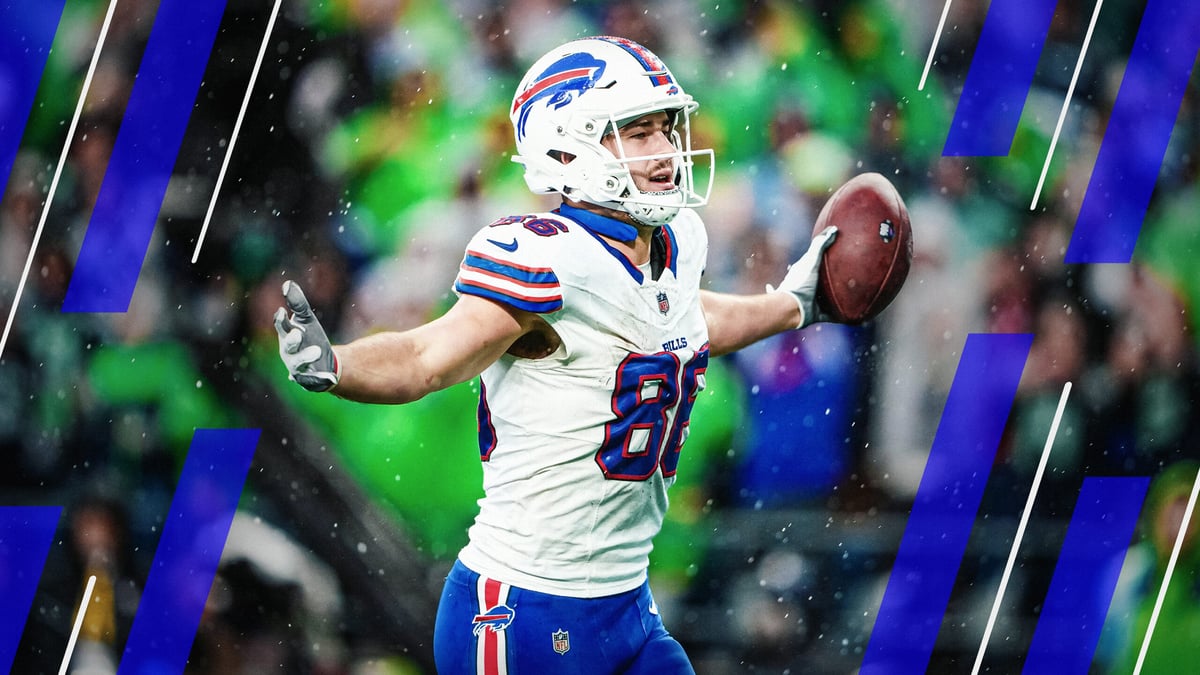
- Surprising consequences of the rise in 12 and 13 personnel: The increase in the number of tight ends on the field could influence which players you’re drafting in the first round next season.
- Introducing the NEW PFF Pro subscription: PFF Pro includes everything in PFF+, plus an upgraded Premium Stats Pro experience, higher base access to Guru AI, revamped player and team pages, enhanced data and visualizations, an improved interface and programmatic data access for modeling. Click here to subscribe.
The start of the fantasy football season is just days away. And while some drafts are already in the books, plenty are still on the horizon, so it’s not too late to make some bold predictions.
These aren’t the most likely outcomes, but they’re far more plausible than you might think.
Last year’s article correctly predicted that Jordan Mason would finish with more fantasy points than Aaron Jones and that Brock Bowers would finish outside the top two fantasy tight ends. I also predicted that the best Day 3 rookie wide receiver would outperform the best Day 2 rookie wide receiver, and that one came down to the wire, with Luther Burden III narrowly beating Chimere Dike, 127.9 fantasy points to 126.1.
Another prediction was that Rashee Rice would rank among the top five wide receivers in fantasy points from Weeks 7 to 17. He finished 11th, although injuries played a role. Rice missed two games during that stretch but still ranked among the top five wide receivers in fantasy points per game.
I wasn’t nearly as close in predicting that Jayden Daniels would lead all quarterbacks in fantasy points, but if I had come close on all five, the predictions probably weren’t bold enough.
So, here are five bold predictions for 2026.
1. Five or more quarterbacks finish among the top 12 in fantasy points per game while finishing outside the top 12 in total fantasy points
Typically, the quarterbacks who finish in the top 12 in total fantasy points also finish in the top 12 in fantasy points per game, with only a few exceptions each season. Last year, Brock Purdy and Daniel Jones cleared the per-game bar but not the total after missing a combined 12 games. In 2024, Purdy was the only quarterback to do it, excluding those who played only one game.
The extreme case was 2023, when Joe Flacco, Kirk Cousins and Kyler Murray all produced at a high level in eight games or fewer, while Justin Herbert did the same across 13 games. All four finished in the top 12 on a per-game basis but outside the top 12 overall. Another five cases occurred from 2020 through 2022 combined.
This year, I expect at least five quarterbacks to finish in the top 12 in points per game without finishing in the top 12 in total points, well above the typical average of two.
The reason isn’t that I expect a spike in quarterback injuries. It’s that I expect the scoring gap between the top 12 quarterbacks and the next 12 to be much tighter than it has been in recent seasons. A missed game or two will do much more damage to a quarterback’s season total while leaving his per-game average intact.
Nineteen quarterbacks have finished in the top 12 in either total points or points per game in 2024 or 2025. All of them are still starters, and all rank among the top 24 at the position this year.
Beyond those 19, Jaxson Dart finished 14th last season and now has three new receivers and an upgrade at tight end. Jordan Love finished 15th, and the Green Bay Packers expect to throw more often. Malik Willis could lead the league in scrambles per dropback, and quarterbacks with that kind of rushing volume tend to finish inside the top 12.
Tyler Shough averaged 17.6 points per start, which would have tied Dart for 14th, and second-year quarterbacks generally take a step forward. Jacoby Brissett’s per-game average was dragged down by the weeks he spent as a backup, but his 19.6 points per start would have put him in the top 12.
That brings the group to 24, and it still leaves out recent top-two picks such as Bryce Young, C.J. Stroud, Cam Ward and Fernando Mendoza.
That makes 28 quarterbacks with a realistic shot at top-12 production in either category. The gap from QB7 to QB20 should be tighter than ever, and the two top-12 lists could end up looking very different from each other.
2. No New York Giants running back finishes among the top 30 in fantasy points
Cam Skattebo is currently the RB18 in average draft position (ADP), occasionally slipping to RB19 behind D'Andre Swift. There is a clear gap between those first 19 backs and everyone after them, as the top group is generally viewed as clear-cut starters while the rest are viewed as committee pieces.
Plenty of evidence suggests Skattebo belongs in the second group. Of the 32 starting running backs, 18 did not play in the preseason. Five took only a handful of snaps and were finished as soon as a backup entered. Another five played a clear majority of the snaps with a backup occasionally rotating in, roughly resembling their expected regular-season splits. Only three teams used a true two-man rotation with their starters: the Minnesota Vikings, Pittsburgh Steelers and Tennessee Titans. The Giants were the only team to use three.
They then added Najee Harris to that backfield. Harris was “brought in under the premise that he’s going to be a significant contributor.” The initial expectation was that he would need time to round back into shape after last season’s Achilles injury, but he was ready to play in the preseason finale.
Head coach John Harbaugh and offensive coordinator Matt Nagy both have a history of rotating running backs. This group resembles Harbaugh’s 2019 Ravens backfield, with Harris in the Gus Edwards role, Skattebo in the Mark Ingram role and Devin Singletary in the Justice Hill role.
Ingram finished as RB11 that season, but Baltimore had one of the best offenses in NFL history behind a top-three run-blocking line. The Ravens outscored every other team by more than 50 points while allowing the third-fewest, creating an ideal environment to run the ball throughout games. The Giants have a below-average offense behind a below-average offensive line and will likely spend much of the second half of games throwing.
Skattebo is a talented back, but this could be one of the league’s least fantasy-friendly rotations in one of its worst offensive situations. That combination could make it difficult for any Giants running back to produce consistently.
3. Seven or more wide receivers have a first-round ADP in 2027 for single-quarterback PPR leagues
Back in the day, every-down running backs dominated the first round of fantasy drafts. As more teams moved to a committee approach and passing games kept producing explosive numbers, receivers steadily crept in. Seven of them carried first-round ADPs in both 2023 and 2024, with Tyreek Hill the one notable bust across that stretch. That number dropped to six in 2025, and three of the top four receivers taken — CeeDee Lamb, Justin Jefferson and Malik Nabers — all finished outside the top 20 at the position. Running backs have also stayed healthier in recent seasons, which has made them easier to trust.
In 2026, we are at an even split of six running backs and six wide receivers in the first round, with picks 13 through 18 all running backs as well. I expect that to reverse in 2027.
For nearly two decades, teams have leaned more heavily on 11 personnel, forcing defenses to adjust until nickel became the new base look and dime became common for some. Lighter defenders on the field made life easier for running backs. That trend is now turning. Teams used more 12 personnel last season than the year before, the Los Angeles Rams used 13 personnel at a historic rate, and others may follow. Sixteen tight ends came off the board in the first five rounds of the draft, and there was heavy movement among TE2s and TE3s in free agency. Defenses will answer with bigger bodies on the field, which raises the injury risk for running backs and makes the early ones harder to trust.
More tight ends on the field also means fewer receivers on it. Production that used to reach the receivers you would start in a flex will instead go to second tight ends, where it does almost no one any good. That will impact positional scarcity. As the usable middle of the position thins out, managers will push the receivers they do trust higher up the board.
We have also had back-to-back strong receiver classes. Big seasons from Tetairoa McMillan, Emeka Egbuka or Luther Burden III could turn any of them into first-round picks next year. This year’s deep rookie class already has three third-round picks in starting roles, and one of them could emerge as a first-round fantasy talent. I don’t think the Jeremiah Smith hype translates into an instant first-round redraft pick, but if anyone from the 2027 draft class gets there, it is him.
Together, these factors should reshape where players come off the board next season, particularly in the opening round.
4. Pat Bryantscores more fantasy points than Courtland Sutton
Sutton has spent most of his career as the Denver Broncos‘ top receiver when healthy, though he wasn't much of a fantasy factor until Sean Payton arrived. After 14 touchdowns in his first five seasons, he has scored 25 in the last three. His 44 end zone targets rank tied for second-most at the position over that span.
There is a real chance he loses both red zone work and playing time. Denver has spent several early-to-middle round picks on receivers in recent drafts, including Marvin Mims, Troy Franklin and Bryant, then traded this year's first-rounder for Jaylen Waddle. The room is crowded.
Waddle carries a 90.0 receiving grade over the last three seasons against 80.8 for Sutton, so he is widely expected to be Denver's No. 1. Payton also rotates receivers more aggressively than any coach in the league. The typical gap between a team's top receiver and its second in routes run is 92 per season, based on every team season in the PFF database. On Payton's teams over the last seven years, that gap has averaged 148, and it has reached at least 145 in five of those seven. Sutton is looking at a decline in both targets per route and total routes.
The touchdowns could go too. Evan Engram should be a bigger part of the offense with Davis Webb, a longtime friend, taking over as coordinator. The addition of Jonah Coleman points toward more running near the goal line. Bryant wasn't a red zone threat as a rookie, but he could take on more snaps at X and inherit the deep-threat role, which is where touchdowns tend to follow. Payton has praised him consistently, both early in training camp and more recently, and he graded well for a first-year player.
Denver's 2027 cap situation is also worth watching. Mike McGlinchey, Zach Allen, D.J. Jones, Patrick Surtain II, Garett Bolles, Nik Bonitto, Jonathan Cooper and Waddle all carry high cap hits, and several other starters are headed for free agency. And then there is Bo Nix, who will eventually need a new deal. Moving on from Sutton next year as a post-June 1 cut or trade would save $22.4 million. The Broncos will want to see whether the offense functions without him during this season before deciding to move on next year. They obviously won’t move Sutton fourth or lower on the depth chart if they view him as a top-three receiver, but they will still want to get other receivers like Bryant more involved to make sure they are ready to step up.
These concerns have pushed Sutton's ADP down, but not far enough. Bryant, meanwhile, is going undrafted almost everywhere and could be one of the better early-season waiver targets.
5. Dalton Kincaid finishes as a top-four fantasy tight end
When healthy, Kincaid has performed like one of the NFL’s best receiving tight ends. Among tight ends with at least 400 routes run over the past two seasons, his 82.0 PFF receiving grade ranks sixth. His 2.12 yards per route run trails only George Kittle and sits ahead of Trey McBride and Brock Bowers. Kincaid also leads all qualifying tight ends in target rate (24.9%) while ranking second in yards after the catch per reception (6.6).
The issue has been availability.
Kincaid suffered a collarbone injury in 2024 before tearing his PCL, an injury that continued to flare up throughout the 2025 season. He missed five games and played just 37.6% of offensive snaps on average across his 12 appearances. Notably, he eclipsed 14.0 PPR points in all three games in which he played more than 50% of Buffalo’s offensive snaps.
The good news is that the first preseason game offered signs that he could be used more frequently in 12 personnel, which would significantly increase his snap share. He played five snaps out of 12 personnel, including four on passing plays. By comparison, he played just one snap out of 12 personnel during the entire 2025 preseason, with Jackson Hawes seeing more work in those formations.
The Bills’ offense should remain largely intact entering 2026, outside the addition of DJ Moore. Moore is expected to become Buffalo’s primary outside receiver, though his presence should not prevent Kincaid from remaining Josh Allen’s preferred option over the middle of the field.
The injury history is concerning, but Kincaid arguably has the strongest quarterback situation among fantasy tight ends outside the elite tier. Alongside George Kittle and Mark Andrews, he is one of the few top-12 fantasy tight ends attached to a top-12 quarterback entering the season.
Ultimately, Kincaid’s fantasy outlook depends on whether he can finally manage the lingering effects of his PCL injury. If healthy, he has the talent and role to finish among the league’s top fantasy tight ends. Still, fantasy managers drafting him would be wise to pair him with a safer secondary option, given the durability concerns.