Rookies are the fun, exciting option for every fan and for every fantasy football manager. They could be anything — perhaps your team has just drafted the next Reggie White, Reggie Bush and Reggie Wayne all in one class.
That thinking extends to fantasy football, especially in dynasty leagues. We’re all excited about Fernando Mendoza, Jeremiyah Love and Makai Lemon, just like we were excited by Tetairoa McMillan, Marvin Harrison Jr. and Kyle Pitts Sr. before them.
But what impact did the skill-position players make throughout the 2025 NFL season?
We’ll take a look at every NFL team’s draft class purely from a skill-position outlook — quarterback, running back, wide receiver and tight end.
We’ll be going in alphabetical order.
Jump to Team ARZATLBALBUFCARCHICINCLEDALDENDETGBHOUINDJAXKCLVLACLARMIAMINNENONYGNYJPHIPITSFSEATBTENWSHArizona Cardinals
Skill-position players drafted: N/A
This is an easy one to start with. The Cardinals didn’t draft a single skill-position player in 2025 and had no notable undrafted free agents. With the status of veterans James Conner and Kyler Murray up in the air, this may be one to revisit next season.
Fantasy points from draft class: 0.0
Atlanta Falcons
Skill-position players drafted: N/A
Like the Cardinals, the Falcons elected to use their draft capital elsewhere in 2025. And, like the Cardinals, this may be a team to revisit 12 months from now. Atlanta's quarterback situation looks uncertain, and if Kyle Pitts Sr. leaves in free agency, a rookie tight end may be on the way.
Fantasy points from draft class: 0.0
Baltimore Ravens
Skill position players drafted: K Tyler Loop (186th overall), WR LaJohntay Wester (203rd overall)
We're kicking things off properly with a kicker.
Loop knocked through 30 of his 34 field goal attempts for the Ravens in 2025 and missed just two of his 46 extra point tries. Three of those four field goal misses came from 50-plus yards, however, and those long kicks are worth a lot of points in fantasy circles.
He did enough to just sneak into K1 (is that a thing?) territory, finishing as the overall K12 with 142.0 points.
Of kickers with at least 10 field goal attempts, Loop ranked 34th out of 37 in PFF overall grade (59.1), largely because of his barrage of illegal procedure penalties.
Wester didn’t log a single offensive touch in his rookie season, but he did get some reps at kick returner. fielding 26 kicks for 246 yards and logging a 55.6 PFF return grade (34th out of 36 qualifying returners).
Fantasy points from draft class: 142.0
Buffalo Bills
Skill-position players drafted: TE Jackson Hawes (173rd overall), WR Kaden Prather (240th overall)
Please don’t leave this article. The next two teams are really exciting. Hawes had a fine rookie season for a fifth-round pick, catching 16 of his 19 targets for 187 yards and three touchdowns.
Even with his limited sample size, he played well when on the field, logging an 85.2 PFF overall grade and generating a 147.3 passer rating when targeted.
Hawes' 52.7 PPR fantasy points were enough to have him finish as the TE49, which was ahead of Los Angeles Rams second-rounder Terrance Ferguson (whom we’ll get to later) and Seattle Seahawks rookie Elijah Arroyo.
Prather never saw the field for Buffalo. He was selected by the Louisville Kings of the UFL in January.
Fantasy points from draft class: 52.7
Carolina Panthers
Skill-position players drafted: WR Tetairoa McMillan (8th overall), RB Trevor Etienne (114th overall), WR Jimmy Horn Jr. (208th overall)
Now we’re talking. McMillan came into the NFL and instantly established himself as an alpha receiver whom the Panthers can build their passing attack around.
The eighth overall pick finished as the WR15 in standard PPR formats with 213.4 points, more than Stefon Diggs, Drake London and Justin Jefferson, to name just three of the top players at the position.
His 120 targets were the 11th most among all wide receivers but second most among rookies. He led all rookie receivers in catches (70), yards (1,014) and touchdowns (seven).
McMillan was an unquestionable success in every aspect, both in real life and fantasy.
Trevor Etienne was a late dart throw for many, given that Carolina's backfield of Rico Dowdle and Chuba Hubbard felt serviceable but not one that couldn’t be broken into. It turns out that was an incorrect assessment.
Etienne handled only 20 carries for 94 yards and notched just 13.7 fantasy points on the season. Meanwhile, Horn finished as the WR140 with 28.7 PPR points.
Fantasy points from draft class: 255.8
Chicago Bears
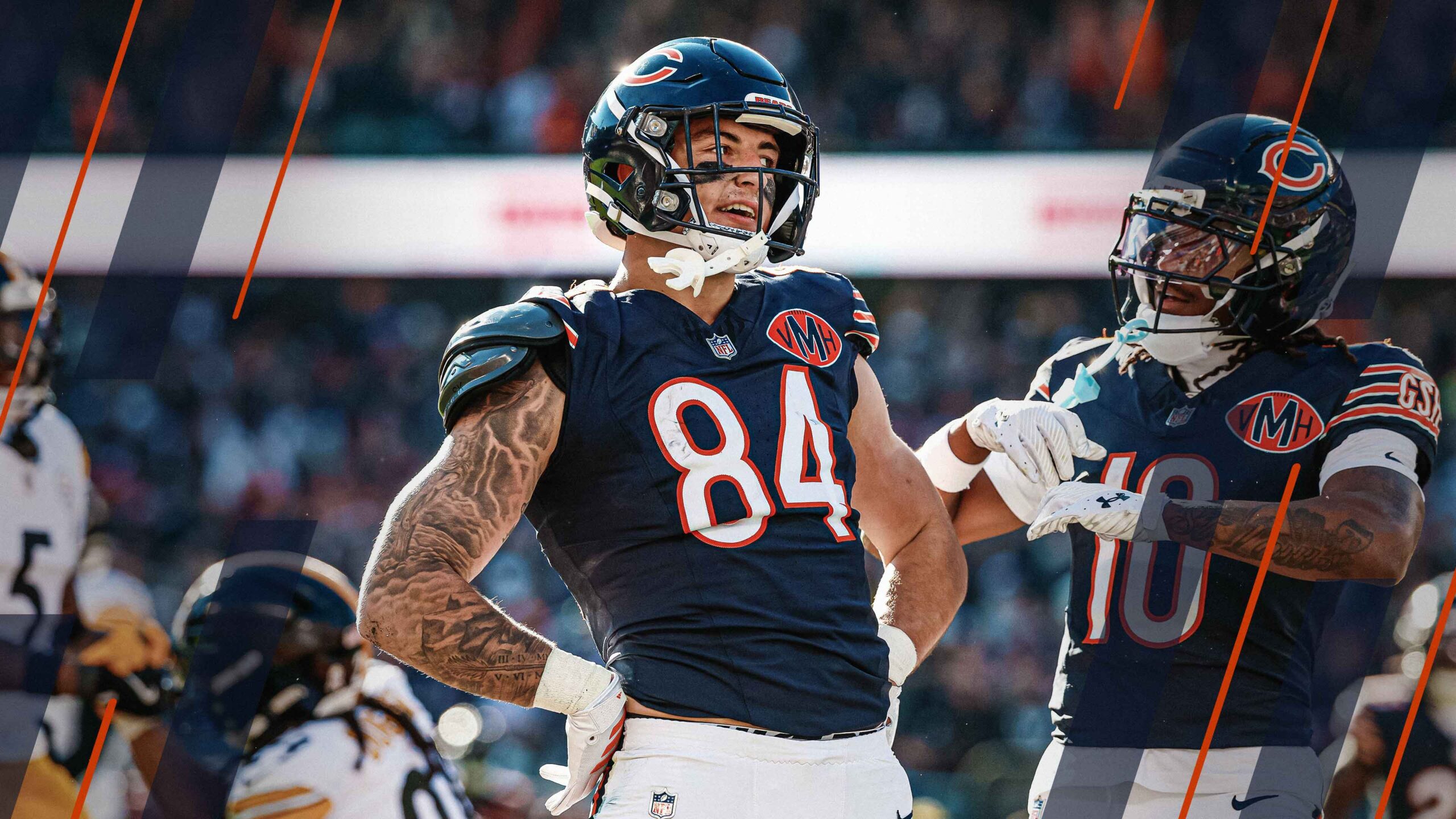
Skill-position players drafted: TE Colston Loveland (10th overall), WR Luther Burden III (39th overall), RB Kyle Monangai (233rd overall)
It took Loveland seven games to log his first NFL touchdown — Week 9 against the Bengals. But from that point on, he was the second-highest-graded tight end in the NFL (85.6, minimum 30 targets), behind only George Kittle.
His six touchdowns in that same stretch were the third most in the NFL. His second-half surge was good enough to land him as the TE12 overall (165.1 points).
Burden experienced a similar slow-burning start to his NFL career. A 101-yard and one-touchdown day against the Cowboys in Week 3 got fantasy managers excited, but he wouldn’t notch another 100-yard game or catch another touchdown until Week 17 at the 49ers (eight catches for 138 and a touchdown).
Among receivers with at least 60 targets, Burden ranked behind only Puka Nacua and Jaxson Smith-Njigba in yards per route run (2.69). He’ll need to clean up his drops (five), but his WR48 finish can be considered his floor, especially if the Bears move on from DJ Moore this offseason.
Monangai had himself a solid NFL rookie season. The seventh-round pick was the grinder to D'Andre Swift’s gashing running style and galloped for 783 yards and five rushing touchdowns while adding 164 yards through the air. It all shook out to Monangai being a dependable RB3 (RB33 overall finish, 142.7 points) and a very capable stand-in when Swift was injured. The Rutgers product averaged a respectable 4.6 yards per carry, 13th in the NFL.
Fantasy points from draft class: 435.7
Cincinnati Bengals
Skill-position players drafted: RB Tahj Brooks (193rd overall)
Brooks was a late-round darling for many fantasy drafters across all formats, but he came out to be just the RB118 overall.
The sixth-round pick handled just 16 carries and gained a meager 45 yards on a Bengals offense that spent much of the season without star signal-caller Joe Burrow and was also being carried in the run game by Chase Brown.
Fantasy points from draft class: 6.4
Cleveland Browns
Skill-position players drafted: RB Quinshon Judkins (36th overall), TE Harold Fannin Jr. (67th overall), QB Dillon Gabriel (94th overall), RB Dylan Sampson (126th overall), QB Shedeur Sanders (144th overall)
This was a fun skill-position class. Sampson (RB54, 89.6 points) took the early shine in the run game while Judkins was away from the team, but both managed to showcase their value. Judkins finished as the RB26 (167.8 points) in a season shortened by off-field issues and then a devastating lower-leg injury.
Judkins’ 3.6 yards-per-carry average isn’t going to blow you away, but the fact that he ground out 735 of his 827 rushing yards after contact behind the Browns' shaky run-blocking offensive line (55.4 PFF grade, 29th in the NFL) speaks to how hard he had to fight for every yard.
The star of this class is Fannin. Only eight tight ends saw 100 targets or more in the regular season, and Fannin was one of them. In fact, he ranked fifth with 104 targets. He parlayed that volume into 72 grabs for 731 yards and six scores and effectively left established tight end David Njoku to find a new home for 2026.
Fannin was just 0.1 point out of the top five at his position for the 2025 season, being narrowly beaten out by another standout rookie, Tyler Warren. But a TE6 finish (188.4) in a Browns offense that had 595 pass attempts (20th in the NFL), recorded just a 10% explosive pass play percentage (31st) and endured inconsistencies at nearly every position (except his own) is a remarkable achievement.
Given that Njoku was the established veteran and that the Browns' offense wasn’t appealing from a fantasy standpoint, Fannin was probably a late-round dart throw. He’s now a lock for a top-10 tight end across all formats.
Gabriel finished as the QB40 (72.1 points), and Sanders performed marginally better from a fantasy standpoint as the QB37 (96.9).
Sanders’ 34.5-point outing against the Titans in Week 14 was the high mark, but his other six starts didn’t see him top 15 points once. And yet, as of right now, he is the best quarterback on the roster and has earned the right to compete for the QB1 job in 2026. But for fantasy managers, he’s probably nothing more than a QB3 or a low-end streaming option.
Fantasy points from draft class: 614.8
Dallas Cowboys
Skill-position players drafted: RB Jaydon Blue (149th overall), RB Phil Mafah (239th overall)
Dynasty general managers who left their rookie draft with Blue were quietly chuckling to themselves. This was the deep sleeper of the draft who would be leading the Dallas backfield by Thanksgiving.
Well, we’re not so smug now. Because 20.4 fantasy points (RB91) and a Javonte Williams (RB12) rejuvenation later, and neither Blue nor Mafah (RB107, 10.9 points) are usable assets.
Quarterback Dak Prescott had the second-most carries for the Cowboys this past season. Blue’s 38 carries show he’s at least more trusted than Mafah (five carries), so he can be stashed, but Mafah can be set free upon the waiver wire.
Fantasy points from draft class: 31.3
Denver Broncos
Skill-position players drafted: RB RJ Harvey (60th overall), WR Pat Bryant (74th overall), TE Caleb Lohner (241st overall)
The good news here is that Harvey had 11 total touchdowns (seven rushing, five receiving), caught 47 balls and finished fourth on the team in targets (57).
The bad news is that his rushing production (146 carries, 540 yards, 3.7 yards per carry) clearly placed him behind J.K. Dobbins, who played only 10 games.
If you’re looking for a reductive, easy comparison, Harvey figures to be the Alvin Kamara of Sean Payton's Broncos offense. In year one, it translated to the second-rounder's RB19 finish (208.6 points).
Bryant was a disappointment early doors. His 31 catches for 378 yards and a single touchdown landed him as the WR85 (74.8 points). His snap count encouragingly rose down the stretch, but then he played just nine snaps in the playoffs due to injury.
Lohner spent the season on the practice squad.
Fantasy points from draft class: 283.4
Detroit Lions
Skill-position players drafted: WR Isaac TeSlaa (70th overall). WR Dominic Lovett (244th overall)
More than one-third of TeSlaa’s catches went for touchdowns. That is upsetting, considering his total production for the 2025 season was 16 catches for 239 yards and six scores.
The third-round pick finished as the WR82 but had four weeks where he could have been a safe WR4 and even snuck into WR2 range down the stretch. He finished as the WR26 in Week 13, the WR31 in Week 14, the WR19 in Week 16 and the WR20 in Week 17.
The rest was bad.
That’s not to say he was bad, though. He wasn’t. TeSlaa had the highest average depth of target (14.8 yards) on a Lions team that features Jameson Williams, a man so fast that pursuit angles turn into straight lines of regret.
He was also reliable. Only two catches didn’t result in a first down or a touchdown. It’s hard to know where the extra targets will come from, but you can bet that TeSlaa has earned some in 2026.
Lovett made the roster as a special teamer and didn’t log a single offensive snap in 2025.
Fantasy points from draft class: 75.9
Green Bay Packers
Skill-position players drafted: WR Matthew Golden (23rd overall) and WR Savion Williams (87th overall)
Back in the sunnier days of August 2025, this very writer said that Matthew Golden would be a WR2 for fantasy rosters right out of the gate.
We don’t need to rehash how wrong that was; just know that lessons have not been learned.
Golden saw just 40 targets and during the regular season, catching 29 for 361 yards and not a single touchdown. He also added 10 rushes for 49 yards. He did take a screen to the house in the Packers’ wild-card loss to the Bears, which convinced us all that he will rumble for 1,200 yards and 10 scores in year two.
The Packers' offense will be one of the units under an intense microscope in 2026, having flipped from insanely efficient to disappearing in an instant.
Matt LaFleur and Jordan Love need to get the 23rd overall pick going early and often in 2026, or questions will, once again and rightly, be asked about the point of spending a first-round pick on a wide receiver who doesn’t feature in the offense.
Golden’s 68.1 PFF receiving grade was steady enough to land him sixth among rookie receivers with at least 30 targets, and his 361 yards were the eighth most out of 15 qualifying rookie receivers. But the expectations were so much more than that and a WR88 finish (70.0 points).
Williams (WR142) looks like a fun player who can be used in many ways. But, much like Golden, you want to see more from someone selected inside the top 100 than just 10 targets (which he caught all of for 78 yards and a touchdown) and 11 rushes on the season.
Fantasy points from draft class: 97.5
Houston Texans
Skill-position players drafted: WR Jayden Higgins (34th overall), WR Jaylin Noel (79th overall), RB Woody Marks (116th overall), QB Graham Mertz (197th overall), TE Luke Lachey (255th overall)
Drafting a wide receiver to a passing game that already features Nico Collins (87.0 PFF receiving grade) and is quarterbacked by C.J. Stroud (70.0 PFF passing grade)? Then, guaranteeing his salary despite his second-round draft stock, giving us extra excitement? Yes please.
Turning that into a WR47 (129.5) finish is less exciting. However, it’s not discouraging. The Texans’ passing attack was troubled throughout most of the season (70.6 PFF grade as a team, 17th in the NFL), and Collins was always going to dominate the target share (117).
But Higgins still notched a respectable 67 targets, converting them into 41 catches for 525 yards and six scores — the joint most on the team with Collins.
Noel (WR91, 68.4 points), Higgins’ Iowa teammate, was more disappointing. The third-rounder logged just 214 receiving snaps across 17 games and had five games where he didn’t even register a target and just three games where he cleared 50 receiving yards.
Marks (69.6 PFF rushing grade) was an unsung hero of many fantasy seasons. Although he entered the year as the third back behind Joe Mixon and Nick Chubb (74.6 PFF rushing grade), Marks was the starter by Week 10.
He logged 20 carries in just one game, and he found the end zone only twice. Among 29 qualifying backs, only Kyle Monangai and Tyrone Tracy Jr. had fewer than his 27 missed tackles forced.
But putting up 145.1 points, having five top-20 weekly positional finishes (including being the RB6 in Week 4 with 27.9 points) meant Marks was the overall RB30 — nothing to scoff at.
Mertz and Lachey didn’t log a single offensive snap in 2025.
Fantasy points from draft class: 343.0
Indianapolis Colts
Skill-position players drafted: TE Tyler Warren (14th overall), RB DJ Giddens (151st overall), QB Riley Leonard (189th overall)
Warren finished as the TE5 (188.5 points) after commanding the third-most targets at the position (106) and the second-most targets among Colts players. He converted those into 817 yards — second on the Colts and fifth at his position — and four touchdowns (third on the Colts). He also added six rushes for eight yards and a touchdown.
All that to say, he was a great fantasy asset.
Only Cardinals star Trey McBride tallied more yards after the catch than Warren at the tight end position in 2025, and not a single one of his peers averaged more than Warren’s 6.4 yards after the catch per reception. He was also a great chess piece for head coach Shane Steichen, who had Warren go in motion on 123 of his snaps — the ninth most at his position.
Like fellow rookie Harold Fannin Jr., Warren is a set-and-forget tight end at every level in every format.
The same cannot be said for his skill-position draft classmates.
Giddens (61.3 PFF rushing grade) didn’t have much chance to show what he could do, given the presence of Jonathan Taylor (84.1 PFF rushing grade) in the backfield. His 26 attempts mustered just 96 yards. It was no surprise then that he finished as the RB110 with just 9.6 points.
Leonard (QB48) flashed some promise in his Week 18 start against the Texans, going 21 of 34 for 270 yards for a pair of touchdowns and a pick. He also ran for 21 more yards and another touchdown. That outing alone accounted for 25.9 of his 36.3 fantasy points.
Prior to that, however, the only other game where he had more than two dropbacks was against the Jaguars in Week 14, and it was rough. Leonard completed 18 passes for 145 yards and a pick (53.6 PFF passing grade). He ended the season with six big-time throws to six turnover-worthy players, including one against the Titans in which he attempted only two passes.
Fantasy points from draft class: 234.4
Jacksonville Jaguars
Skill-position players drafted: WR Travis Hunter (2nd overall), RB Bhayshul Tuten (104th overall), RB LeQuint Allen (236th overall)
Hunter's value (WR96) was all over the place heading into fantasy drafts because you simply couldn’t predict how many offensive snaps he would play. And then, after seven games, he was shut down for the season with a knee injury.
Before that, though, Hunter (62.7 PFF receiving grade) managed to command 45 targets, the second most on the team, behind Brian Thomas Jr. (66.7 PFF receiving grade), and matched his running mate in catches with 29.
Before injury curtailed his season, Hunter was coming off an eight-catch, 101-yard game against the Rams in which he also found the end zone. Alas, he ended his season with just 63.8 fantasy points.
The Jaguars' receiver room is crowded with Parker Washington (83.0 PFF receiving grade) and Jakobi Meyers (77.6 PFF receiving grade with Jacksonville), acquired mid-season in a trade with the Raiders, meaning Hunter will probably spend more time at cornerback in 2026.
Tuten (RB53) was a fun find and will surely top 100 fantasy points next season (90.6 points in 2025). If Travis Etienne (73.1 PFF rushing grade) leaves during free agency, the fourth-rounder may find more touches available in 2026 as Liam Coen continues to work his offensive wizardry.
Tuten racked up 267 yards after contact — a large portion of his 307 total rushing yards — showcasing his excellent balance once hit. And his 3.22 yards after contact per attempt ranked 14th in the NFL among qualifying running backs.
Allen (RB88) is not a usable fantasy asset unless a series of injuries strikes the Jaguars' running back room. He notched just 23 carries and 10 catches in 2025 for 24.8 points.
Fantasy points from draft class: 179.2
Kansas City Chiefs
Skill-position players drafted: WR Jalen Royals (133rd overall), RB Brashard Smith (228th overall)
We had such high hopes for Royals entering the season. Given that Rashee Rice missed the first six games of the campaign, Travis Kelce was showing obvious signs of slowing down and Xavier Worthy was more of a deep specialist, the door was, seemingly, open for Royals to carve out a role for himself in the Chiefs' offense.
He finished the regular season with 38 offensive snaps, three targets and two catches for four yards. That made him the WR215 with 2.4 fantasy points. Moving on.
Smith (RB61) carved out a much better role for himself in the Kansas City offense, although the bar is so low that tripping over it is still possible.
Smith registered 44 carries, 20 fewer than Patrick Mahomes, and his season ended three games short due to a torn ACL. He ended up with 151 yards and 25 catches for 172 yards and a touchdown, resulting in 63.3 fantasy points.
His 3.4 yards per carry average also ranked second to last across the Kansas City running back room. Isiah Pacheco (67.4 PFF rushing grade) paced the backfield with 3.9 yards per carry, so it was obviously not pretty.
If the Chiefs decide to inject some much-needed juice into their run game this offseason — Jeremiyah Love has often been mocked to them and is currently the sixth overall player on the PFF Predictive Big Board — then Smith instantly becomes a droppable asset in all formats.
Fantasy points from draft class: 65.7
Las Vegas Raiders
Skill-position players drafted: RB Ashton Jeanty (6th overall), WR Jack Bech (58th overall), WR Dont'e Thornton Jr. (108th overall), WR Tommy Mellott (213th overall), QB Cam Miller (215th overall)
Was Jeanty (70.4 PFF rushing grade) a fantasy bust? The short answer is “yes” with an if. The long answer is “no” with a but.
If you drafted Jeanty expecting him to be a top-five fantasy running back right out of the gate, then yes — his RB11 finish (247.1 points) probably burned you.
But if you took Jeanty knowing that no matter how polished a prospect he was coming out, the transition to the NFL could take time and the Raiders' offensive line was not in the best position to help, then no, he has not been a bust. But you shall expect better as time goes on.
Jeanty’s 0.6 yards per carry before contact ranked joint second to last in the NFL among qualifying backs, along with Zach Charbonnet (85.9 PFF rushing grade). Only Quinshon Judkins had it worse (0.4).
The Raiders also ran the ball just 36.3% of the time, 28th in the NFL, and when the box was stacked with eight or more defenders, he handled just 125 attempts, 31st in the league.
Jeanty salvaged his fantasy season in the passing game, snatching 55 balls for 346 yards and five touchdowns.
Unfortunately, Bech (61.2 PFF receiving grade) couldn’t salvage anything from his season. The second-rounder pick logged just 28 targets — fewer than Tyler Lockett’s 32 after he joined in Week 9 from the Titans.
The high mark of Bech’s season was a six-catch, 50-yard game in Week 14 against the Broncos. It was expected that he might be a fantasy sleeper with potential deep-stash status in dynasty leagues. But the WR119 finish he charted this season, with just 42.4 points, is truly bleak.
Not as bleak as Thornton’s season, however. He, too, logged more targets than Bech (30) but parlayed that into only 10 catches for 135 yards.
Although Thornton's 13.5 yards per catch and insane average depth of target (17.9 yards) paced the Raiders' pass catchers as a whole, it was not enough to be anything more than the WR148 with just 23.5 points.
Mellott and Miller didn’t log a single offensive snap.
Fantasy points from draft class: 313.0
Los Angeles Chargers
Skill-position players drafted: RB Omarion Hampton (22nd overall), WR Tre Harris (55th overall), WR KeAndre Lambert-Smith (158th overall), TE Oronde Gadsden II (165th overall)
Hampton was restricted to just nine games in 2025 due to injury, but he looked like a star almost immediately. The 22nd overall pick averaged 4.4 yards per carry on 124 rushes, ran in four touchdowns and logged an 84.8 PFF rushing grade — eighth best among backs with at least 120 carries.
He also added 32 catches for 192 yards and a further score to punctuate a highly encouraging first season. The RB35 (135.7 points) finish doesn’t do justice to how good Hampton looked on the field, and if he can manage a full season in 2026, he will be pushing to be a fantasy RB1.
Like Ashton Jeanty, Hampton had to do so much of the work after contact. He averaged just 1.0 yards before contact per attempt (34th out of 44 qualifying backs) and averaged 3.4 yards after contact per attempt (joint 10th best with Zach Charbonnet).
The Chargers may have found themselves another star in Gadsden (71.5 PFF receiving grade). The fifth-round tight end had an inconsistent season, with more games with one target (five) than he had with five or more targets (four).
But he still managed to rumble for 664 yards on 49 catches and add three touchdowns. Gadsden ranked third on the team in yards per catch (13.6) and led the team, along with Keenan Allen (77.6 PFF receiving grade), with 1.66 yards per route run.
Finishing as the TE15 (133.4 points) is commendable, given Gadsden was fighting for targets with Allen and Ladd McConkey (69.1 PFF receiving grade). If Allen decides to retire or leave in free agency, then 118 targets are suddenly up for grabs and a top-10 fantasy tight end finish is not out of the question for Gadsden.
Second-rounder Tre Harris (67.0 PFF receiving grade) had a disappointing season by fantasy metrics, logging just 30 catches for 324 yards and a single touchdown, making him the WR90 (69.4 points).
Pre-season darling Lambert-Smith (58.6 PFF receiving grade) contributed just five catches for 51 yards and a touchdown. His 16.1 fantasy points landed him as the WR162.
Fantasy points from draft class: 354.6
Los Angeles Rams
Skill-position players drafted: TE Terrance Ferguson (46th overall), RB Jarquez Hunter (117th overall), WR Konata Mumpfield (242nd overall)
Ferguson (64.4 PFF overall grade) was a trendy pick across the fantasy landscape. The Rams spent a top-50 pick on him and appeared to need a tight end upgrade. Plus, he had Sean McVay as his play-caller.
Unfortunately, it was a false start for Ferguson and his fantasy managers. The Oregon product collected just 11 passes for 231 yards and three touchdowns, finishing as the TE52 (52.1 points).
Averaging 21.0 yards per catch is, of course, absurd. And turning nearly a quarter of your catches into touchdowns is Isaac TeSlaa levels of efficiency in the red zone, but volume is so often king in fantasy.
Mumpfield worked himself into more playing time in the final weeks of the season, but with Puka Nacua (96.2 PFF receiving grade) and Davante Adams (84.1 PFF receiving grade) dominating the targets, it’s hard for anybody else to get a look, let alone a seventh-rounder.
But Mumpfield's 10 catches for 92 yards and a touchdown was a solid contributing effort, even if basically useless for fantasy. He finished as the WR146 with just 25.2 points.
Hunter didn’t have a touch in 2025.
Fantasy points from draft class: 77.6
Miami Dolphins
Skill-position players drafted: RB Ollie Gordon II (179th overall), QB Quinn Ewers (231st overall)
Gordon (70.0 PFF rushing grade) was absolutely fine as a thunder to De'Von Achane’s (91.0 PFF rushing grade) lightning. The problem is that when Achane is your running mate, you aren’t going to get many touches.
And Gordon did not. He had 70 attempts for 199 yards and three scores. He finished as the RB68 (54.1 points) and had just one weekly finish inside the top 20 — in Week 8 against the Falcons, which was propped up by a 20-yard touchdown on a screen.
Ewers (40.5 PFF passing grade) had a respectable outing in Week 17 against the Buccaneers (14 of 22 for 172 and two scores), but outside of that, he made just two big-time throws and five turnover-worthy plays.
He finished as the QB49 (35.8 points) and will likely be fantasy relevant only in an injury crisis.
Fantasy points from draft class: 89.9
Minnesota Vikings
Skill-position players drafted: WR Tai Felton (102nd overall), TE Gavin Bartholomew (202nd overall)
Felton (59.3 PFF receiving grade) saw just three targets, and he caught all of them for 25 yards. He finished as the WR194 with 5.5 points.
That’s about as much as we can give you for this duo. Bartholomew didn’t log a single target.
Fantasy points from draft class: 5.5
New England Patriots
Skill-position players drafted: RB TreVeyon Henderson (38th overall), WR Kyle Williams (69th overall), K Andres Borregales (182nd overall)
Henderson (75.0 PFF rushing grade) ended the regular season leading the Patriots in carries (180), rushing yards (911) and rushing touchdowns (nine). And yet, it still felt like there was meat left on the bone for the second-round pick.
Among running backs with at least 175 carries, Henderson tied with Bijan Robinson (83.4 PFF rushing grade) in yards per carry (5.1). He also ranked ninth among qualified backs with 1.6 yards before contact per attempt, tied with Derrick Henry (79.4 PFF rushing grade).
The RB20 (208.2 points) finish was impressive, given that he didn’t get more than 11 carries in a game until Week 9 and that he wasn’t supplementing his production with elite pass-catching work, grabbing 35 balls for 221 yards and a single score.
Williams (61.7 PFF receiving grade) was a wild card for the Patriots. Entering camp, there was a real possibility he could fight for a WR2 role opposite Stefon Diggs (87.5 PFF receiving grade) right out of the gate. Alas, he caught just 10 passes for 209 yards and three touchdowns. He ended as the WR111 with 49.2 points. Another year in the offense could yield more, but it makes him an unstable fantasy asset.
Borregales (71.4 PFF field-goal grade) ended the season tied for the K10 overall (149.0 points). He nailed 53 of his 55 extra points and made 27 of his 32 field goal kicks, including all four from 50 yards or longer.
Fantasy points from draft class: 406.4
New Orleans Saints
Skill-position players drafted: QB Tyler Shough (40th overall), RB Devin Neal (184th overall)
Shough (73.1 PFF passing grade) started the season as the backup to Spencer Rattler (66.1 PFF passing grade) but quickly showed he belonged in the NFL when he got his first start against the Rams in Week 9.
His ratio of 10 touchdowns to six interceptions isn’t eye-popping. Nor are his 13 big-time throws against eight turnover-worthy plays. But across his nine starts, he finished as at least a viable QB2 in all of them and had three weeks (14, 17 and 18) where he was a top-10 weekly quarterback. It was all enough to make him the QB26 (166.0 points) by season’s end. Had he started all 17 games, he’d have been a solid QB2 in all formats.
Among quarterbacks with at least 350 dropbacks, Shough earned a better PFF passing grade than Caleb Williams (71.1), Patrick Mahomes II (70.7) and C.J. Stroud (70.0), to name just three.
He also protected the ball well. From Week 9 onward, only Joe Burrow (0.8%), Stroud (1.3%), Jared Goff (1.4%), Kirk Cousins (1.9%) and Aaron Rodgers (2.1%) had a lower turnover-worthy play rate than Shough (2.2%).
Neal wasn’t given a chance to shine until Week 10 against the Panthers, the first time he logged double-digit snaps.
When the opportunity did come, he was hard-pressed to find great success. Of 49 qualifying running backs since Week 10, Neal ranked 49th in PFF rushing grade (63.0), his average of 3.6 yards per carry tied for 40th and he had just three runs of over 10 yards (48th out of 49).
He finished as the RB64 (60.0 points). Maybe if Alvin Kamara moves on, he will see an uptick in work, but there is every chance he didn’t flash enough on limited opportunities to stop the Saints from adding competition to the backfield in 2026.
Fantasy points from draft class: 226.0
New York Giants
Skill-position players drafted: QB Jaxson Dart (25th overall), RB Cam Skattebo (105th overall), TE Thomas Fidone II (219th overall)
Has a rookie class ever threatened to be so good for fantasy purposes before injuries ripped it away from us? There will surely be some examples, but we’re going for some dramatic effect here.
From Week 4, when Dart got the starting gig, to the end of the season, the rookie passer registered a pretty pedestrian 64.8 PFF passing grade with 19 big-time throws and 15 turnover-worthy plays.
But it wasn’t the passing that made him special. Dart’s 75.3 PFF rushing grade ranked seventh among all quarterbacks with at least 50 rushing attempts, and he rumbled for 487 yards (third at the position) at 5.7 yards per carry (fifth among qualifying quarterbacks) and nine rushing touchdowns.
Dart finished as the QB14 (248.6 points) and would have probably been a solid QB1 option had he started from Week 1 and been able to avoid concussions with safer running.
That same running style could also be attributed to backfield mate Cam Skattebo. The fourth-rounder suffered a nasty lower-leg injury in Week 8 against the Eagles, ending a promising rookie campaign.
Among players with at least 100 attempts through the first eight weeks of the season, Skattebo was the third-highest-graded rusher (81.0), behind only James Cook (90.4 PFF rushing grade) and Jonathan Taylor (83.4 PFF rushing grade).
Though his running style is punishing, he also has some wiggle to him, forcing 22 missed tackles (tied for 11th among qualifying rushers).
He ended the season as the RB37 (127.7 points), but before the injury, the rookie rusher was the RB8. Once he returns to the field, he’ll surely be taking the job back from Tyrone Tracy Jr.
Fidone didn’t log a single offensive touch in 2025.
Fantasy points from draft class: 376.3
New York Jets
Skill-position players drafted: TE Mason Taylor (42nd overall), WR Arian Smith (110th overall)
Taylor (60.0 PFF receiving grade) paced the Jets in targets (62) and catches (44) and still finished 26 yards behind Garrett Wilson, who played in only seven games and was shut down after Week 10.
The second-round selection from LSU finished as the TE32 (86.9 points), and he was considered a bright spot for the offense.
The Jets' passing attack was truly anemic, logging a 30th-ranked team PFF grade (51.1). Their 2,784 passing yards ranked dead last in the NFL — and 368 behind the next-worst team, the Browns.
Not great.
But it was better than Smith, who saw only 15 balls thrown his way all season and caught seven for 52 yards and not a single score. It meant he finished as the WR173 on the season (13.5 points).
Fantasy points from draft class: 100.4
Philadelphia Eagles
Skill-position players drafted: QB Kyle McCord (181st overall)
McCord did not play an offensive snap for the Eagles. Moving on.
Fantasy points from draft class: 0.0
Pittsburgh Steelers
Skill-position players drafted: RB Kaleb Johnson (83rd overall), QB Will Howard (185th overall)
This one hurts. I once suggested that Johnson would be a set-and-forget running back down the stretch who could power rosters to championships.
He finished his rookie season with 28 carries for 69 yards and one catch for nine yards. Again, we will learn nothing. Nearly one-third of those yards came in a Week 4 tussle against the Vikings when he turned six carries into 22 yards. It was a bleak high mark.
He finished as the RB113 with just 8.8 points.
Howard didn’t play for the Steelers this season.
Fantasy points from draft class: 8.8
San Francisco 49ers
Skill-position players drafted: WR Jordan Watkins (138th overall), RB Jordan James (147th overall), QB Kurtis Rourke (227th overall), WR Junior Bergen (252nd overall)
It feels like we’re ending this list how we started it: with some bleak rookie fantasy campaigns.
Watkins saw just three targets across the four games he featured in, and he caught two for 26 yards. His WR196 finish (4.6 points) means you can probably leave him on waivers for now. Meanwhile, James missed all of the season through a combination of injuries, according to head coach Kyle Shanahan in November.
Rourke and Bergen did not take a single offensive snap all season.
Fantasy points from draft class: 4.6
Read More Stories Explore PFF Tools 16 min read Quick Read While running back injuries may cause panic for dynasty fantasy football managers, history tells us that it's not all doom and gloom. Fantasy Football: How do running backs perform after serious injuries? By Ryan Conway 13 min read Quick Read Nathan Jahnke reveals his top 60 rookies for dynasty superflex leagues. Fantasy Football Rankings 2026: Top 60 rookies for dynasty superflex leagues By Nathan Jahnke Try the tool Mock Draft Simulator Make picks, trade up, and run your own draft in minutes. Build your board Big Board Builder Create custom rankings with Scouting Mode at the core. Subscribe For Full Access Mock Draft Simulator Be the GM for any team in the 2026 NFL Draft with a fully immersive simulation that lets you trade picks and players for a realistic, in-depth draft experience. Customizable Draft Big Board Trevor Sikkema’s Take control of your rankings with a customizable big board that lets you add players, share with friends, export to CSV and save your personalized list. Scouting Assistant Master the evaluation process with a customizable grading system built for serious scouts. Choose your own scouting categories, assign 0–10 grades in each area and generate a finalized prospect grade tailored to your criteria. NCAA Premium Stats Our exclusive database, featuring the most in-depth collection of NCAA player performance data. Subscribe For Full AccessSeattle Seahawks
Skill-position players drafted: TE Elijah Arroyo (50th overall), QB Jalen Milroe (92nd overall), WR Tory Horton (166th overall), RB Damien Martinez (223rd overall), WR Ricky White III (238th overall)
Arroyo (52.3 PFF receiving grade) was seen as an explosive tight end threat who could have really eaten into AJ Barner’s snap count. Alas, that did not happen. The second-round pick from Miami registered just 15 catches for 179 yards and a single touchdown.
Tight end has been known as a notoriously difficult position at which to transition from college to the NFL, so perhaps Arroyo will see more success in year two and progress from a TE58 (38.9) finish.
Then again, with Jaxon Smith-Njigba (93.1 PFF receiving grade) dominating the target share (157 in 2025), he may be relegated to a bit-part role that doesn’t translate well for fantasy.
The same can be said of Horton (69.1 PFF receiving grade). The fifth-round pick impressed in his limited role, catching 13 passes for 161 yards and five touchdowns.
Those scores were enough to sneak Horton into the top 100 at his position in fantasy (WR98, 59.1 points).
But if there aren’t enough targets to go around, it makes Horton hard to trust in a fantasy setting, especially if Seattle locks down mid-season trade acquisition Rashid Shaheed (61.7 PFF receiving grade with the Seahawks) on a long-term deal.
Meanwhile, White and Martinez didn’t feature for the newly crowned champions, while Milroe (26.4 PFF overall grade) had three rushing attempts for four yards and one fumble. He finished as the QB72 with 0.4 points, one spot ahead of Anthony Richardson Sr.
Fantasy points from draft class: 98.4
Tampa Bay Buccaneers
Skill-position players drafted: WR Emeka Egbuka (19th overall), WR Tez Johnson (235th overall)
Egbuka (68.5 PFF receiving grade) finished the 2025 regular season with the most targets (126) out of the rookie receiver class, the second-most yards (938) and tied for the second-most touchdowns (six).
The 19th overall pick started the first five weeks of the season on fire with 445 yards (fourth most in the NFL among qualifying wideouts) and five touchdowns, tying him for second with Rome Odunze (71.0 PFF receiving grade) and George Pickens (87.2 PFF receiving grade).
While Egbuka’s average depth of target (13.2 yards) was fourth highest at his position (minimum 100 targets), he averaged 5.2 yards after the catch per reception, third highest in the league. Not only was he getting downfield, but he managed extra yards with the ball.
Though he recorded only a single 100-yard receiving game after Week 5's seven-catch, 163-yard and one-touchdown outing against Seattle, he did enough across the season to finish as the WR24 (193.7 points) — right at the tail end of WR2 territory.
Johnson (64.3 PFF receiving grade), conversely, did nothing for the first month of the season, then started to work his way into a respectable role within the Tampa Bay offense.
A late seventh-round selection, Johnson hauled in 28 of his 42 targets for 322 yards and five scores. If you were forced into starting him in Week 10 against the Patriots, well done; his 20.2 points were enough to make him the week's WR10.
Johnson will never be a target hog, but he’ll probably give you at least one game a year where he finishes as a WR1 in fantasy. It’s just luck of the draw (or desperation).
But his WR66 (92.4 points) finish was ahead of some surprising names, such as Xavier Legette and Ricky Pearsall. While they battled various injuries throughout the campaign, they are both former first-round picks whose teams were trying to feature them much heavier than the Buccaneers were with Johnson until he forced their hand.
Fantasy points from draft class: 286.1
Tennessee Titans
Skill-position players drafted: QB Cam Ward (1st overall), WR Chimere Dike (103rd overall), TE Gunnar Helm (120th overall), WR Elic Ayomanor (136th overall), RB Kalel Mullings (188th overall)
What a class. This is not sarcasm. I am a Cam Ward believer, and Ayomanor (62.8 PFF receiving grade) proved to be a very nice find for both the Titans and fantasy managers who might need a WR4 with the potential for a WR2 week.
The first overall pick was dealt a tough hand in 2025. Ward finished dead last among quarterbacks with at least 340 dropbacks in PFF passing grade (56.4). The Titans' receiving unit as a whole placed 30th in the NFL with a 67.3 PFF grade — ahead of only the Browns (62.2) and Jets (60.8).
The Titans' offensive line also gave up the second-most sacks (35), the 12th-most hurries (127) and the ninth-most pressures (183). Some of that is on Ward, whose average time to throw was 3.00 seconds.
Ward finished as a very low-end QB2 (QB22 overall, 207.7 points). If the Titans can find him a high-volume pass-catching target in the offseason and solidify the offensive line, then he could be a solid QB2 with QB1 upside.
Some help came in the form of Ayomanor, Dike (65.1 PFF receiving grade) and Helm (69.3 PFF receiving grade). They were three of the top four target getters in the Tennessee offense, with Ayomanor, a fourth-round selection, pacing the team in targets (86) and tying with Dike in touchdowns (four).
The pair of receivers were going stride for stride trying to help the Titans produce something through the air, but WR53 (116.5 points) and WR54 (116.1 points) finishes, respectively, showcase that it was not a fantasy goldmine. Meanwhile, Helm finished as the TE31 with 91.7 points.
By this time next year, it is realistic to expect those players to have slipped down the pecking order of some kind, unless the Titans refuse to add to the receiving room or one of them takes an enormous step forward and stands out as Ward's No. 1 target.
Let’s stick Carnell Tate (88.6 PFF overall grade and seventh on the PFF Predictive Big Board) on the Titans and see what happens.
Mullings had just three carries for seven yards on the season, finishing as the RB140 with 0.7 points.
Fantasy points from draft class: 532.7
Washington Commanders
Skill-position players drafted: WR Jaylin Lane (128th overall), RB Jacory Croskey-Merritt (245th overall)
With Terry McLaurin (87.0 PFF receiving grade), Deebo Samuel (70.3 receiving grade) and Zach Ertz (63.3 receiving grade) already on the roster, the chances of Lane (59.7 receiving grade) breaking into the receiving room and making a sizable impact were slim in 2025.
He logged just 16 catches for 225 yards and no touchdowns, culminating in a WR121 finish and just 39.2 fantasy points.
His production was almost certainly not helped by the rotation of Jayden Daniels (73.8 PFF passing grade), Marcus Mariota (72.3 PFF passing grade) and Josh Johnson (55.4 PFF passing grade) at quarterback, but the same could be said of the entire Washington offense.
Croskey-Merritt (75.4 PFF rushing grade), a seventh-rounder, led the team in rushes (175), rushing yards (805) and rushing touchdowns (eight).
Through the first four weeks of the season, Croskey-Merritt was the NFL's highest-graded qualifying rusher with an elite 90.6 mark — clear of James Cook’s excellent 82.5 PFF grade. A late-round dart throw in a lot of leagues and a waiver-wire pick-up in others, Croskey-Merritt was supposed to take us all to the championship.
Then the wheels came off a bit. After racking up 111 rushing yards and two touchdowns against the Chargers, the rookie rusher went on to top 50 yards on the ground just once until Week 15, when he logged 96 against the Giants.
He finished strong in the fantasy championship game for many in Week 17, with 105 yards and two scores on the ground against a porous Cowboys defense.
However, the Washington back still ended the season averaging 4.6 yards per attempt, 13th in the NFL among qualified backs, and his 3.50 yards after contact per attempt ranked sixth.
He has certainly done enough to earn the first crack at the starting job in 2026, and it helps that the Commanders are paying him peanuts, so his RB31 mark in 2025 (144.3 points) could easily go into the 20s and see him as a viable RB2 — especially if Daniels is healthy for a full season.
Fantasy points from draft class: 183.5