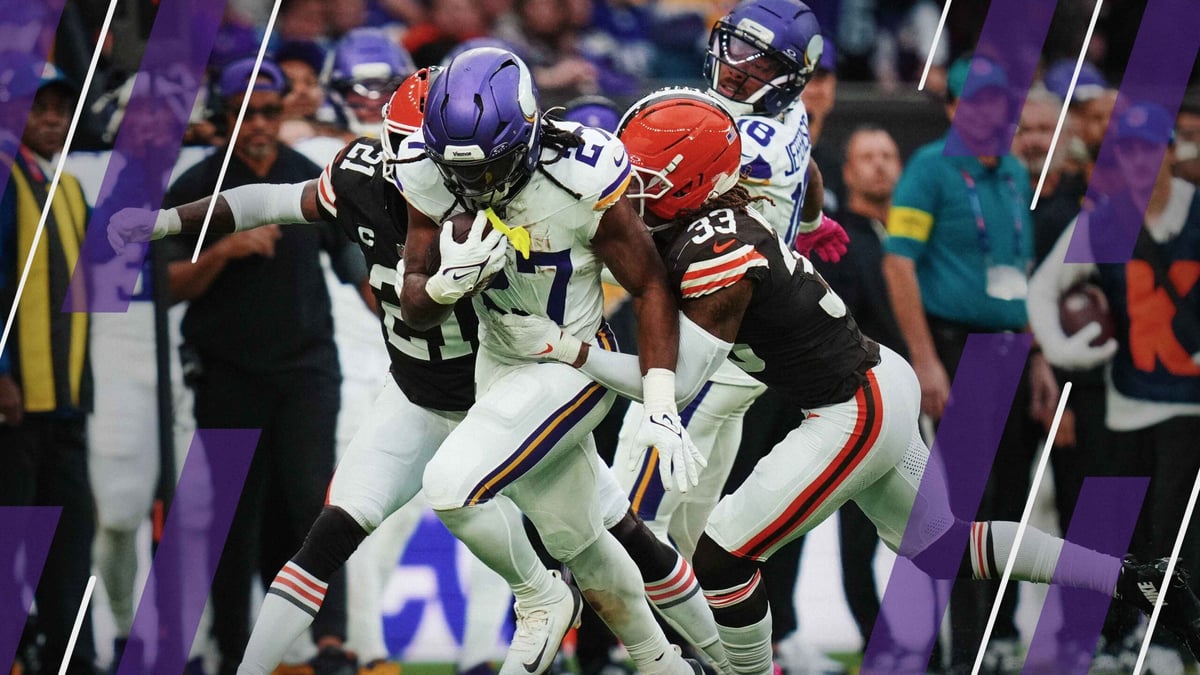
- Chris Rodriguez Jr. could own the goal-line work: Rodriguez is a bigger back than Bhayshul Tuten and LeQuint Allen, which should help him win short-yardage work in a potentially high-scoring offense.
- Practice with PFF's Mock Draft Simulator: Run your own reps with your exact league settings, then put this round-by-round plan into action before draft day.
Regardless of whether a fantasy manager employs a Zero-RB, Hero-RB or Robust-RB strategy, it makes sense to target at least one late-round running back with a realistic path to a starting role. By the 11th round, most of the league's projected starters are long gone, but every season, a handful of overlooked backs emerge as league-winning values. Last year, Javonte Williams, Rico Dowdle and Kenneth Gainwell were all available in the late rounds and went on to finish among the top 20 fantasy running backs.
The goal isn't necessarily to find a Week 1 starter. It's to identify players whose roles could expand dramatically if circumstances break their way.
Below are five running backs currently being drafted in the 11th round or later who have the potential to become weekly must-start fantasy options in 2026.
Last updated: Thursday, Aug. 27
Jordan Mason, Minnesota Vikings (ADP: 11.05)
Mason has been one of the top running backs in the NFL since joining the league in 2022. His 91.3 rushing grade over the last four seasons ranks 10th among all running backs. He has averaged 5.1 yards per carry and 3.4 yards after contact per carry, and he has generated a first down or touchdown on 26.6% of his runs. Those marks all rank third among the 56 running backs with at least 300 carries. He is the only running back in that group to have earned a positive play-level grade on over half of his runs.
That has translated to fantasy success when he has been his team's lead back. He was RB10 in PPR leagues over the first seven weeks of 2024 with the San Francisco 49ers while Christian McCaffrey was injured, and he averaged 14.5 PPR points per game in his four starts last season with Minnesota, 16th-best among running backs during that span.
He and Aaron Jones return to the Vikings, where they will likely continue to share the backfield, with Mason handling more early-down work and Jones taking third-down work. Jones has missed at least five games in two of the last three seasons and, at 31 years old, is the second-oldest back expected to make a 53-man roster. Chances are, Mason will be the primary running back for some stretch of 2026.
The Vikings' offense should be much improved with Kyler Murray at quarterback, which should help Minnesota climb from 26th in scoring in 2025 toward the top half of the league. Mason should see the majority of goal-line carries, so a better offense should directly lift his fantasy production, including more fourth-quarter running opportunities, a category where Minnesota was below average last season.
The offensive line should also be healthier. Four-fifths of it missed at least three games each last season, adding to the unit's instability throughout the year. Ryan Kelly's retirement doesn't help, but Minnesota retained the five linemen who started the most games for them last season. A healthier offensive line should help Mason’s efficiency.
Mason shouldn't be relied on as a Week 1 fantasy starter, but he is one of the top handcuff options in fantasy, with real standalone value even if Jones stays healthy.
Chris Rodriguez Jr., Jacksonville Jaguars (ADP: 13.12)
Rodriguez was a sixth-round pick by Washington in 2023. He initially served as the third-string back behind Brian Robinson Jr. and Antonio Gibson, running just 51 times as a rookie but averaging 4.8 yards per carry. He fell to fourth on the depth chart in 2024 behind Robinson, Austin Ekeler and Jeremy McNichols, leaving him without a role for most of the season. His carry total dropped to 35, but he stayed effective, averaging 4.9 yards per attempt.
He again looked like the odd man out in 2025 after Jacory Croskey-Merritt was drafted in the seventh round. But Robinson was traded, Ekeler was hurt early in the season and Croskey-Merritt's efficiency declined, opening the door for Rodriguez to take over the starting job in Week 10. He missed two games late in the year with an injury but had double-digit carries in each of his final five.
Rodriguez has averaged 3.6 yards after contact per carry over the past three years, second-best among running backs with at least 150 carries. His 28.3% first-down rate also ranks second, and his 0.25 avoided tackles per attempt are tied for fifth. He has earned a +1.0 rushing grade or better on 6.6% of his carries, the third-highest rate behind Raheem Mostert and Jahmyr Gibbs. His rushing efficiency suggests he could be an excellent fantasy back with more volume, but the Commanders never used him as a receiver, as he caught just six passes in 35 career games.
Rodriguez signed with the Jaguars in free agency, reuniting with his former college coach, Liam Coen. He will compete for playing time with Bhayshul Tuten and LeQuint Allen. Tuten has the best chance to lead the team in fantasy points as the one back most likely to see significant volume as both a rusher and a receiver, but Rodriguez has been the more efficient runner. He is also notably bigger than Tuten and Allen, which could earn him goal-line carries in what may be a high-scoring offense.
There is a chance Tuten leads the Jaguars' backfield in fantasy points, and also a chance the offense plays well enough to support two fantasy-relevant backs. That makes Rodriguez an intriguing late-round option.
Keaton Mitchell, Los Angeles Chargers (ADP: 16.01)
Mitchell entered the league as an undrafted rookie with the Baltimore Ravens in 2023 and received his first carry in Week 9 of his rookie year. Over the following six weeks, he recorded 47 carries for 396 yards and two touchdowns, averaging 8.4 yards per carry and at least 6.0 in five of those six games. A significant ACL injury late in 2023 sidelined him for much of 2024 and clearly affected his play upon his return. By 2025, he had settled in as Derrick Henry's primary early-down backup, averaging 5.8 yards per carry on a limited 4.5-carry per-game workload.
Mitchell signed with the Los Angeles Chargers this offseason, joining a backfield that also includes 2025 first-round pick Omarion Hampton and Kimani Vidal, who played well in Hampton‘s absence last season. Despite his down 2024 campaign, Mitchell earned the highest PFF grade of the trio over the past three seasons, including the top receiving grade.
He is also the running back most closely tied to new offensive coordinator Mike McDaniel's preferred archetype. McDaniel brought Mitchell to Los Angeles himself, while Hampton and Vidal are holdovers. More importantly, Mitchell most closely resembles McDaniel's previous featured back, De'Von Achane. Achane, Mitchell, and Jaleel McLaughlin are the only running backs 5-foot-8 or shorter and 200 pounds or lighter to log at least 300 snaps over the past three seasons. That group joins Isiah Pacheco, Ty Chandler, Latavius Murray, and former McDaniel back Raheem Mostert as the only backs to run both a sub-4.40 40-yard dash and a sub-1.50 10-yard split at the combine while recording at least 300 snaps in a season.
The first week of the preseason was also encouraging for Mitchell, as he sat out alongside the starters. He played in the second preseason game, but only for two drives. There had been some concern that Kimani Vidal might remain the primary backup, but Vidal played while Mitchell sat in the opener and didn’t enter the second game until after Mitchell’s final snap. That usage suggests Mitchell is the clear second option on the depth chart.
Given those similarities to Achane, there is a real chance McDaniel ultimately prefers Mitchell over his other options. If Mitchell approaches Achane's level of production, he offers top-10 upside at the position.
Najee Harris, New York Giants (ADP: 20.10)
Harris established himself as one of the league’s most durable workhorse backs after the Pittsburgh Steelers selected him in the first round of the 2021 NFL Draft. He scored 300.7 PPR points as a rookie, rushing for 1,200 yards and leading all running backs with 74 receptions. Undrafted rookie Jaylen Warren claimed the third-down role in 2022, significantly cutting into Harris’ receiving production. The two shared Pittsburgh’s backfield for the next three seasons, with Harris recording at least 250 carries and 1,000 rushing yards each year.
Harris never missed a game during his four seasons in Pittsburgh, an impressive feat given his workload. He generally finished among the top 20 running backs in total fantasy production while providing borderline RB2/RB3 value on a per-game basis. His appeal was consistency rather than upside. Harris has never been an explosive runner, averaging 3.8 to 4.1 yards per carry each season.
Pittsburgh moved on after the 2024 season, leading Harris to sign with the Los Angeles Chargers. The Chargers then drafted Omarion Hampton, pushing Harris into a backup role, before a torn Achilles in Week 3 ended his season and ultimately his time in Los Angeles.
Harris signed with the New York Giants in the middle of training camp, joining head coach John Harbaugh, who faced him twice a year while coaching the Baltimore Ravens. Two of Harbaugh’s primary runners over the past decade have been Gus Edwards and Derrick Henry. Like Harris, both are at least 6-foot-1 and 235 pounds, giving Harris a familiar physical profile for Harbaugh’s offense. There are also connections from Harris’ year in Los Angeles. He played for Harbaugh’s brother Jim with the Chargers, while Greg Roman, the Chargers’ offensive coordinator last season, is now a senior offensive assistant with the Giants.
The Giants’ backfield also includes Cam Skattebo, Tyrone Tracy Jr. and Devin Singletary, with Skattebo coming off a season-ending injury of his own. Harris’ size and durability should earn him a spot in the rotation, potentially including goal-line work. He could also emerge as the lead back if Skattebo struggles to regain his pre-injury form.
Harris is a solid handcuff option. His lack of big-play ability and the uncertainty surrounding New York’s offense limit his ceiling compared to some alternatives, but he has a clearer path than most handcuffs to standalone flex value. He could even climb to the top of the depth chart without needing another back to suffer an injury.
Tyjae Spears, Tennessee Titans (ADP: 14.10)
Spears has spent the first three years of his career as a receiving back for the Titans, first alongside Derrick Henry and then Tony Pollard. He played a significant role as a rookie in 2023, averaging 4.5 yards per carry and catching 52 passes.
Injuries have slowed Spears over the past two seasons. He dealt with multiple leg injuries and two concussions before a high ankle sprain cost him the first four weeks of the 2025 season.
When healthy last season, Spears consistently played between 41% and 47% of Tennessee’s offensive snaps, but his efficiency declined to 3.9 yards per carry and 5.9 yards per reception. The Titans retained Pollard and Spears while adding Nicholas Singleton in the fifth round, although Pollard and Spears are still expected to lead the backfield for a third straight season.
Tennessee has a new head coach in Robert Saleh and a new offensive coordinator in Brian Daboll, which could shake up the rotation. During his time with the New York Giants, Daboll was willing to lean on whichever running back was playing better. Pollard has graded better than Spears as a rusher in each of the past two seasons, while Spears has been the better receiver in both. Pollard started each of the first two preseason games, but Spears played more snaps with the starters, and the two were used more interchangeably than in previous seasons. That suggests Spears could see more touches this year.
Spears is a worthwhile late-round option because he doesn’t necessarily need a Pollard injury to gain fantasy value. If he outplays Pollard, he could quickly emerge as Tennessee’s lead back. That gives him more upside than traditional handcuffs who need the starter to miss time before earning a larger role.