Culture
From the artist who painted with his feet to the splashes of Pollock: abstraction takes over the Centre Pompidou MalagaThe Muelle Uno museum exhibits 'Gesture and Matter' until September, with works by Mathie, Shiraga, Soulages and the El Paso Group
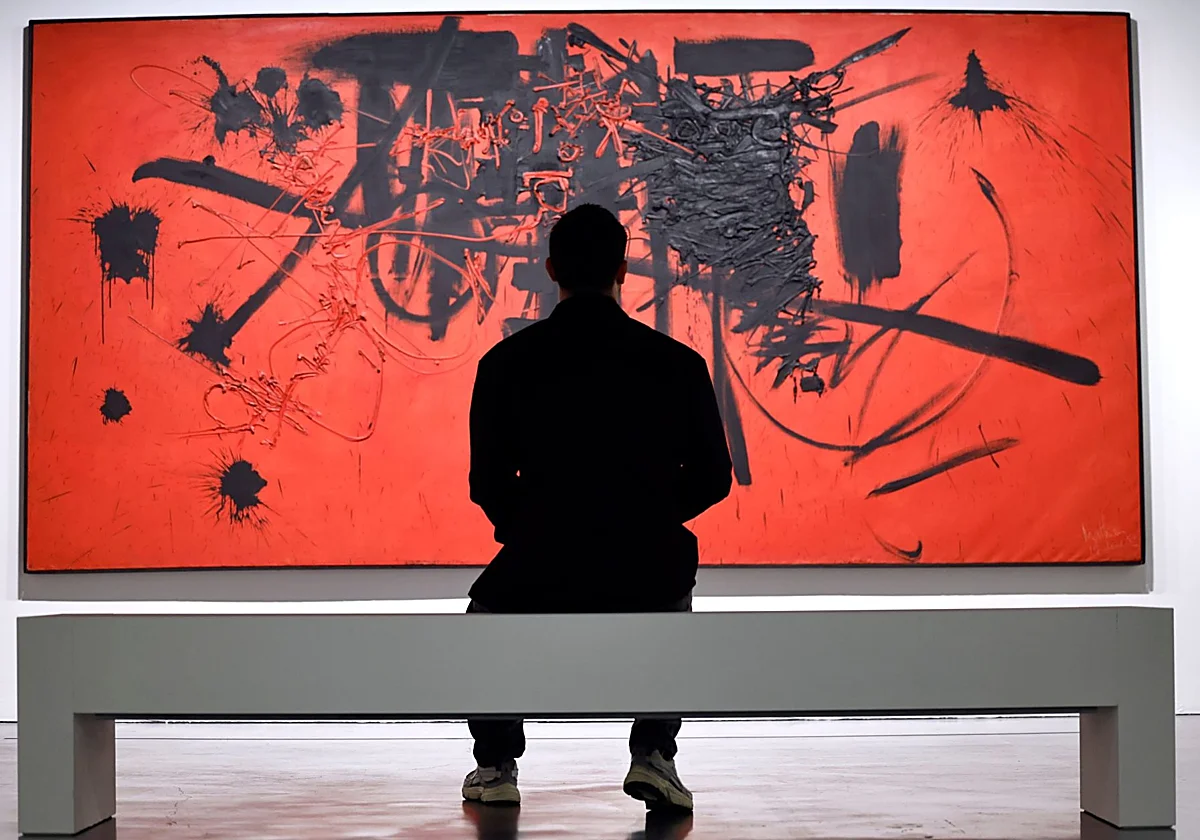
Añádenos en Google The most monumental work is by Mathie, who painted this work by jumping in front of the canvas. (Salvador Salas)Málaga
20/05/2026 Actualizado a las 17:55h.Abstraction was not merely a shift in perspective, or a response to the figurative art and realism that had come before. It was all of ... that, instilled with the spirit of rebellion that reached the easel, which more than one artist kicked over.
Jackson Pollock became the poster boy for this when he threw his canvas on the floor and turned splashes into an art form known as ‘dripping’. But he was not the only one. On the other side of the world, in Japan, Kazuo Shiraga would hang himself from the ceiling by ropes at that very time to paint with his feet, halfway between dance and art. His work, ‘Planet Nature’, captivates with its choreography of reds and blacks.
It is more than enough reason for it to become the main attraction and image of the exhibition ‘Gesture and Matter. International Abstractions (1945–1965)', which runs until next September at the Centre Pompidou Malaga, bringing together the major international names of this artistic ‘movement’ that emerged from Paris and New York as a response to the horror and trauma of the Second World War.
'We are looking at an exhibition of artists who paint with their whole bodies,' explained Anne Foucault on Wednesday, co-curator of the exhibition alongside Christian Briend, who pointed directly to the American Jackson Pollock and his abstract dripping onto the stretched canvas as one of the major influences on his contemporaries.
“Rather than an artistic movement, this is a trend, because there is no single body or manifesto; instead, it is international, with hubs in Paris and New York, but it is spreading across Europe, Asia and Japan,” noted the expert, who highlighted the presence in the exhibition of historic works such as ‘Number 26A. Black and White’, which comes from the Pompidou Centre in Paris, which is currently closed for renovation, and which formed part of Pollock’s first exhibition in France in 1952.
The exhibition features "Number 26A. Black and White", a historic work that was displayed at Pollock’s first exhibition in Paris in 1952.
“We have brought together some 30 works by 26 different artists that spectacularly highlight the diversity of an art form that rejects figuration and geometry in favour of lyricism and painting as an act of freedom,” explained Foucault regarding an exhibition supported by the La Caixa Foundation.
The narrative that both curators have constructed for the Pompidou’s temporary exhibition spaces emphasises the power of abstraction through large-scale works, ranging from the symbolic painting by the acrobat-painter Kazuo Shiraga to oil paintings exceeding five metres in size, such as another piece dominated by red and signed by Georges Mathieu, 'Homage to Marshal Turenne', which the artist also created by leaping in front of the canvas, as if painting were a performance.
“Gesture and Matter. International Abstractions (1945 - 1965)” is more thematic than chronological, although the beginning and end of its discourse does frame the exhibition between the Second World War and the new spirit of the 1960s. The tragedy that the world had emerged from can be seen in the first room of the exhibition, in which abstraction still struggles to free itself from the figurative.
This is the case for the German painter, Wols, who developed his work in hiding from the Nazis and whose biomorphic watercolours such as “La Granada Azul” are on display.
The work 'Planet Nature' and its author, Kazuo Shiraga (right), who painted with his feet in the form of a dance. (SUR)The deputy director-general of the Centre Pompidou in Paris reaffirms the strong relationship with Málaga and the city’s museum as an iconic cultural hub.
The presentation of the Centre Pompidou’s new temporary exhibition on Wednesday was attended by the mayor of Malaga, Paco de la Torre, who recalled the city’s agreement with the Paris museum, which is currently closed for renovation work on its main building. His words were echoed by the Deputy Director General of the French cultural institution, Charlotte Bruyerre, who reasserted the strength of the ‘partnership’ with Malaga and the importance of the Muelle Uno art gallery as an ‘extraordinary icon’ that allows the Pompidou to remain in direct contact with the public at this time.
“Our museums are not closed; rather, we have transformed ourselves and, with a loyal partner like Malaga, we are able to roll out this cultural programme,” said the French official, who extended a “special invitation for 2027”, the year in which the 50th anniversary of the founding of the Centre Pompidou in Paris will be celebrated, as the occasion will serve to organise special exhibitions at its only museum in Spain.