Archeaology
From the banks of the Nile to the Spanish plateau: The 2,600-year journey of the Psamtek scarabHow an Egyptian Pharaoh’s name ended up in a Spanish grave
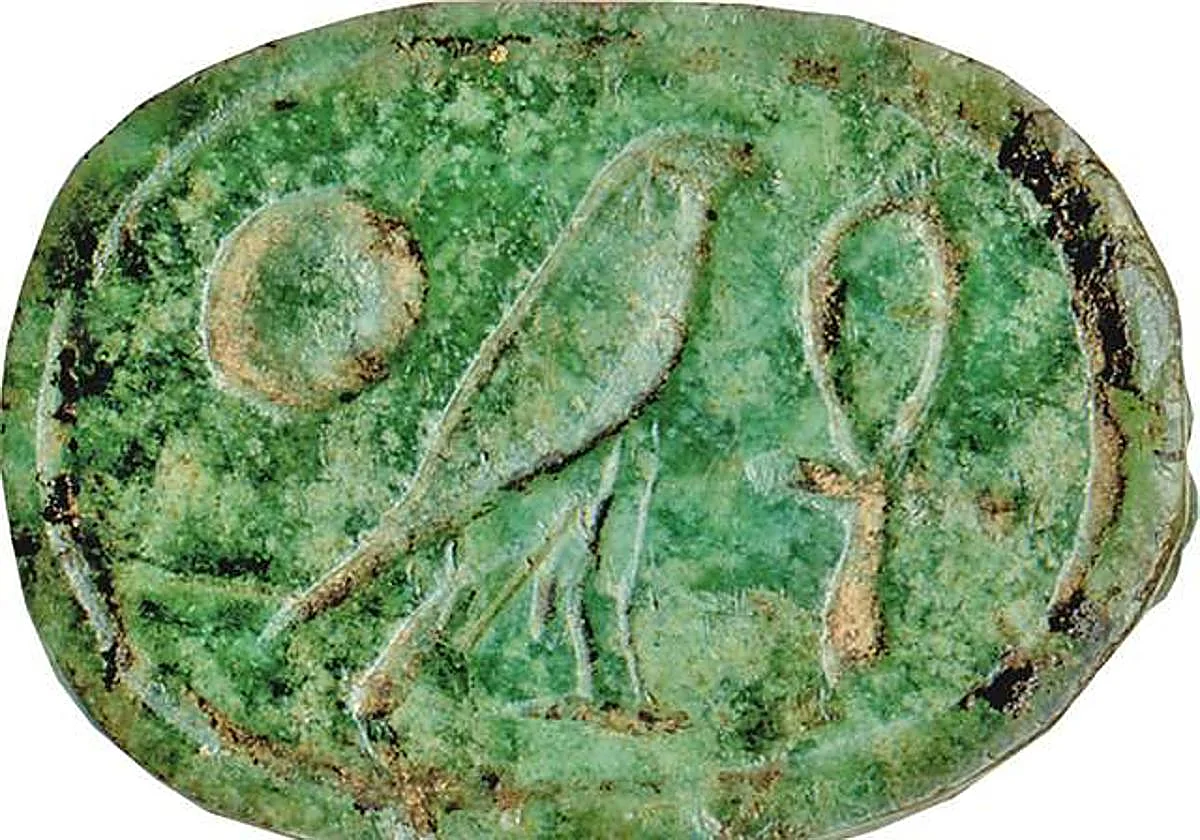
An Egyptian Scarab amulet. (Public Domain)A miniature masterpiece of Egyptian craftsmanship, no larger than a fingernail, has emerged from the red earth of Castile-La Mancha to tell a story of ancient global trade.
The 1.5-centimetre faience scarab, recently chronicled in The Journal of Egyptian Archaeology, represents a remarkable 4,000-kilometre odyssey that began in the pharaonic workshops of the Nile Delta over two and a half millennia ago.
Discovered in 2016, it has since been extensively analysed, and this month (April 2026) the results published in he publication of a major international paper titled Mediterranean Parallels of a Psamtek Egyptian Scarab from El Toro Necropolis.
Crafted from blue-green glazed composition, the amulet is a "time capsule" from the Saite Dynasty (664–525 BC). It bears the royal cartouche of Pharaoh Psamtek, a name synonymous with Egypt's Late Period renaissance.
A product of the Delta workshops
Archaeological analysis suggests the piece originated in the specialised workshops of Naucratis or Memphis. These hubs were the "free trade zones" of antiquity, where Egyptian artisans produced high-status amulets for an international market.
The scarab’s base features five meticulously engraved hieroglyphs: p-s-m-T-k. Research indicates it likely dates to the reign of Psamtek I or II, a period when Egypt was opening its doors to Mediterranean explorers and mercenaries.
The Mediterranean circuit
The object did not travel directly to the Spanish interior. Instead, it followed a sophisticated maritime "prestige circuit" that linked the great empires of the East to the indigenous cultures of the West. Similar "Psamtek scarabs" have been tracked across the ancient world:
•The Levant: Samples found in Israel share near-identical chemical signatures.
•The Islands: Specimens have surfaced in the Phoenician necropolises of Sardinia and Ibiza.
•The Pillars of Hercules: A parallel find was discovered in the sacred Gorham’s Cave in Gibraltar.
•The final destination: A woman of the Oretania
The scarab eventually reached the El Toro necropolis in modern-day Alcubillas, likely passing through the hands of Phoenician or Greek traders before being acquired by the local Oretanian elite.
Its journey ended after a funeral pyre. It was found among the calcined bones of a young woman, placed inside a ceramic urn as a final act of devotion. Though her identity is lost to time, the presence of the scarab - alongside bronze ornaments and a rare pure iron needle - marks her as a person of immense social standing.
Related story
History
J. M. L.
While other scarabs have been found in central Spain, they typically date centuries later. The Alcubillas scarab stands alone as the earliest and most direct link between the Pharaohs of the Nile and the ancient inhabitants of the Spanish plateau.
The scarab is currently a centerpiece of the Atempora exhibition at the Provincial Museum of Ciudad Real, where it is being celebrated as a rare physical bridge between the world of the Pharaohs and the ancient peoples of Spain