Gibraltar treaty
Gibraltar says goodbye to its borderThe inclusion of the British Overseas Territory in the Schengen Area has eased the situation for the 16,000 workers who cross the border every day - most of whom are Spanish - and who were previously forced to endure queues of up to five hours
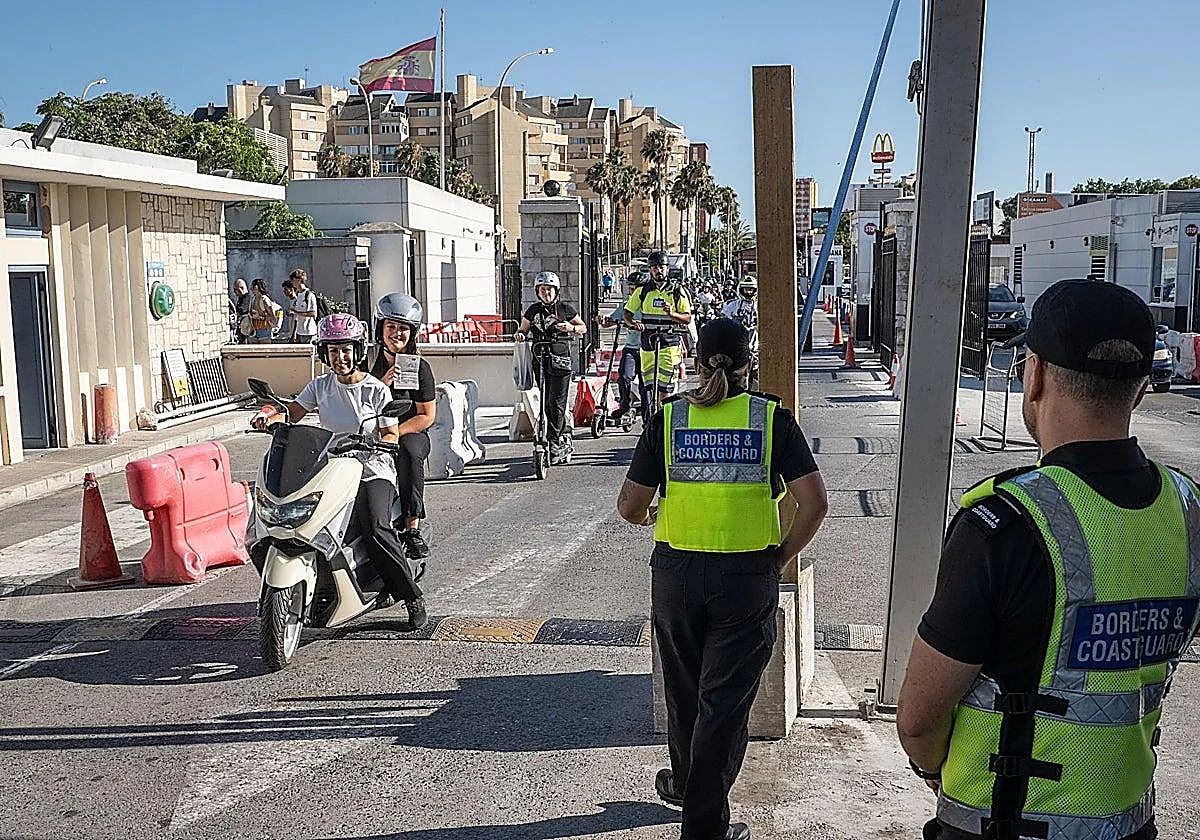
Añádenos en Google Customs officers were still asking for passports last week, but not as strictly as they used to. (S. GARCÍA)Sergio García
Gibraltar
14/07/2026 a las 11:21h.They say that one’s true homeland is one’s childhood. And the ‘llanitos’ - as those born in Gibraltar are known - have theirs etched into ... their memories.
“I was two years old when Franco closed the border. If we wanted to visit family in La Línea, we had to take a ferry to Tangier and from there the Transmediterránea to Algeciras. So, a five-minute car journey turned into an ordeal that lasted a whole day,” says John Isola.
His fellow Gibraltar native Stephen Hermida recalls that era without a hint of nostalgia. “I didn’t know what fresh tuna was until I turned 21. When I saw those slices for the first time, I thought they were meat, because until then we’d only ever eaten it from a tin. There was no fresh milk either, just powdered or condensed milk; and the meat we ate was frozen and brought in from Poland or New Zealand. We didn’t even have polvorones at Christmas.”
Geraldine, his wife, recalls all those broken families who had to shout across the fence to communicate: “Hey, your mum’s died”, “Congratulations, you’re an uncle now”... “It was heart-wrenching,” she says.
“There was no oxygen for the hospitals or wine for Mass,” she adds.
What the authorities at the time didn’t count on was that this isolation would turn into a source of strength. Many thought that this sort of siege would break the British spirit, that Gibraltar would fall like ripe fruit. But the exact opposite happened.
“Nothing did more to create a Gibraltarian identity than shutting ourselves away behind a fence,” the locals agree. Given the circumstances, it is hardly surprising that, over time, a climate of resentment took root; while this has largely faded, some still harbour these feelings. “If the current Treaty had been proposed 15 years ago by Peter Caruana, the former Chief Minister, he would have been hanged,” Stephen quips.
Related story
EU Treaty
reached an agreement to tear down the fence, “the last wall of continental Europe” and a constant source of conflict, to guarantee the free movement of people and goods, and to establish a framework for fiscal and environmental cooperation, “while keeping Spain’s position on sovereignty intact”, as the foreign ministry insists.
What does this mean? There will be no passport checks between the two territories, and Spain will take over Schengen border controls at Gibraltar’s airport and port, although it will do so in its capacity as a European police force. This, which to the rest of the world may sound like a trivial matter, has shaped relations for decades, turning the movement of people into an ordeal, often at the mercy of the authorities’ changing moods and the resulting zeal with which officers on both sides enforced the regulations.
“Imagine eight hours at work and then another five queuing in the car, sometimes under a scorching sun. That was our daily routine,” explains Francisco Javier Téllez, a waiter from La Línea who has been making the journey back and forth for 13 years now.
The agreement also includes safeguards designed to ensure balanced development. To this end, it provides for the creation of a financial mechanism for employment training to offset income inequalities, the strengthening of coordination on social security matters, and specific measures to protect cross-border workers. Furthermore, both parties will play a central role in the implementation of the agreement, including the power to suspend its application, apply safeguards or terminate it.
One of its key architects, Chief Minister Fabian Picardo, will no longer have a say in its implementation; having lost support among the local people during the process, he is set to step down shortly. Most agree that "while the agreement was ongoing, it was not the time to change the jockey mid-race".
"Not reaching an agreement would have been a catastrophe. The irony is that it was forced by Brexit"
John Isola
President of the Gibraltar Chamber of Commerce
"It is a unique opportunity to take progress to the Campo de Gibraltar as a whole. And more so now that Morocco is gaining great influence"
Charles Gómez
Lawyer
"Imagine eight hours at work and then five more to get in and out, sometimes under a scorching sun"
Francisco Javier Téllez
Spanish waiter in Gibraltar
The Treaty, which dates from 11 June 2025 but will enter into force provisionally this Wednesday following its ratification in Brussels, marks the successful conclusion of negotiations that would have been very unlikely to succeed had the European Union not been involved.
Charles Gómez is a lawyer and a seventh-generation Gibraltarian. He has no doubts about the benefits of the agreement, but warns against those who do not live here - “nationalists on both sides”, he specifies - who are merely seeking to “undermine a legitimate aspiration”.
“We live in an area with great economic potential and a positive neighbourly relationship,” he explains, referring to the nearly 11,000 Spaniards - most of them from La Línea de la Concepción - who cross the border every day, alongside Moroccans, Indians and, of course, Britons…
“We account for 30 per cent of the Campo de Gibraltar’s economy - a strategic, commercial and cultural potential that must be promoted, especially now that Morocco is gaining influence in the Strait. We are facing a unique opportunity to take prosperity a step further; we cannot afford to ignore this reality.”
A bobby is on patrol along Main Street, the nerve centre of the British colony.Insecurity: the greatest fear
Gómez believes that the Treaty has the merit of satisfying both sides, even though everyone fought tooth and nail during the negotiations. As well as facilitating border crossings, “one of the most obvious achievements for Spain is that it is its own officers who will oversee the checks”.
This also applies to taxation on goods such as tobacco, fuel and alcohol. Gibraltar is moving away from its long-standing low-tax regime (excise duties) and introducing a transaction tax, which was initially set at 15 per cent and will gradually rise to 17 per cent, in line with the lowest VAT rate applied anywhere in the EU.
John Isola, president of the Gibraltar Chamber of Commerce, believes the measure will mark a turning point in the colony’s relations with Spain.
“Failing to reach an agreement would have been a disaster. The irony of the situation is that it was forced by Brexit.” But the deal has not been without controversy, particularly among those in the retail sector who stand to lose their competitive edge.
Take this example: 60 per cent of the price of a packet of cigarettes is made up of tax; “applying a very low rate gave that sector an advantage that it is now set to lose. Add to that the fact that the costs a business has to bear here are higher, as are land prices and the burdens arising from import procedures… Furthermore, Gibraltar has committed to applying European standards, meaning it will not be able to import goods if they do not comply with EU regulations. It all adds up.”
"If the current treaty had been proposed 15 years ago by Caruana he would have been hanged”
Stephen Hermida
Retired bank employee
"The influx of people from Gibraltar seeking affordable rents has sent housing prices soaring in La Línea, a town crippled by unemployment"
Juan Franco
Mayor of La Línea
And what has the Rock gained? “The opportunity to create a commercial hub that extends beyond the Campo de Gibraltar,” explains Charles Gómez, “an area that has historically been somewhat neglected and whose potential has not been fully realised.”
And that is no small thing. Because the Rock - with a population of 38,000 - occupies a highly desirable position in terms of trade, but also in sectors such as online gambling, where, despite covering less than seven square kilometres, it has emerged as a true global powerhouse.
The sector, which comprises 54 licensed operators, employs nearly 3,300 people and accounts for almost 30 per cent of Gibraltar’s GDP. The fact that Spain removed this enclave from its list of tax havens two weeks before the Treaty came into force - on the very day that Russia was included - is a nod that illustrates the new era both countries are prepared to explore together.
It also makes it easier to find accommodation for all those thousands of people who see the current situation as an opportunity to move to the Rock and who have prompted the authorities to take unprecedented measures, such as limiting the number of residence permits granted (3,000 in the last quarter, whereas the usual figure used to be 1,000 for a whole year), on the pretext of preserving Gibraltarian identity.
This situation is causing great concern on the other side of what has until now been the border, where "the influx of people seeking affordable rents has sent housing market prices soaring in La Línea, a town with twice the population of Gibraltar and one of the areas hardest hit by unemployment in Spain".
This is highlighted by its mayor, Juan Franco, who is calling for an action plan to counteract this imbalance, as illustrated by Francisco Javier Téllez.
“Here, a British person or a local is earning 3,000 or 4,000 euros a month, while a waiter like me takes home 1,500 or 1,800 at best. What’s going on? They have greater purchasing power; they’re in a different league and don’t mind paying 1,000 euros to rent a two-bedroom flat. But for us, the numbers just don’t add up.”
As for the people of Gibraltar, the issue that keeps them awake at night is quite a different one. They are concerned about the lack of security which, in their view, will result from reducing controls in a region particularly vulnerable to illegal migration and where smuggling in general - and drug trafficking in particular - have been running rampant for years.
In an effort to allay fears, the local government has invested millions of pounds in increasing the number of - now ubiquitous - CCTV cameras and police officers, and in installing facial recognition systems.
“We learned to live in a cage, but that protected us from the outside world,” remarks Geraldine, who has always kept her front door open and now wonders whether it is a good idea to continue doing so.