3 min read
Hubble’s Album of Planet-Forming DisksNASA Hubble Mission Team
Goddard Space Flight Center
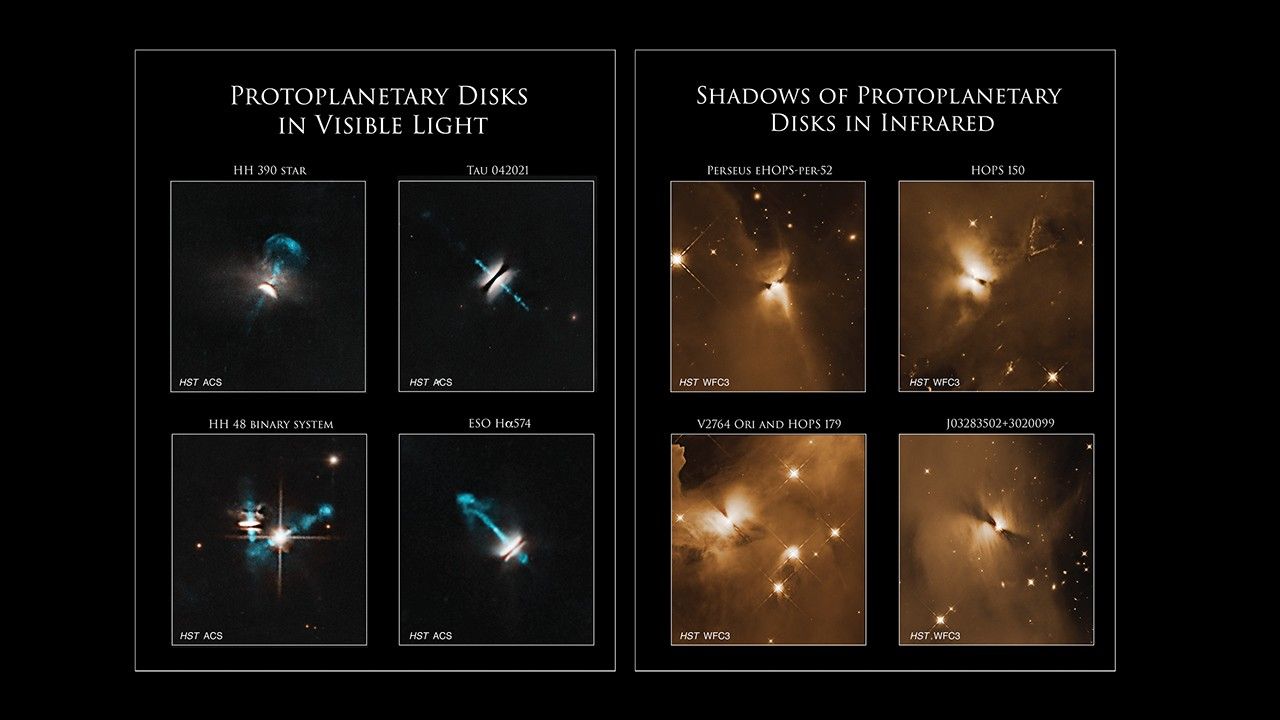
Jan 15, 2026 ArticleThis collection of new images taken by NASA’s Hubble Space Telescope showcases protoplanetary disks, the swirling masses of gas and dust that surround forming stars, in both visible and infrared wavelengths. Through observations of young stellar objects like these, Hubble helps scientists better understand how stars form.
Jets of gas blast from protostars in these visible-light images. HH 390’s outflow is accompanied by a one-sided nebula, evidence that the protoplanetary disk is not viewed edge-on from our perspective. Tau 042021 is a large, symmetrical disk seen edge-on, and is in a late stage of dust evolution, since the dust particles have clumped together into larger grains. HH 48 is a binary protostar system in which gravitational tidal forces from the larger star appear to be influencing the disk of the secondary object. ESO Hα574 is a very compact disk with a “collimated” ― or beam-like and linear ― outflow, and one of the faintest edge-on disks yet recognized.NASA, ESA, and K. Stapelfeldt (Jet Propulsion Laboratory); Processing: Gladys Kober (NASA/Catholic University of America) Download this image (34.6 MB)These visible-light images depict dark, planet-forming dust disks around a hidden, newly developing star, called a protostar. Bipolar jets of fast-moving gases, traveling at about 93 miles (150 km) per second, shoot from both ends of the protostar. The top two images are of protostars found about 450 light-years away in the Taurus Molecular Cloud, while the bottom two are almost 500 light-years away in the Chameleon I star-forming region.
Stars form out of collapsing clouds of gas and dust. As surrounding gas and dust falls toward the protostar, some of it forms a rotating disk around the star that continues to feed the growing object. Planets form from the remaining gas and dust orbiting the star. The bright yellow regions above and below the spinning disks are reflection nebulae, gas and dust lit up by the light of the star.
The jets that are released from the magnetic poles of the stars are an important part of their formation process. The jets, channeled by the protostar’s powerful magnetic fields, disperse angular momentum, which is due to rotational movement of the object. This allows the protostar to spin slowly enough for material to collect. In the images, some of the jets appear to broaden. This occurs when the fast jet collides with the surrounding gas and causes it to glow, an effect called a shock emission.
Bright central protostars and the shadows of their dusty disks appear in these infrared images.NASA, ESA, and T. Megeath (University of Toledo); Processing: Gladys Kober (NASA/Catholic University of America) Download this image (36.6 MB)These edge-on views of protostars in infrared light also reveal thick, dusty protoplanetary disks. The dark areas may look like very large disks, but they are actually much wider shadows cast in the surrounding envelope by the central disks. The bright haze throughout the image comes from light scattering off of the surrounding cloud’s dust grains. The top right and bottom left stars reside in the Orion Molecular Cloud complex about 1,300 light-years away, and the top left and bottom right stars lie in the Perseus Molecular Cloud roughly 1,500 light-years away.
In its early stages, these disks draw from the dust that remains around the forming stars. Unlike visible light, infrared light can travel through this “protostellar envelope.” The protostars in the visible images above are further along in their evolution, so much of the dusty envelope has dissipated. Otherwise, they could not be seen in visible wavelengths.
Viewed in infrared light, the central star is visible through the thick dust of the protoplanetary disks. Bipolar jets are also present but not visible because the hot gas emission isn’t strong enough for Hubble to detect.
HOPS 150 in the top right is actually in a binary system, in orbit with another young protostar. HOPS 150’s companion, HOPS 153, is not pictured in this image.
From a wider Hubble survey of Orion protostars, including HOPS 150 and HOPS 367, astronomers found that regions with a higher density of stars tend to have more companion stars. They also found a similar number of companions between main-sequence (active, hydrogen-fusing stars) and their younger counterparts.
New images added every day between January 12-17, 2026! Follow @NASAHubble on social media for the latest Hubble images and news and see Hubble's Stellar Construction Zones for more images of young stellar objects.
Facebook logo @NASAHubble@NASAHubble Instagram logo @NASAHubbleExplore More
Finding Plantary Construction Zones Hubble's Exoplanets Recognizing Worlds Beyond Our SunMedia Contact:
Claire Andreoli
NASA's Goddard Space Flight Center, Greenbelt, MD
claire.andreoli@nasa.gov
Share
Details
Last Updated Jan 15, 2026 LocationNASA Goddard Space Flight CenterRelated Terms
- Hubble Space Telescope
- Astrophysics
- Astrophysics Division
- Goddard Space Flight Center
- Protostars
- Stars
- The Universe
Discover More Topics From Hubble
Hubble Space Telescope
Since its 1990 launch, the Hubble Space Telescope has changed our fundamental understanding of the universe.
Hubble’s Stellar Construction Zones
Explore the Night Sky
Hubble News