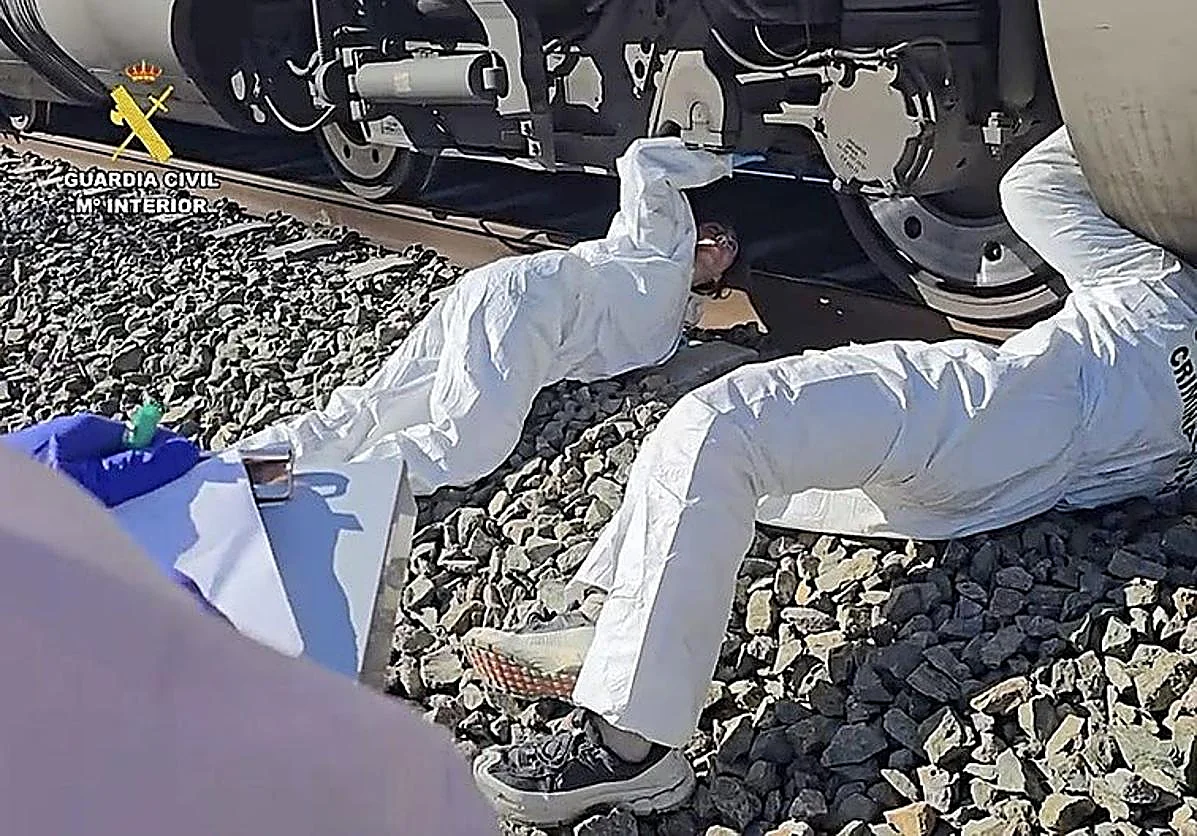
The commission team has found marks on the 'treads' of the carriages before the one that derailed, which would support the hypothesis that there was an already existing fracture in the track which then widened
Wednesday, 21 January 2026, 16:03
Investigators examining the Iryo train crash near Adamuz, Cordoba, have found significant evidence suggesting the derailment was caused by an existing fracture in the track caused by wear and tear.
The Commission for the Investigation of Railway Accidents (CIAF) has identified marks on the wheel treads of the carriages immediately preceding the derailed unit. These findings support the hypothesis that a defect in the rail was present before the accident occurred and widened as the train passed over it.
Initial analyses conducted on Wednesday point to a "clean break" of more than 30 centimetres in the outer steel rail of Line 1 as the origin of the accident. Experts noted that the fracture is highly unusual due to its lack of deformity, suggesting it was not a consequence of the crash itself but the primary cause.
While the damaged section of the rail is due to be transported to a laboratory in Madrid for exhaustive testing, the most solid leads so far are high-resolution photographs taken by the forensic team.
These images reveal small indentations on the treads - the surface of the wheel that directly contacts the rail - on the first five carriages of the Iryo 6189 train. These units passed over the fracture point safely before the sixth carriage derailed. Crucially, these marks appear only on the wheels corresponding to the side of the track where the fracture occurred.
According to preliminary technical information, these marks, common in the reports of many other railway accidents, are an "indication" that the rail may have "broken due to wear" at the exact moment of the passage of the sixth carriage.
This initial small deformity must have become larger at a certain point, between the passage of the fifth and the sixth unit, when the metal finally cracked due to "intensive use".
Investigators look for such marks as a kind of 'tell-tale sign', because the wheel treads, which are slightly conical in shape to aid cornering and self-centring, keep record of any significant anomaly in the track.
Research in train workshops
To confirm this hypothesis, however, the high-speed trains that had passed on that exact track before the Iryo train must be inspected to check whether they also have those marks.
This "wear rupture" would explain why the safety systems did not raise the alert that there was a disruption on the track.
The big question at this point, according to sources close to the CIAF and Adif, is why the three inspections carried out by experts between October and November did not detect any anomaly. On 3 October and 5 and 21 November, specialists carried out "exhaustive" tests, including an analysis that verified the correct layout of the track and confirmed that train convoys accordingly responded to interaction with the track.
What is also important to note is that this track underwent an exhaustive renovation process in May 2025.
Lab analysis
On Wednesday morning, the Ministry of Transport outlined the steps that the CIAF has taken and is to take in the following days, including compiling documentation, collecting information at the site, transferring track material for a lab analysis, etc.
"At this initial stage, all hypotheses regarding the possible causes of the event are open," the ministry announced.
Also key to the investigation will be the 'black boxes' of both the Iryo and the Alvia trains. The CIAF already has the "data from the on-board legal recorders of both trains", as confirmed by sources involved in the case.