Sumer Loggins
Johnson Space Center Office of Communications
Jan 20, 2026 ArticleFor Jaclyn Kagey, helping astronauts put boots on the Moon is part of her daily work.
As the Artemis III extravehicular activity lead in NASA’s Flight Operations Directorate, Kagey plays a central role in preparing astronauts for humanity’s return to the lunar surface.
She helps define how astronauts will work on the Moon, from planning detailed spacewalk timelines to guiding real-time operations. Crews will conduct these activities after stepping outside NASA’s human landing system, a commercial lander designed to safely transport astronauts from lunar orbit to the surface and back during Artemis missions.
Official portrait of Jaclyn Kagey. NASA/Robert MarkowitzAs NASA prepares to return humans to the lunar surface for the first time in more than 50 years, Kagey’s work is helping shape how Artemis missions will unfold. Astronauts will explore the Moon’s south polar region, an area never visited by humans, and the Artemis III mission will serve as the proving ground for future lunar exploration.
Kagey’s career at NASA spans more than 25 years and includes work across some of the agency’s most complex human spaceflight programs. While studying at Embry-Riddle Aeronautical University, she watched space shuttle launches that solidified her goal of working in human spaceflight. That goal became reality through United Space Alliance, where she and her husband began their careers as contractors.
Jaclyn Kagey works in the Mission Control Center during a spacewalk simulation at NASA’s Johnson Space Center in Houston. NASA/Robert MarkowitzOne of Kagey’s career-defining moments came during a high-pressure operation aboard the International Space Station.
“I’ve planned and executed seven spacewalks, but one that stands out was U.S. EVA 21,” she said. “We had a critical ammonia leak on the station, and from the time the issue was identified, we had just 36 hours to plan, prepare the spacesuits, and execute the repair.”
The team successfully completed the spacewalk and restored the system. “The agility, dedication, and teamwork shown during that operation were remarkable,” Kagey said. “It demonstrated what this team can accomplish under pressure.”
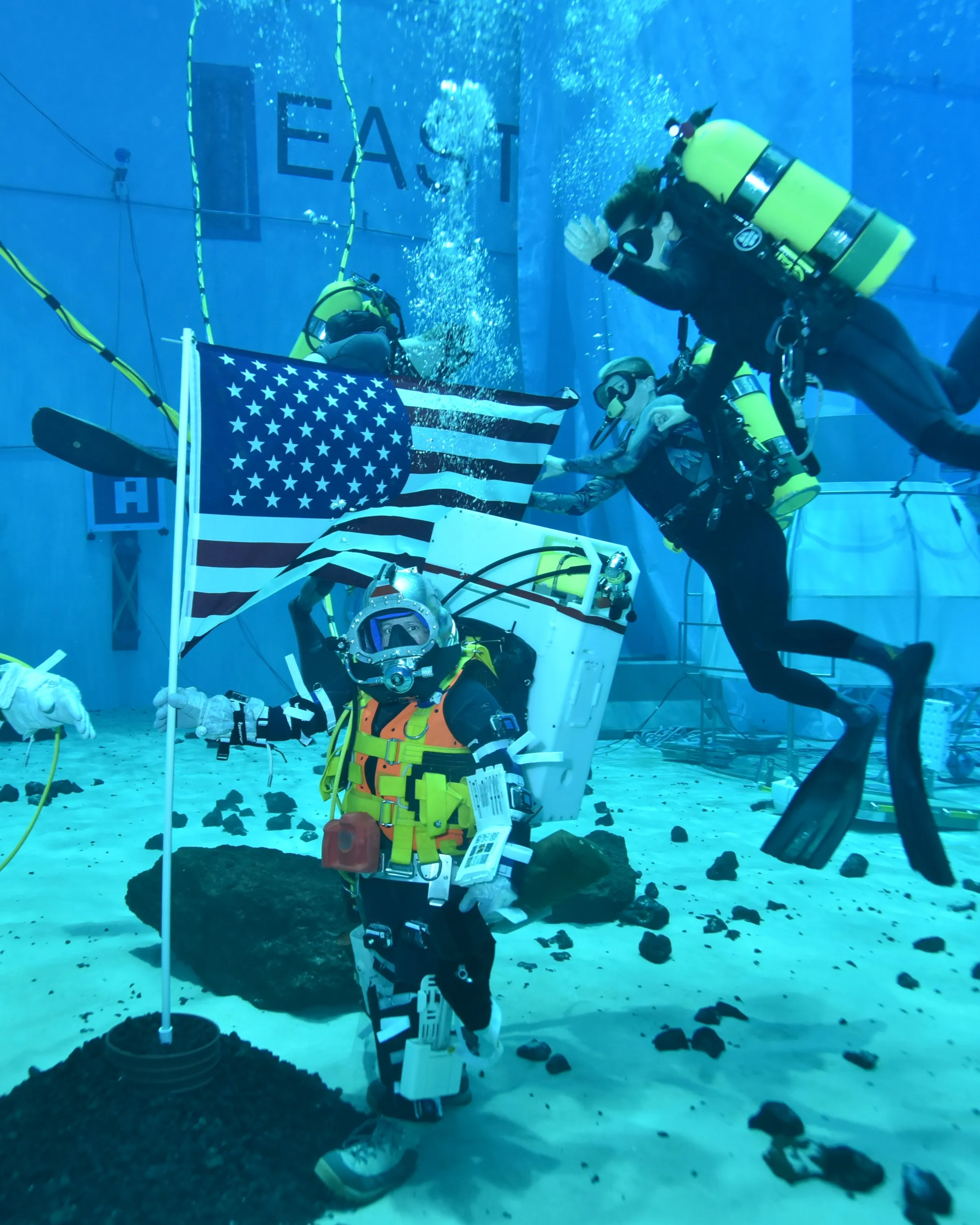
Jaclyn Kagey trains in NASA’s Neutral Buoyancy Laboratory, where astronauts and flight controllers rehearse spacewalk procedures in a simulated microgravity environment. NASAThroughout her career, Kagey has learned that adaptability is essential in human spaceflight.
“You have to be flexible,” she said. “Things rarely go exactly as planned, and your job is to respond in a way that keeps the crew safe and the mission moving forward.”
She has also learned the importance of balance. “There are times when the mission requires everything you have,” she said. “And there are times when you have to step back. Learning when to do each is critical.”
Jaclyn Kagey suited up in Axiom Space’s Extravehicular Mobility Unit (AxEMU) spacesuit during a test on the Active Response Gravity Offload System (ARGOS) at Johnson’s Space Vehicle Mockup Facility. Axiom SpaceKagey’s influence also extends to the future of spacesuit development. Standing on the shorter end of the height spectrum, she once could not complete a full test in the legacy Extravehicular Mobility Unit despite passing the fit check. Although Kagey could don the suit, its proportions were too large for her and made it difficult to move as needed for the test. That experience drove her to advocate for designs that better support a wider range of body types.
That effort came full circle when she recently completed her first test in Axiom Space’s lunar spacesuit, called the Axiom Extravehicular Mobility Unit (AxEMU), on the Active Response Gravity Offload System at Johnson Space Center.
“It’s exciting to literally fit into the future of spacewalks!” Kagey said.
Jaclyn Kagey conducts lunar surface operations training in the Rock Yard at Johnson Space Center, where teams test tools and procedures for future Artemis missions. NASAAs momentum builds around Artemis, Kagey remains focused on the responsibility that comes with advancing human space exploration.
“My mission is to shape this historic endeavor by working closely with scientists and industry partners to define lunar surface activities,” Kagey said. “We are setting the standard for humanity’s return to the Moon.”
About the Author
Sumer Loggins
Share
Details
Last Updated Jan 08, 2026Related Terms
Explore More
7 min readA Quarter Century in Orbit: Science Shaping Life on Earth and Beyond
Article 1 week ago 4 min readSusan Schuh: Supporting the Humans in Human Spaceflight
Article 1 week ago 1 min readNASA Starts Up Gateway’s Power System for First Time
Article 2 weeks ago Keep ExploringDiscover More Topics From NASA
Missions
Humans in Space
Climate Change
Solar System