Zoom
Work by Federico Miró Art and culture Malaga artists shine at Arco 2026 as private galleries face regional 'blackout'Despite the creative power of 13 local creators and a debut by Pedro Hoz, high tax rates and economic pressures leave Málaga's private galleries absent from Spain's premier art fair
Thursday, 5 March 2026, 12:21
A total of 13 artists are presenting Malaga at this year's Arco - Spain's largest exhibition for contemporary art.
As it has previously happened, however, the province has not a single private gallery among the 200 names and there are only two Andalusian galleries: Alarcón Criado and Rafael Ortiz.
This scarcity of Andalusian names is starting to become common, especially at such a sensitive time for the sector: Spain is applying a 21 per cent IVA tax on art purchases, as opposed to the reduced tax in neighbouring countries.
What makes up for the lack of galleries is the creative power of Malaga's artists. Arco is once again showcasing the works of veterans Rogelio López Cuenca, Carlos Aires, Nono Bandera, Cristóbal Ortega and the late Chema Cobo and Manuel Barbadillo. There will also be works by Regina de Miguel and Juan del Junco, as well as by up-and-coming names such as Julio Anaya, Leonor Serrano Rivas, Federico Miró and Paloma de la Cruz.
Malaga also has a debut this year in the face of young Pedro Hoz. At the age of 25, Hoz positions himself as one of the most singular artists of his generation. Represented by Galería Mayoral, he is taking his surrealist universe a step further with two large-format crosses topped with a red wooden ball. A striking proposal that refers to his cultural roots, to that image of sacrifice that has been present in the collective imagination since childhood and which he reinvents with recognisable bodies that are slightly removed from reality. In his work, as he explains, "the familiar becomes strange".
In many cases, the Arco coincides with certain artists' exhibitions in Madrid. This is the case for Rogelio López Cuenca, whose work is currently on display at the Círculo de Bellas Artes, always with pieces that reflect his untamed spirit, his critical gaze and his reflection on the construction of individual and urban identities through the figure of Picasso.
Paloma de la Cruz has brought her textile reinvention of ceramics with one of the pieces in homage to the Manila shawl that she made during her residency at the Casa de Velázquez. At the same time, she is showing her latest creations (surprising black 'mud canvases') at the gallery's new headquarters in Madrid.
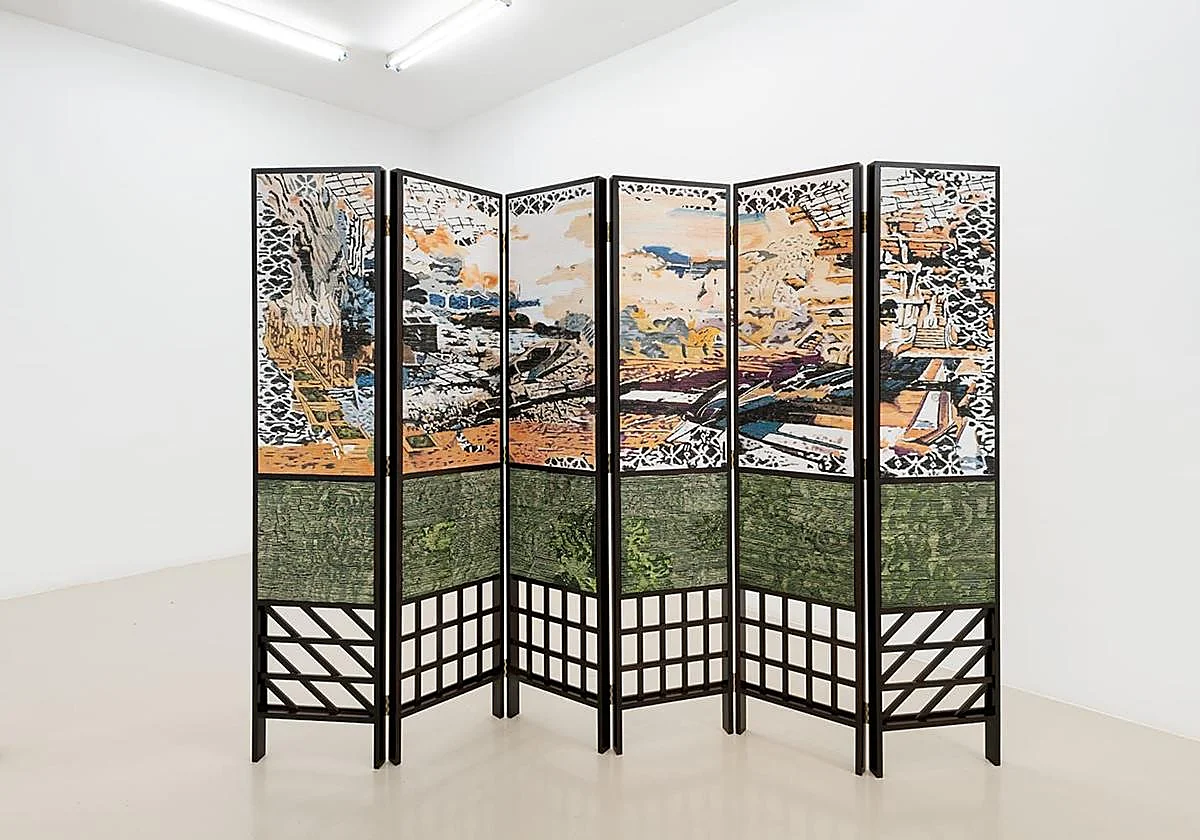
Federico Miró also has a dual presence in Madrid. At the Arco, he is exhibiting a folding screen-canvas, his new attempt to leap from the conventional canvas and combine unreal landscapes with the architectural-decorative. From mid-March, the piece is moving to the F2 gallery.
Malaga-based visual artist Juan del Junco, a lecturer at the Faculty of Fine Arts at the UMA, is demonstrating his own conceptual language through photography.
Leonor Serrano Rivas is at the Arco with her Serpiente de agua dulce - a fountain-sculpture with electroformed copper plant forms that generate a kind of organic body that refers to both natural systems and internal structures, between the botanical and the anatomical, between the ornamental and the visceral.
The signature style of Alhaurín de la Torre native Cristóbal Ortega's paintings are returning to Madrid. Several oil paintings on canvas, each measuring one and a half meters and showcasing the internationally renowned artist's continued exploration of his unique technique: applying oil to the back of the canvas, allowing the material to 'perspire' and seep to the visible side. The exhibition shares a space with late Chema Cobo's Words are fictions (2020).
Carlos Aires is once again exhibiting in two spaces at the Arco, with pieces that confront the spectator with uncomfortable realities that invite reflection. The artist from Ronda is exhibiting Cara cara con la muerte III - a composition of original banknotes from the 35 richest countries in the world altered with forms alluding to death (wealth does not save one from mortality).
He is also showcasing his Visceral Edition - an installation of seven silkscreen prints with the artist's blood representing parts of the human body.
Aires is sharing space with another Malaga-born artist - Julio Anaya, who has reinvented Goya's Los caprichos on cardboard with eight small pieces where the master's engravings are adapted to the fragility and imperfection of a discarded surface.
Zoom
Goya's Los caprichos, by Julio Anaya.Nono Bandera is presenting a new work he completed barely a month ago, Arlequinado - an oil painting on an assemblage of cut pieces of canvas in which; a kind of collage in which he displays his technical skills and his original perception of reality.
Regina de Miguel has not one but five pieces: four watercolours and an acrylic on wood panel with her surrealist imagery. Master of geometric abstraction Manuel Barbadillo completes the list of Malaga artists.
Nowadays, Malaga is full of gallery proposals, but none of them have reached the Arco in Madrid. In Malaga city, there are Javier Marín, Isabel Hurley, Gravura, La Casa Amarilla and Benedito; in Marbella, well-established galleries such as Yusto/Giner coexist with interesting recent initiatives such as Reiners Contemporary Art; in Villanueva del Rosario, Ignacio del Río Estudio.
Genalguacil and the UMA: Malaga public proposals at the Arco
There might be no private Malaga representations at the Arco, but there are two strong public proposals. Genalguacil Pueblo Museo and the UMA, alongside the Once foundation, have returned to the great contemporary art fair. For the sixth consecutive year, the Genal Valley village-museum consolidates its commitment to contemporary art at Ifema, with art residents Miguel Fructuoso and Liu Cheng-Hsiang. Yinka Esi Graves and Lola Lasurt are presenting their Arte Vivo 2025, curated by Laura Vallés Vílchez. All the pieces originate from Malaga, in direct dialogue with its landscape, identity and, above all, inhabitants.
Particularly interesting is the work of Taiwanese artist Liu Cheng-Hsiang, the result of research in the Serranía de Ronda on landscape, rural culture and adaptation to the environment. His practice interweaves photography, moving image, generative algorithms and installations with projections to create contemplative encounters between the material and the immaterial.
The University of Malaga, with the support of the Once foundation, is exhibiting works by students and creators with intellectual disabilities. The authors are students of the Technical Assistant Degree in Cultural Environments (TAEC) who have received supervision by artists Elo Vega, Beatriz Ruibal, Abraham Lacalle, the Picasso Museum and the Prado Museum.