Zoom
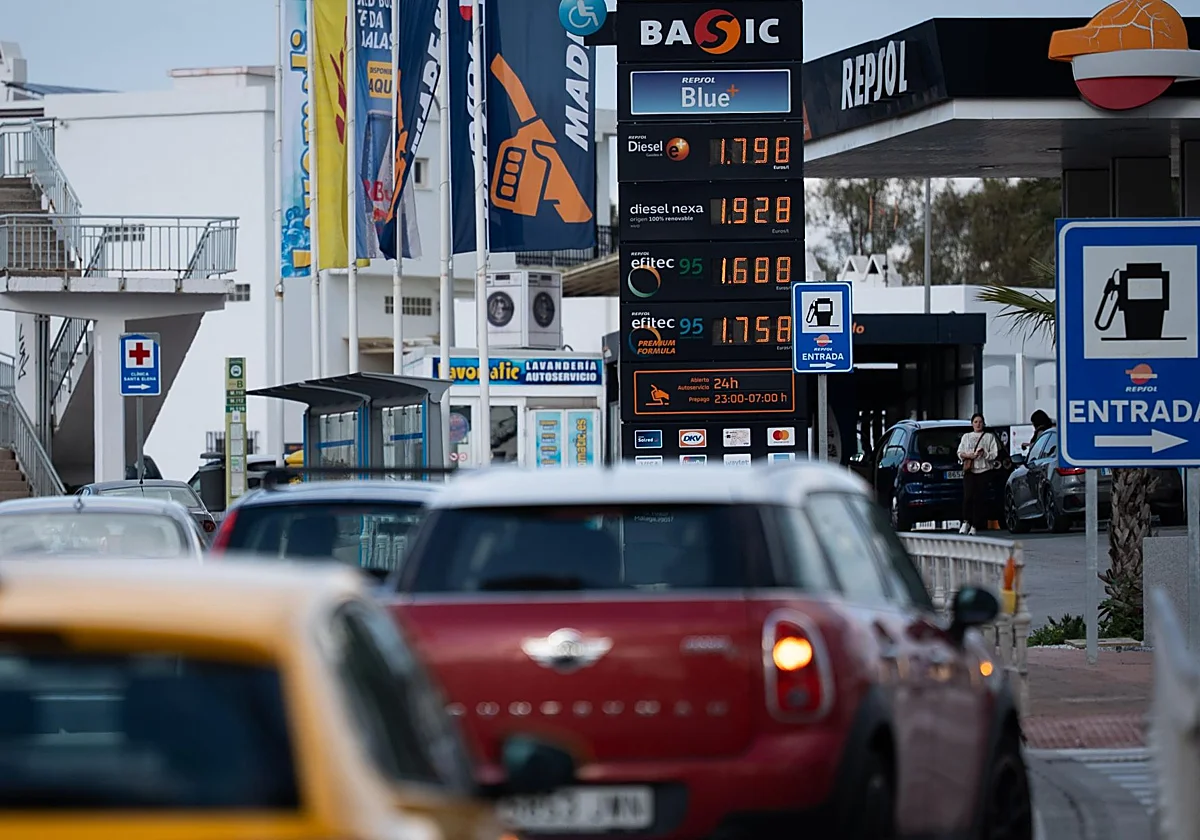
Prices at a Repsol station in Malaga city. ÑITO SALAS Economy Malaga households under pressure as Middle East war sends fuel prices soaring by 25 per centDiesel, which is the fuel most in demand in the province, has reached an average of 1.78 euros per litre, far exceeding that of 95 octane petrol
Málaga
Tuesday, 10 March 2026, 10:06
The war in Iran, coupled with the speculative prices set by some suppliers, has already caused fuel prices to soar in Malaga province and in the whole of Spain this month.
According to data from the Ministry of Ecological Transition, on 1 March, diesel A (regular) cost an average of 1.33 euros. Only a week later, it had reached 1.65 euros.
Malaga's vehicle fleet is old and mostly uses diesel, which means that the most sought after fuel in the province has risen by 32 cents (+25 per cent).
1.78
euros per litre is the usual price of diesel this week in Malaga city.
Paradoxically, 95 petrol has risen less: from 1.40 euros on 1 March to 1.64 euros on Monday, 10 March. The average increase was therefore 24 cents (+17 per cent).
This, however, is just the average price. In Malaga city, where the lack of competition implies that prices are generally higher than the average for the province, a litre of diesel on 10 March was 1.78 euros, while a litre of 95 petrol was 1.68 euros.
Why has the price gone up so much?
Traders blame the war in Iran for this rapid and sharp rise. Consumer associations, on the other hand, while agreeing that the war does have repercussions, also blame suppliers for setting "speculative" prices, using the armed conflict as a pretext.
1.68
euros is the price of one litre of 95 petrol at most stations in the city of Malaga.
"There are mixed emotions here, because although the rise in the barrel is very high, the dollar is quite low against the euro, which makes things less serious than they could be," president of the Andalusian association of fuel retailers Álvaro Fontes has stated.
Although this factor is somewhat mitigating the impact, Fontes admits that the sector is "very concerned". "For business owners, such radical and rapid rises are not good, because they negatively impact people's daily lives."
Demand is Malaga province is already falling. "There were some initial days of queues and a bit of panic, but now we are noticing a significant drop in sales," Fontes said. Drivers think twice before using their cars for non-essential leisure purposes.
"Before, people used to refuel normally; now they think more before going on a trip. This is fatal for the whole economy, because it has repercussions for commerce, hotels and transport," the expert said.
Fontes is optimistic, basing his prognosis on experience from the early stages of the war in Ukraine, when the initial panic eventually dissipated. Nevertheless, the latest news suggests that the price will remain high, at least for the next two weeks.
Compare before filling
President of Malaga's branch of consumer organisation Facua Lola García agrees that there is a speculation with prices that aggravates the situation.
"Consumers end up paying the price of everything, because the price rises not only for vehicles, but for all products, since transport is one of the most important determinants of prices," she says.
Her main advice to consumers is to use Facua's online tool to compare prices at different stations. In the meantime, everybody is waiting for the government or the EU to activate regulatory measures and prepare for a possible extension of the conflict in time.
Fuel is already close to two euros at the most expensive petrol stations
Fuel is already close to the psychological barrier of two euros per litre at several petrol stations in the province. The highest price so far has been in the municipality of Casares: 1.99 per litre of diesel on 10 March. Several other stations had prices around 1.90, which marks a difference of 36 cents between the cheapest and the most expensive stations. The lowest price on Monday was in Pizarra, 1.64 euros.
In the case of petrol, the lowest on Monday was 1.53 and the highest 1.89 (a difference of nearly 37 cents). Therefore, for every three litres of petrol, the consumer can save one euro, just by choosing the right supply point.