Zoom
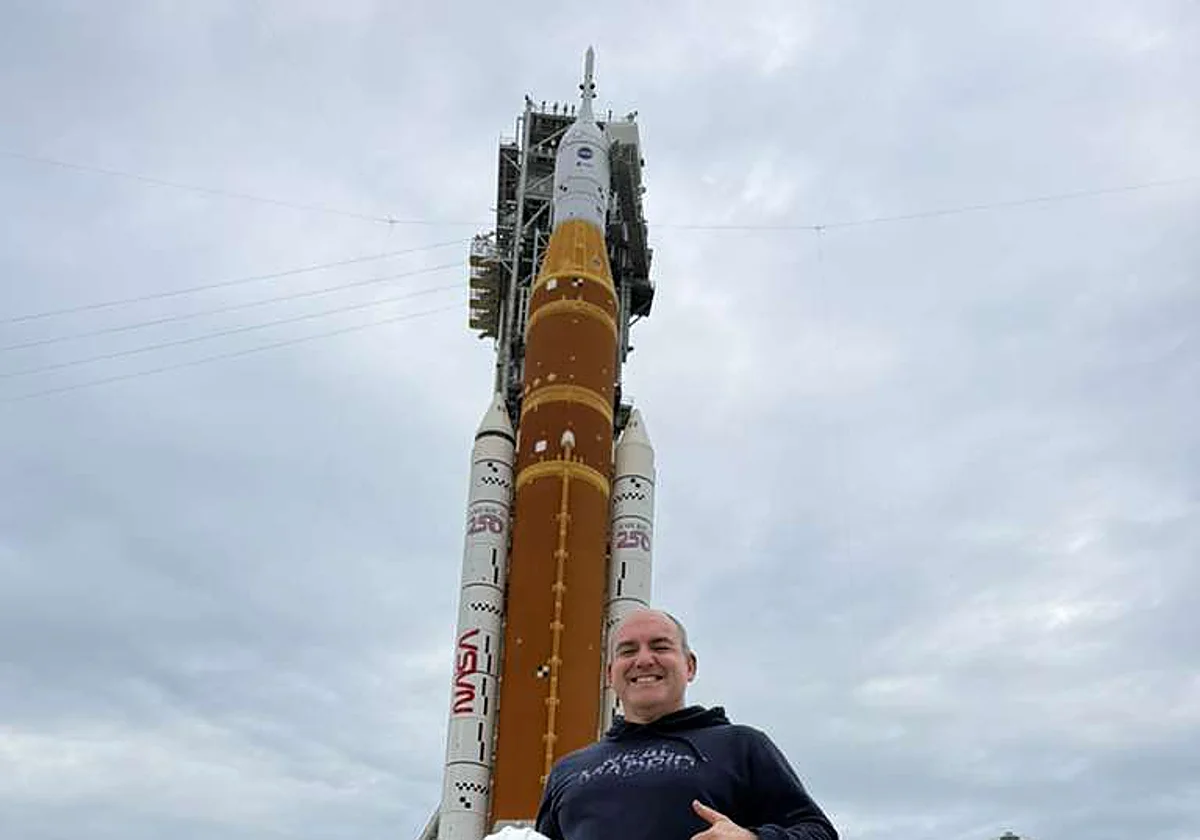
Carlos García-Galán posing in front of the rocket that will propel the Orion spacecraft. SUR People Malaga-native Carlos García-Galán counts hours to Artemis II Moon missionThe engineer and recently appointed executive of Nasa's programme to build a lunar base is preparing the launch of the Orion spacecraft with four astronauts at the Kennedy Space Center
Nuria Triguero
Wednesday, 1 April 2026, 10:13
Malaga-born engineer Carlos García-Galán has been living the life of a movie star these days, with interviews scheduled every 15 minutes. Nasa places great importance on communication and has its staff (from astronauts to technicians) well-trained to handle the media with professionalism and an engaging approach.
The newly appointed Moon Base Program Executive at the American space agency smiles widely when he talks to fellow Spaniards. He seems more happy than nervous during the final countdown to the launch of Artemis II - the first crewed mission of the Orion spacecraft that will take four astronauts to lunar orbit and back to Earth on a ten-day journey. "It's a historic moment: we're returning to the Moon for the first time in more than 50 years," García-Galán says from the Kennedy Space Center in Florida.
The Artemis II will launch at 12.24am Spanish time on Thursday. "There are very few hours left until launch. We are making the final preparations so that we can fill the rocket with fuel and send our four astronauts to the Moon," the engineer says.
At the Kennedy Space Center, they are optimistic about the atmospheric conditions, on which the launch depends as much as on the absence of any flaws in the complex engineering of the launch pad, the SLS rocket, and the Orion spacecraft. The key moment, as García-Galán explains is the start of fueling. If for any reason the rocket cannot lift off on the first attempt, there will be more opportunities in the coming days: the current launch window extends until 6 April.
For García-Galán, this launch is both an accomplished goal, one he has been working toward for years as Deputy Manager of the Gateway programme, and a starting point, as his new job involves leading the design and construction of a permanent base on the Moon. "I'm here now working on the Artemis II mission as part of the management team and after this I'm going to manage the construction of the new lunar base, the first for humankind," he says.
Last week, Nasa announced a radical shift in its lunar exploration roadmap: it no longer simply aims to send astronauts back to the Moon. Now, at the behest of President Donald Trump, it seeks to build and operate a permanent base on the Moon to "ensure continued US superiority in space".
A man from Malaga will be ultimately responsible for making these seemingly science-fiction plans a reality. "It seems impossible, but we are Nasa and that's what we do," Carlos García-Galán said at the presentation of the Moon Base Program. The established timeframe for this objective is seven years and its cost is 20 billion dollars.
A mission to prove that everything works
Reid Wiseman, Victor Glover, Christina Koch and Jeremy Hansen are the names of the Artemis II crew. If the launch is successful, they will embark on a ten-day round-trip mission to the Moon, without landing, including a flyby of the far side. The purpose of this mission is to test the performance of essential Orion spacecraft systems in deep space.
On the outbound journey to the Moon, the crew will conduct a manual piloting test. Additionally, while still near Earth, the crew will evaluate the performance of the life support systems necessary to generate breathable air and confirm that the communications and navigation systems are ready for the trip. The spacecraft will then perform the next propulsion manoeuvre, called the translunar injection engine burn, for a one-way trip lasting approximately four days, orbiting the far side of the Moon in a figure-eight pattern that will extend more than 370,000 kilometres (230,000 miles) from Earth before its return.
During the remainder of the journey, the astronauts will continue evaluating the spacecraft's systems, including practicing emergency procedures, testing the radiation shelter, participating in scientific experiments and observing the Moon from a closer vantage point than human eyes have had in more than 50 years.
Once Orion completes its orbit around the far side of the Moon, it will begin its return journey. It will no longer need propulsion because it will utilise the Earth-Moon gravitational field. The spacecraft is expected to land in the Pacific Ocean, where it will be recovered with the assistance of the US Navy.
From Torre del Mar to Nasa
As a child in his hometown of Torre del Mar, Carlos García-Galán dreamt of being an astronaut. At 18, he left for the US, determined to do everything possible to fulfill that dream. While embarking on a spacecraft ultimately wasn't to be, Carlos García-Galán has become an expert in building them. He studied aerospace engineering and at 23 began working at Nasa, where he started at the Mission Control Center of the International Space Station in Houston.
He has spent 18 years with the American agency, during which time he has enjoyed a meteoric rise. In December 2024, he was appointed Deputy Manager of Nasa's Gateway Program. Last week, he became the head of the Moon Base Program: an ambitious plan aimed at creating a habitable base on the Moon.