Zoom
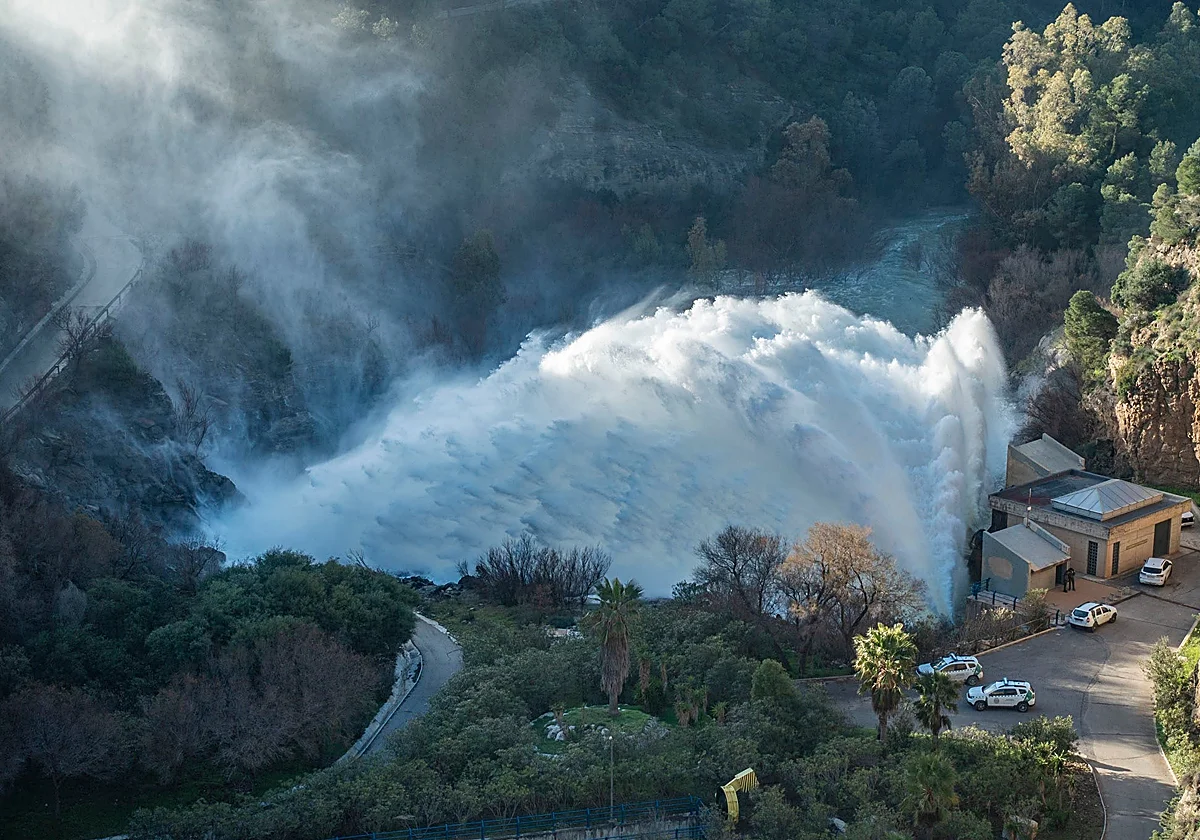
Image of the Guadalhorce reservoir. José Luis Escudero Water welfare Malaga reservoirs have released four years' worth of water after heavy stormsProvincial dams reach 93% capacity with 562 million cubic metres, triggering massive controlled releases to manage excess runoff
Friday, 6 March 2026, 11:53
Malaga's reservoir network might not have reached the all-time record of 2013, but it currently holds 562 million cubic metres, which is 93 per cent of its capacity.
From the start of the year and due to the significant amount of rainfall, the system has released more than 200 million cubic metres, which would be enough water to supply Malaga city for four years.
Why have reservoirs in Malaga been releasing water?
Controlled releases: Strategic drainage is essential to maintain dam integrity and prevent silting. This water also serves to recharge aquifers, irrigate farmland, and support coastal ecosystems.
Reservoir status: The Guadalhorce system (comprising El Conde, Guadalhorce, and Guadalteba) and La Concepción have all opened their floodgates.
The exception: La Viñuela is currently the only major reservoir that has not yet reached its release threshold, sitting at 87% capacity.
Safety limits: Several dams, including El Limonero and Casasola, are being held below their maximum physical capacity due to strict safety operating rules.
While the release of such amounts of water might seem like a waste, especially given previous periods of drought in the province, this water also serves an important purpose.
On the one hand, it recharges aquifers, irrigates land, favours ecosystems and helps coastal regeneration. On the other hand, it helps to maintain the reservoir basins and drainage bodies in good condition to prevent chronic silting and sedimentation processes. The water also reaches the treatment plants less turbid.
Thanks to runoffs, the reservoirs in the province continue growing at a rate of five million cubic metres per week, even as they are draining.
The first reservoir to open its floodgates during this hydrological year was La Concepción, followed by the Conde de Guadalhorce, Guadalteba and Guadalhorce. The 200 million cubic metres they have released under these extraordinary circumstances do not include the regular maintenance and safety releases at La Viñuela, Casasola and Limonero.
Many of the dams have operating rules that don't allow them to reach their actual capacity for safety reasons. This is the case of El Limonero, whose threshold is 14 million cubic metres instead of 21, or Casasola, which cannot exceed eleven million cubic metres. Then, there's La Concepción, which cannot exceed 48 million cubic metres between October and April, despite having a capacity of 57.
Lack of capacity
Releases are a key, non-negotiable part of water management. This, however, reveals the lack of investment in increasing their capacity.
The central government, for example, has not improved La Viñuela since it built it four decades ago.
In addition, there are projects such as the Cerro Blanco and Gibralmedina dams that are still pending.
Reluctant to provide data
Authorities are very reluctant to provide data on reservoir releases. The regional government has declined SUR's requests on several occasions, prompting the newspaper to rely on the estimates of several highly qualified experts in the field.
They suggest that the Guadalhorce system has already released 140 million cubic metres, while La Concepción has released 62, enough to fill another reservoir with twice the capacity. Despite its restrictive capacity, authorities have discarded the latter's expansion plan.
Only Viñuela has not opened its floodgates
Of the large reservoirs, only La Viñuela remains without opening the sluice gates. This will happen only if it increases its volume by ten million cubic metres. Right now, it is at 87 per cent of its capacity.
The Guadalhorce system
The Guadalhorce system consists of three major reservoirs which are fed by three different rivers (Guadalhorce, Guadalteba and Turón) and whose waters end up back in the Guadalhorce riverbed, pass through the Chorro and the Tajo de la Encantada and from there are distributed for irrigation in the area and to supply Malaga city.
El Conde, the smallest in capacity, has been at 99 per cent for weeks. The Guadalhorce reservoir and the nearby Guadalteba reservoir are linked by a spillway. When the latter fills up, water flows by gravity into the former. However, continued heavy rainfall and strong runoff have caused water levels in both reservoirs to rise to the point that the surface now forms a single continuous body of water.
It is not usual for more than one dam to drain at a time, unless there is a flood. They usually take turns: it starts with El Conde, then Guadalteba and ends at Guadalhorce.