Zoom
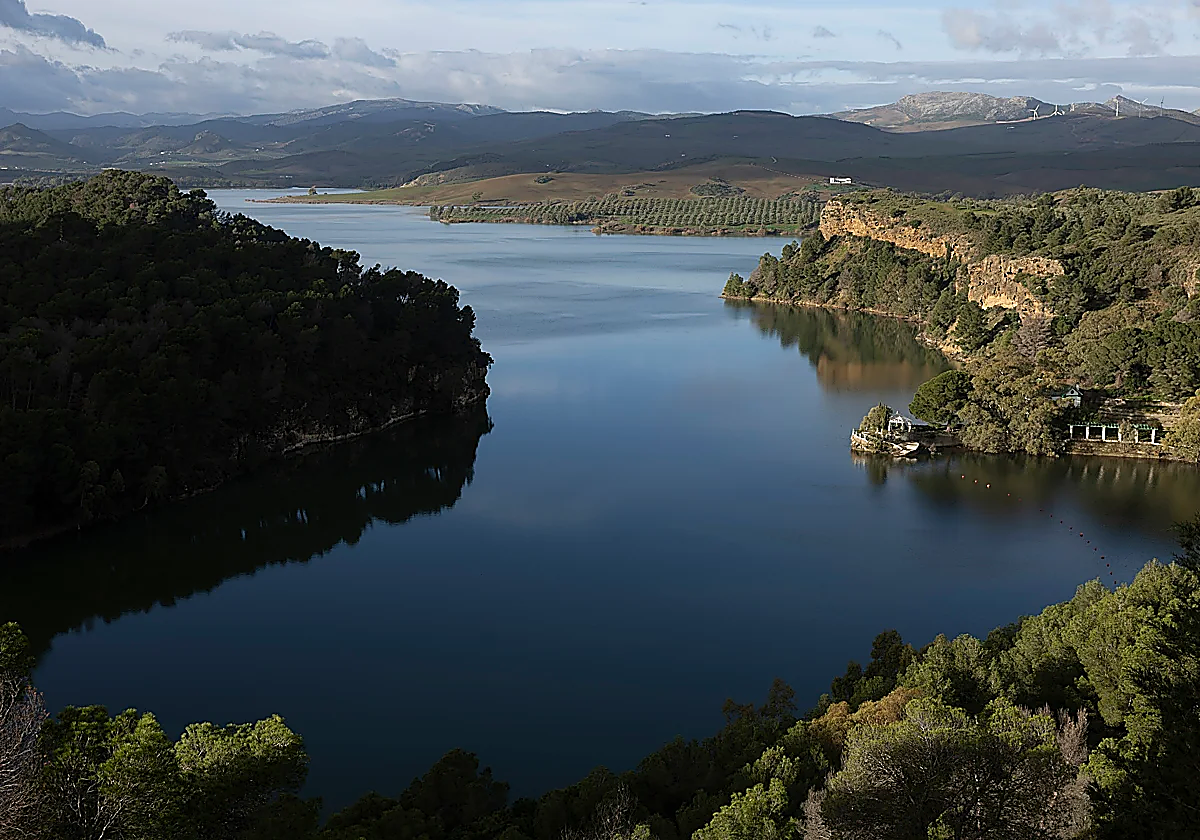
The Guadalhorce reservoir in Malaga province. Ñito Salas Water welfare Malaga reservoirs reach all-time high ahead of peak demand seasonDespite having drained the amount of water equivalent to four-year demand, runoffs keep increasing provincial reserves
Chus Heredia
Tuesday, 31 March 2026, 12:14
Reservoir management regulations typically mark 1 April as the start of the peak demand season. This influences maximum allocations for the months ahead. Malaga province is now facing the months of declining water levels after reaching its highest reserves ever recorded. As Holy Week begins, levels have started to stabilise after three months of continuous increases.
On Holy Monday, the reservoirs in Malaga were at 98.25% of their operational capacity. This means that they could technically store more water and, consequently, the percentage of capacity used would fall. However, considering the operating plans and safety limits they establish, the province's surface reserves are at their best level in history.
The seven large reservoirs in the province contain 578 million cubic metres, according to data collected by the Hidrosur network. Without considering the aforementioned reserves, this would represent more than 95% of their capacity. However, factors such as those at Casasola (which needs a buffer of 9.88 million cubic metres in the coming months in case of flooding) and La Concepción (where the safe filling level is measured by elevation, but is equivalent to 48 out of the 57 million cubic metres it can store) come into play here.
184.7
mm was the average rainfall in the province of Malaga this winter, making it the fifth wettest winter on record
Reserves would be no less than 200 million cubic metres higher had technicians not carried out massive releases due to lack of capacity and safety concerns. The volumes they have released in the past few weeks are equivalent to four years of demand in the city of Malaga. In the Guadalhorce system alone, releases would have exceeded 140 million cubic metres. The remainder of the significant volumes come from La Concepción.
The fifth rainiest winter in Malaga province
The series of storms between December and February have been crucial in confirming the end of the drought. It hasn't been the wettest winter on record, but the rainfall has been concentrated in reservoirs and headwaters.
Director of the Aemet state meteorological centre in Malaga Jesús Riesco ranks this fifth rainiest winter in the province, only surpassed by 2010 (262mm), 1969 (231.6mm), 1968 (225.5mm) and 1963 (212.3mm).
618.58
was the capacity of Malaga province's reservoir network in 2013, exceeding the current capacity of 603.14 million cubic metres
The water currently stored in the reservoirs would be enough to supply the province for almost four years, although there are some caveats, as these calculations must be made on a river basin basis. The Costa del Sol, with its limited reservoir capacity, is not in the same situation as the Guadalhorce or La Viñuela systems.
If we look at the volume of water stored, we have not yet reached the all-time high since Hidrosur began recording data. The record for the province was 611.94 million cubic metres of water stored on 28 May 2013. This represented 98.13%, which is lower than the current technical figure of 98.25%.
61.85
million cubic metres was the capacity of the La Concepción dam in 2013 - it is the reservoir that has shrunk the most
Here's a key point worth highlighting: reservoirs lose capacity over time due to erosion and sedimentation. In 2013, they could store 618.58 million cubic metres. Now, they can store 603.14. This doesn't mean that all the loss is due to erosion: the management regulations for El Limonero, which have recently significantly increased its buffer zone, are crucial.
The reservoir that has lost the most capacity in recent years due to erosion is La Concepción. It has decreased from 61.85 to 57.54 million cubic metres. Meanwhile, Casasola, has dropped from 23.45 to 21.72 million cubic metres; La Viñuela, from 165.43 to 164.37. The Guadalhorce system (Conde, Guadalteba, and Guadalhorce) has not changed.
25%
is the annual loss of water at the La Viñuela reservoir due to evaporation
Therefore, the province's reservoirs are facing the peak season and the months of highest evaporation with complete peace of mind. Let's not forget the water level is also subject to the amount of sunshine. Some studies estimate annual losses of up to 25% annually in La Viñuela, for example.
Guadalteba, Limonero, and Guadalhorce are currently at 100% capacity. El Conde is over 98%; La Concepción, 92%; La Viñuela, 90%; and Casasola (where operating regulations apply again) is at 57%.