Construction
Malaga's El Bulto area regeneration with 22-storey building advances after second competitionUrbania is competing to build the project designed by Marbella-based developer Sierra Blanca, which the city's urban planning department picked
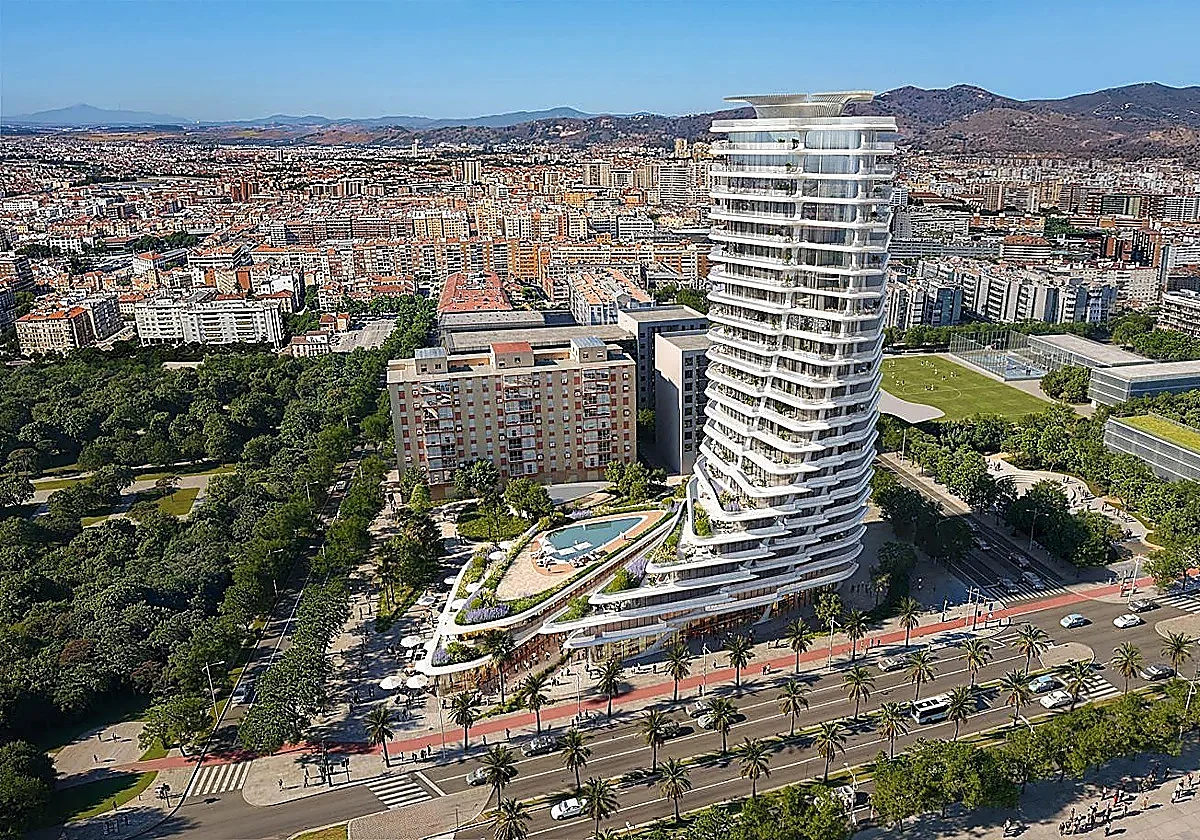
Añádenos en Google Recreation of developer Sierra Blanca's project for the El Bulto area in Malaga. (SUR)Jesús Hinojosa
09/06/2026 a las 14:22h.The project to regenerate the El Bulto area, close to Malaga city's main train station, is due to develop in the coming years, according to the city council's plan. .
In the first stage, the municipal urban planning department selected a winning proposal from the three submitted.
Marbella-based developer Sierra Blanca's project features a ground floor plus a 22-storey tower designed by prestigious Iraqi architect Zaha Hadid which would house a total of 153 market-rate housing units. The construction, which would also have tertiary uses, would have a facade front of 40 metres and a volumetric layout - the height would decrease towards the Huelin park area.
This first phase of the unique urban planning process was not decisive in selecting the developer for El Bulto. That relied on a second competition in which any company could submit a proposal to bring Sierra Blanca's idea to fruition.
The deadline for this second bidding process was midnight on Monday. As SUR has learned, in addition to the financial Sierra Blanca had submitted, developer Urbania has also submitted a financial project to develop Sierra Blanca's idea, although it differs substantially from the one in the first stage. While Sierra Blanca proposed a 22-storey tower, Urbania proposed buildings no taller than ten floors.
However, Urbania has ultimately chosen to compete for the Sierra Blanca project, meaning the urban planning department will have to analyse and evaluate both financial proposals.
In this second phase of the process, the evaluation will focus primarily on factors such as greater land availability in the area, either due to ownership or agreements reached with current owners, higher land value, lower development costs and shorter construction timelines, among other aspects.
In this second stage, the urban planning department's committee will again rank the bids from highest to lowest score and select the developer, with whom the city council must sign a development agreement outlining their obligations and rights for the development of the area.
Among these obligations are adherence to deadlines. The developer must submit the project's environmental impact assessment and progress report within three months of signing the agreement. It must then submit the area's zoning plan three months after the regional government's environmental approval and the development project six months after the initial approval of that plan.
Urban planning has set a series of deadlines for the contracting and commencement of the development works in the area. Should the selected company fail to meet its commitments, a series of financial penalties will come into force, which, in the worst-case scenario, could lead to the withdrawal of the developer's status as a developer.
The proposal, advised by consultancy firm Ejecución del Planeamiento, places this tower in the space currently occupied by the Cottolengo shelter, which would be moved to a new building on the corner of Paseo de Antonio Machado and Calle Góngora, according to an agreement that the developer has already reached with the Malaga diocese, if this intervention is successful. The new Cottolengo will occupy a plot of 2,800 square metres, on which the shelter will have 2,500 square metres of built space and a basement of 500 square metres for a minimum of 15 vehicles.
The project keeps the Luis de Góngora public school in the same location but proposes the demolition of the municipal hostel and other buildings owned by the city council. In exchange, with the new development, which creates a large 21,055-square-metre block of interior facilities, the city council would have two plots of land "for uses it deems necessary and convenient for the area".
The proposal also includes the construction of two ground floor buildings plus nine for 40 social housing units (VPOs) each, with a cultural space on the ground floors. The aim is to rehouse the families who live in the houses that still remain in the area as heirs to the shantytown past of this area.
The football pitch next to the school would be dismantled to create an underground car park with spaces for public and private use. A new north-south-facing football pitch would be built on this car park.