Zoom
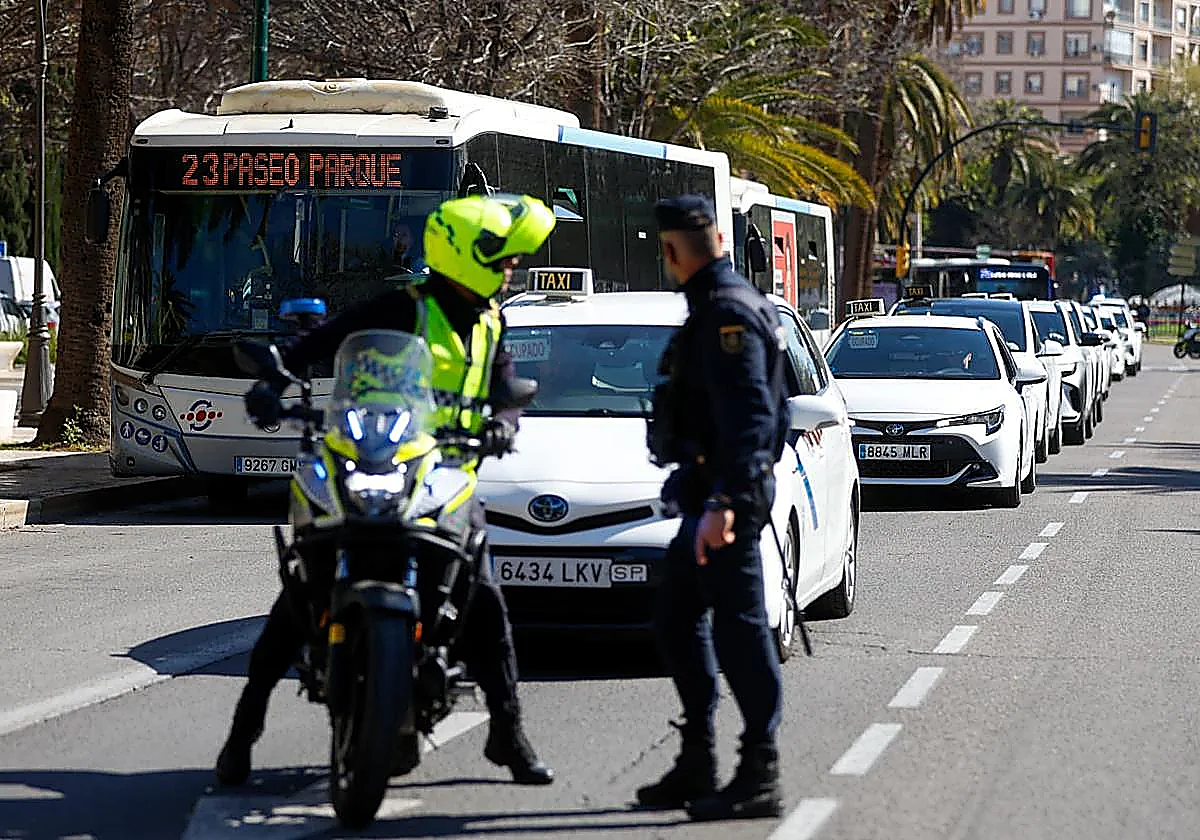
Taxi drivers protesting in front of the Malaga city hall. Marilú Báez Traffic Malaga taxi protest blocks central artery and causes traffic jamsTaxi drivers oppose the city council's plan to approve 60 new licences for vehicle adapted for people with reduced mobility
Cristina Vallejo
Thursday, 26 March 2026, 19:14
A taxi drivers' demonstration blocked one of the main arteries in Malaga city centre on Thursday morning, causing traffic jams. The taxis stopped right in front of the city hall on Paseo del Parque, exactly when the local ruling team held its March meeting.
The taxi drivers are rallying against the city council's plan to approve 60 new licences for vehicles adapted for people with reduced mobility. According to them, Malaga's fleet already exceeds the minimum requirement for this service, while, at the same time, there are not enough parking spots for such big vehicles.
The sector complains that this measure was adopted unilaterally and without a real analysis of its economic impact on their business. Taxi drivers say that the decision could directly impact the viability of a public service on which more than 1,400 households in the city rely.
Miguel Ángel Martín from the Aumat association of self-employed taxi drivers says that Malaga's fleet currently reaches 6.9 per cent of adapted vehicles, when the EU regulation requires five per cent. According to Martín, the Costa del Sol capital, along with Zaragoza, has one of the highest rates in the country.
Accorrding to Aumat, the addition of the 60 new licences would raise that percentage to around ten per cent, which taxi drivers consider to be well above actual demand.
Martín criticises the city council because, even now, during the off-season, there is not enough space for the taxis in Malaga.
Aumat is planning more protests on 9 and 30 April. The taxi drivers are demanding the immediate suspension of the new licence process, the establishment of a technical working group with direct participation from taxi drivers and the commissioning of an independent economic study to assess the impact of the measure.
People with disabilities see the situation very differently. Spokesperson Alfredo de Pablos says that high-capacity taxis, those with nine seats, can provide service for people with reduced mobility.
Of the 76 licenced vehicles adapted for people with disabilities, however, only 14 are standard taxis (not large-capacity). Of the larger taxis, De Pablos says, only around ten to 15 actually provide this service. He believes this is because it is more profitable for drivers to carry groups or families, who tend to take longer and better-paid journeys, rather than passengers with disabilities.
De Pablos also says that current taxi drivers have declined to apply for the new licences, which is why it has been necessary to raise the issue. "We need more taxis for people with disabilities and also for the elderly. The 60 new taxis will be able to serve any user," he states.