Population
Malaga will account for 64% of Andalucía's new residents over the next 15 yearsThe province's population will continue growing by more than 10%, compared to the stagnation in Seville and the decline that Jaén, Cordoba and Cadiz will suffer
Añádenos en GoogleCristina Vallejo
18/06/2026 a las 12:03h.Andalucía will gain 391,939 inhabitants between now and 2041, reaching a population of 9.1 million. Of this regional population growth, the province of Malaga will account for approximately 254,000 new residents or 64%.
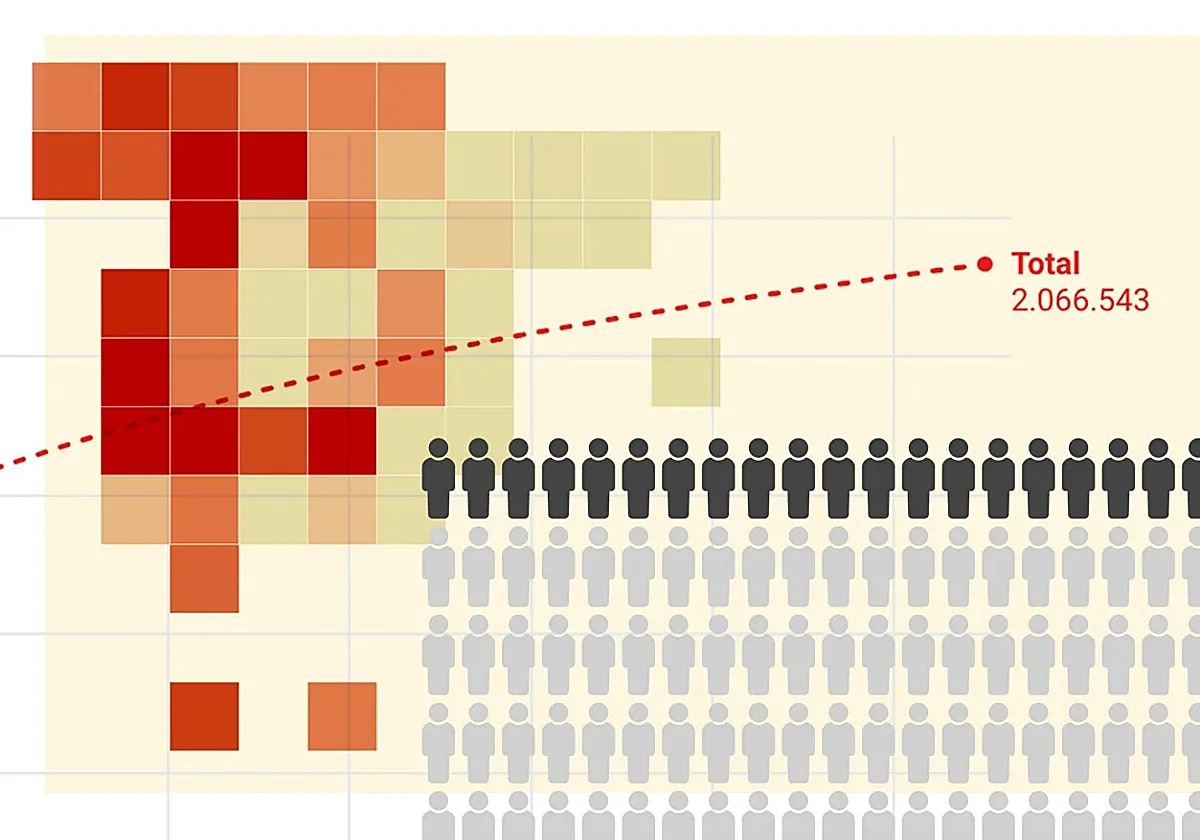
These figures come from population projections the national institute of statistics (INE) published on Wednesday. They reveal that Malaga's population will grow by 14% over the next 15 years, reaching 2.07 million inhabitants in 2041.
Malaga will not be the most demographically dynamic province in Andalucía. Almeria will grow by 16% in population, reaching 908,000.
Three provinces in the region (Jaén, Cordoba and Cadiz) will experience population declines. Jaén will lose more than 47,600 residents or 7.7% of its population. Cordoba will decrease by more than 33,000 inhabitants (-4.3%). Cadiz will have 1,000 fewer residents by 2041, a drop of just 0.1% of its population.
Meanwhile, Granada and Huelva will register slight increases of around 5%. Finally, Seville will remain practically stagnant, registering only 1% growth, settling at just over two million inhabitants.
The dynamism of Malaga's population will make it possible for the province to become the fifth most populous in Spain by 2041, behind Madrid, Barcelona, Valencia and Alicante, ahead of Seville.
Previous forecasts from the INE predicted that the province would surpass Seville and reach the two million inhabitant mark by 2031. According to Wednesday's projections, the two-million mark is now delayed until 2035 and the demographic overtaking of Seville will take place in 2037.
Over the next 15 years, the INE estimates that Malaga's population will continue to grow faster than the national average (8.5%, reaching 53.84 million inhabitants). However, the INE also indicates that a dozen provinces, besides Almeria, will grow even faster than Malaga: Guadalajara (18.8%), Alicante (18.2%), Castellón (17%), Tarragona (16.25%), the Balearic Islands (16%), Girona (15.22%) and Valencia, Toledo and Madrid, all three with growth rates exceeding 14%.
This implies a reflection, albeit with some contrast, of what has occurred in the last 15 years. The INE estimates a population of 1.81 million inhabitants for Malaga in 2026, representing a 14.6% increase since 2011, surpassed only by the Balearic Islands (15.4%).
For the period between 2026 and 2041, the province of Malaga drops to eleventh place, because, there are about ten other provinces in the country for which the INE projects more significant growth.
Provinces with declining population
The Andalusian provinces with the strongest decline in population over the next 15 years will be Zamora (-8.1%), Palecia (-5.8%) and Badajoz, León and Cáceres, with a decline slightly higher than 4%.
Salamanca, Lugo, Pontevedra, Asturias, Ciudad Real and Orense are other provinces that will experience population decline between now and 2041.
Many of these provinces have already been losing population in the last 15 years, especially Zamora, León, Jaén, Orense, Lugo, Salamanca or Asturias.
Who will be responsible for population growth? While Malaga will gain more than 254,000 inhabitants between now and 2041, it will lose nearly 7,000 residents born in Spain, representing a 0.5% decrease.
Therefore, the total number of residents that Malaga will register, its surpassing of Seville in demographic terms and its reaching fifth place in the provincial ranking by population will be solely due to the arrival of people born in other countries, who will contribute more than 260,000 people, bringing the total to over 714,200 (+57%).
Over the next 15 years, Spain is estimated to gain more than 4.25 million inhabitants, resulting from the addition of six million immigrants, which will compensate for the loss of more than 1.7 million births in Spain.
According to INE projections, the arrival of immigrants from other countries will decrease year after year, from around 64,000 in 2026 to around 39,000 in 2040. The opposite will happen with the arrival of residents from other parts of Spain, which will increase from the 27,000 expected in 2026 to 31,500 within 15 years.
There will also be people leaving Malaga. Fewer will leave for other countries: from the 35,000 people projected for this year, the number will drop to 25,500 in 2040.
More will leave for other provinces in Spain: from 24,800 this year to 29,500 in 2040. In any case, the net migration is always in favour of remaining in Malaga, which explains the population increase projected for the province in the coming years.
This continued population growth that Malaga will register will not prevent its progressive aging, from an average age of 43.74 years in 2026 to 47.46 in 2041. Something similar will happen in Spain as a whole.
In parallel, the INE has also published its household projections for 2041. For the province of Malaga, it estimates that households will reach 827,000 in 2041, compared to the current 715,838. The proportion of single-person households will remain around 30%, rising from approximately 200,000 in 2026 to 236,000 in 15 years.