Zoom
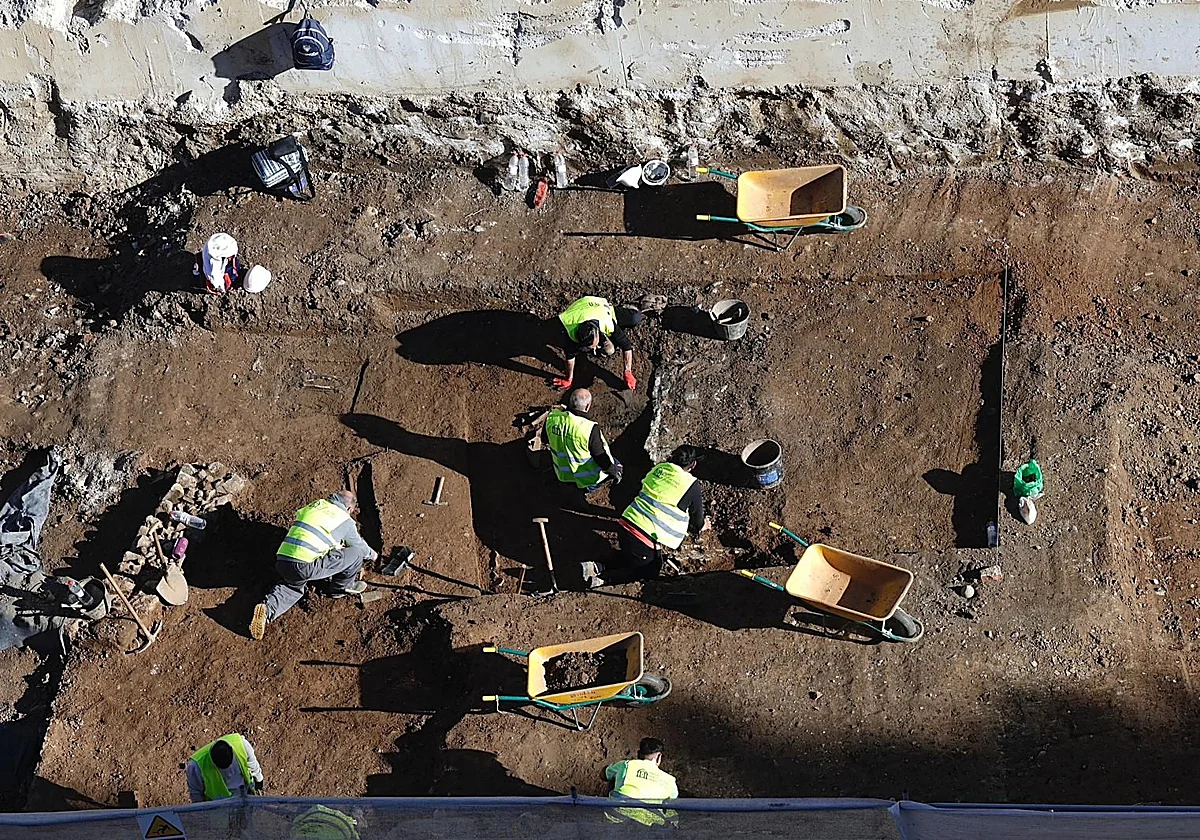
Archaeologists work at the Roman site on Calle Hilera. MIGUE FERNÁNDEZ Infrastructure Metro extension work in Malaga city centre suspended for excavation of Roman necropolis: this is the estimated delayThe archaeological work will delay the return of traffic to Calle Hilera, but it will not affect the plan concerning the metro extension to Hospital Civil
Málaga
Thursday, 18 December 2025, 21:08
The regional ministry of public work had only just celebrated the progress in the work on the first section of the extension of the metro to the Hospital Civil in Malaga, when the discovery of a large Roman necropolis on Calle Hilera led to the temporary suspension of the work for the full excavation of the remains.
The find was a surprise, as there had been no evidence of the existence of a large burial ground. The regional ministry of culture, however, believes that the remains are of such historical importance that their careful and full excavation will take between six and nine months. This is still an initial estimate, pending confirmation by the archaeologists who are working on the site and depending on their progress. There is already evidence pointing to almost 300 skeletons, according to various technical sources consulted by SUR.
There is currently no reliable date for the completion of the metro tunnel at Calle Hilera, because the archaeological remains prevent work on the phase that was due to be carried out now.
The presence of the remains prevents the execution of the work phase due now
At least the rest of the section of new line, at both ends, continues progressing according to schedule. The change concerns some 400 metres and entails an amendment to the contract.
Uncertain development
The archaeological method applied on Calle Hilera differs from those used in previous excavations. Unlike the houses from the Nasrid period that appeared in the area around Avenida de Andalucía, where it was feasible to use machinery, now the excavation has to be done tomb by tomb, manually, more slowly and with a density of remains that varies in each case (depending on the burial items and the bones that have been preserved).
"Following the decision of the regional ministry of culture on the discovery of the Roman necropolis, it is too soon to specify the deadline for the development of the planned archaeological work and its repercussions on the overall deadline for the Guadalmedina-Hilera section," the regional ministry of public work said, adding that the process of modifying the project must now be initiated.
274
tombs have been discovered for the moment, although there could be more; once excavated, they will be moved to the future museum space next to the Guadalmedina station
What are the real consequences of this decision? There is good news and bad news. Starting with the latter: in September, in one of the last visits of regional minister for public work Rocío Díaz, it was announced that the first pavements and some lanes would be open again within four months. This is still possible, because work is continuing in the areas not affected by the discovery. On the other hand, it was also said that Calle Hilera could be reopened to traffic by the middle of next year (at least for most of its length). This has been suspended and won't happen until at least the end of 2026 or early 2027.
The good news is that this will not alter the timetable for the arrival of the metro to Hospital Civil. In fact, the commissioning of the 1.8 kilometres from El Corte Inglés to the junction with Arroyo de los Ángeles will be marked by the third section (that of Blas de Lezo), which has not yet been awarded and which, once it starts in 2026, will require at least three years, just like the other two sections.
Culture
The Roman necropolis is from the 2nd to 4th centuries AD (Upper and Lower Imperial periods). As this is an extraordinary discovery, of which there has been no documentary evidence or previous historical references, as well as due to the state of the remains, the regional ministry of culture's ruling demands great care in the excavation process.
"The resolution calls for a full archaeological excavation, work on all the graves, and the relocation and preservation of the most significant ones," the regional ministry of public work told the media.
The possible existence of occupation from the Roman period had only been identified in the area of Perchel Norte. In fact, according to the research carried out to date and the bibliography consulted, the sector comprising Calle Calvo, Calle Hilera and Avenida de Andalucía was reclaimed from the sea from the Muslim period onwards, which explains the absence of Roman funerary remains in the area.
The find opens up a new panorama of research, which could illustrate the possible existence of a suburban area from the imperial period connected with the city and, consequently, a burial route or exit route from the city of Malaga.
As for the number of bodies, a total of 274 have been officially uncovered so far, although there could be more. The work is located outside the travel agency in the El Corte Inglés home building, and will continue to progress as far as Armengual de la Mota. The type of ritual is based on burial and there are few grave items.
A high percentage of the bodies were buried in pits with horizontal 'tegulaes' (flat tiles placed over the body as a funerary cover). In terms of burial types, frame tombs covered with tegulae have been found; 'mensa' tombs with a pit and boundaries made with mortar; simple pit graves; tombs with ossuaries; perinatal burials in complete amphorae or selected fragments or in pits lined with bricks, among other types. Funerary enclosures have also been found, some built with masonry and foundations of river cobbles, in varying states of preservation.
Given the scope of the discovery, the resolution of the regional ministry of culture has determined the need to extend the investigation, applying new excavation techniques related to the anthropological perspective and obtaining additional information for the heritage assessment of the site as a whole.
In addition, priority will be given to the excavation, protection and enhancement of those tombs and remains that are in the best condition and that stand out for their monumentality. They will be transferred to the future museum space at Guadalmedina station.