Zoom
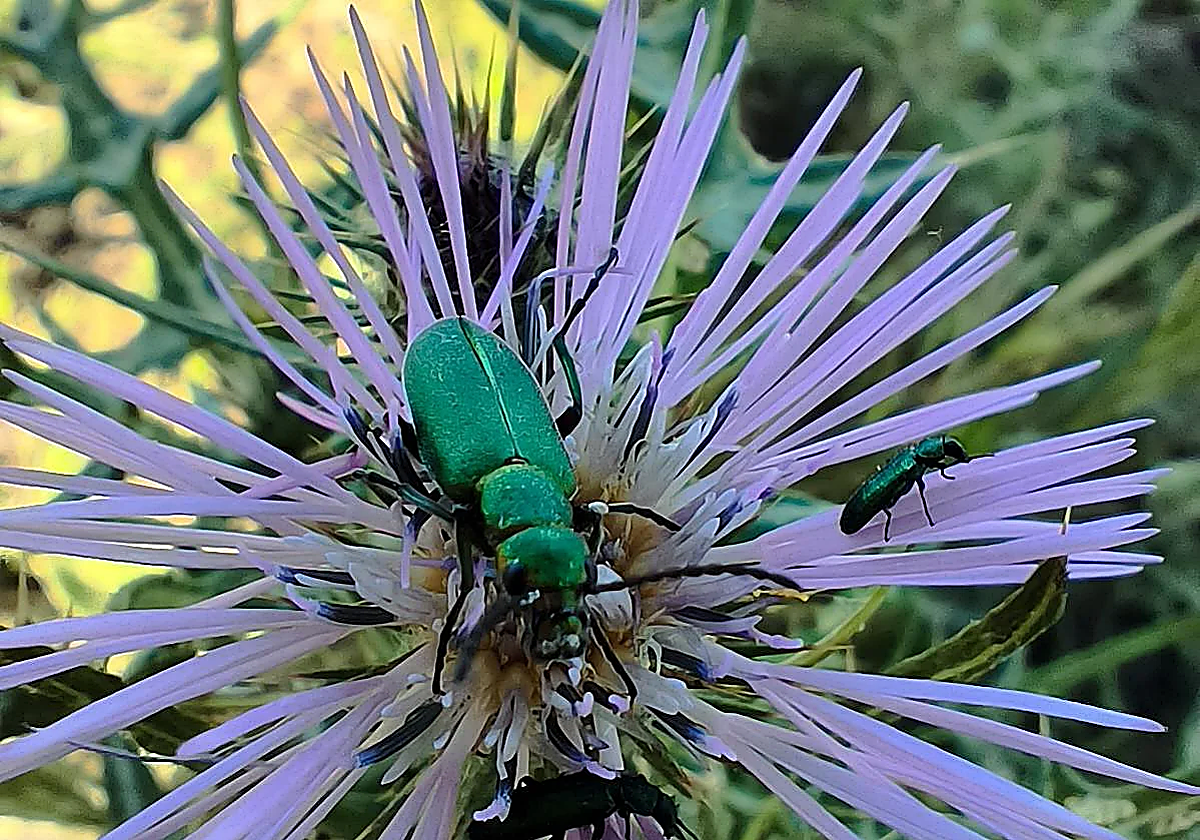
A Lagorita sericea beetle on a thistle flower. Environment Much more than bugs: insects can save Malaga's Soliva lagoonGuided tours take residents and visitors through this little-known site in Malaga city to raise awareness
Javier Almellones
Malaga
Monday, 6 April 2026, 15:25
Surprise lands gently on a hand. A praying mantis that doesn't attack, a shiny beetle that seems otherworldly or tiny creatures that go unnoticed until someone knows where to look. Pablo and Adriana, both eight years old, observe with a mixture of wonder and caution what until recently they considered to be simply "bugs". Now they understand that they are somethingm much more.
This scene often repeats at Malaga's Soliva lagoon, where the Andalusian entomological society has launched a series of walks to introduce the public to a nearly invisible world. José Manuel Moreno Benítez starts the activity with a simple but revealing gesture: he sweeps an entomological net gently over the vegetation. From what looks like a random movement, insects appear that would otherwise go completely unnoticed.
Each catch turns into a small lesson. Participants examine the insects, learn about them and, unless they need further study, release them straight away. The aim isn't to collect specimens, but to record them, understand them and challenge common fears.
"Does it sting?" people often ask. The answer shifts their perspective: most insects are harmless and very important. In reality, only mosquitoes really bite. Wasps and bees use their stingers mainly to defend themselves. Moreno explains the unique features of each insect to both children and adults.
These entomology walks began in February and will continue throughout the year. They're free, open to everyone and don't require booking. The organisers simply announce them on social media. They attract a wide range of people, from university students to local residents and environmental campaigners concerned about the area, which faces a potential development threat: plans propose draining the lagoon to build a road. Everyone shares a growing interest in a place that might look like a wasteland at first glance, but actually hides extraordinary biodiversity.
The lagoon's value goes far beyond its water. As Moreno says, its real richness lies in the surrounding landscape: olive groves, grasslands and vegetation that has flourished after two favourable hydrological years. This plant diversity has triggered what he calls an "explosion of life". In fact, early surveys suggest the area hosts a greater variety of insects than some nearby mountain areas that appear better preserved and protected.
Researchers have already identified more than 100 species, though the real number could be much higher. Many insects require closer analysis to identify properly. By the end of the year, the team hopes to complete as comprehensive a survey as possible.
Among the most striking finds is the so-called curita payoyo - a beetle endemic to the Baetic mountain ranges, found only in parts of Malaga, Cadiz and Granada. Its name comes from its dark colour, reminiscent of a priest's cassock, and from traditional uses linked to wound healing in animals.
Alongside it, brightly coloured metallic species and unusual forms such as Lagorina sericea amaze Pablo, Adriana and other participants. After examining one specimen, Moreno releases it back into the wild, where it lingers on a flower, almost as if posing for a photograph in its natural setting.
Beyond curiosity, the message is clear: insects play a crucial role in maintaining ecological balance. They attract insect-eating birds, which help control populations of flies and mosquitoes throughout the year. Protecting insects ultimately means improving the health of the environment and the quality of life for people who live in it.
That's why one of the main goals of these walks is to identify key species that could help strengthen the case for protecting the lagoon. The aim is not just to raise awareness, but to produce useful scientific knowledge.
This work extends to other projects led by the Andalusian entomological society. In the Sierra Mijas-Alpujata, for example, similar campaigns are under way to update previous studies and support efforts to have the area declared a natural park. The group also works with the Mariposario de Benalmádena to monitor the endangered Velludita parda bética, found near Villanueva del Rosario, as part of the Plan Violetae 2025-2028, which will mark its first year this June.
Meanwhile, in Soliva, the clearest sign of the tour's success shows in the reactions of those who take part; in the moment people realise that what they once feared or ignored forms an essential part of a much bigger system; in the understanding that sometimes, saving a place begins with learning to notice what lives at your feet. As the saying goes: we only protect what we love and we only love what we understand.