5 min read
NASA’s Chandra Finds Small Galaxies May Buck the Black Hole TrendLee Mohon
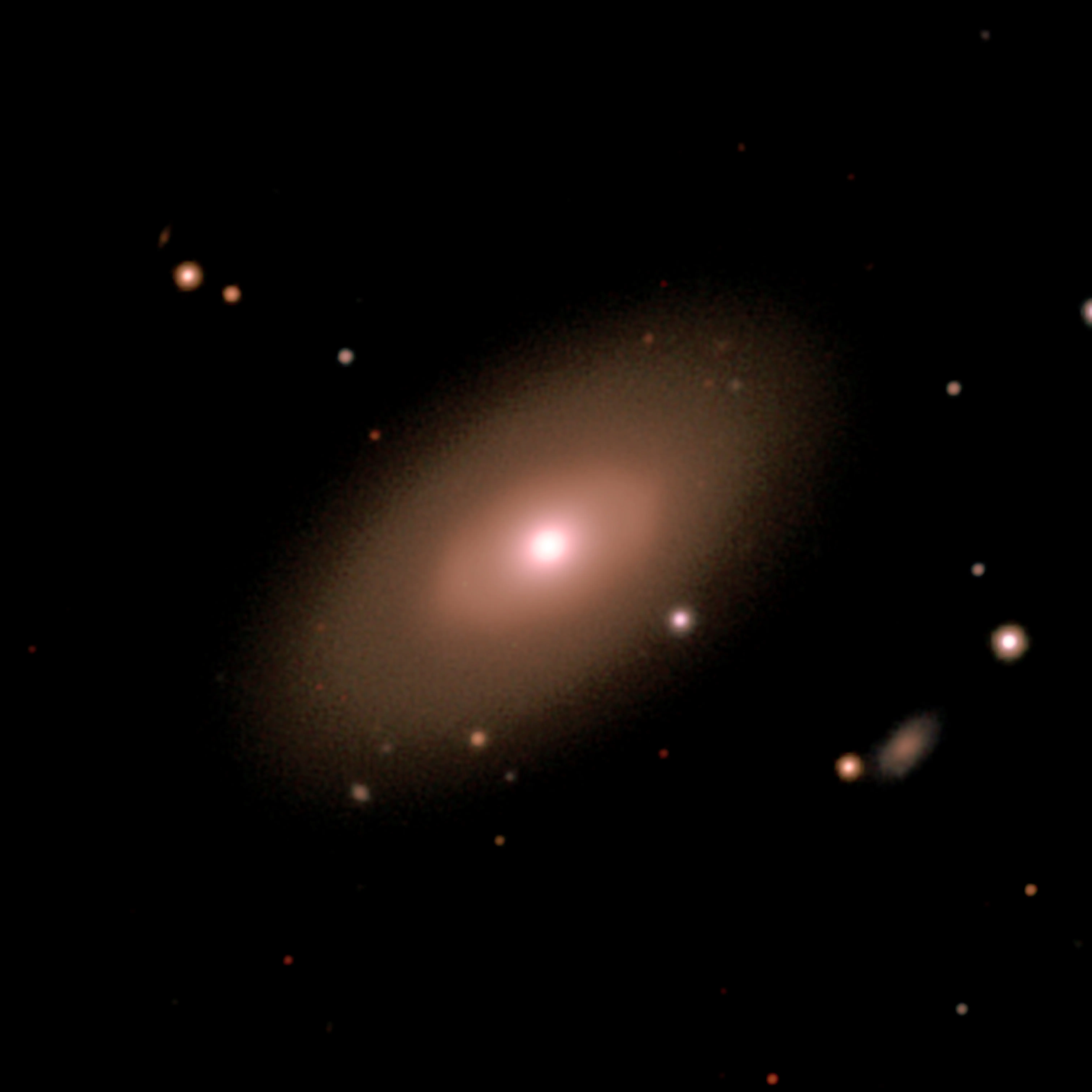
Dec 11, 2025 ArticleMost smaller galaxies may not have supermassive black holes in their centers, according to a recent study using NASA’s Chandra X-ray Observatory. This contrasts with the common idea that nearly every galaxy has one of these giant black holes within their cores, as NASA leads the world in exploring how our universe works.
A team of astronomers used data from over 1,600 galaxies collected in more than two decades of the Chandra mission. The researchers looked at galaxies ranging in heft from over ten times the mass of the Milky Way down to dwarf galaxies, which have stellar masses less than a few percent of that of our home galaxy. A paper describing these results has been published in The Astrophysical Journal and is available here https://arxiv.org/abs/2510.05252.
The team has reported that only about 30% of dwarf galaxies likely contain supermassive black holes.
“It’s important to get an accurate black hole head count in these smaller galaxies,” said Fan Zou of the University of Michigan in Ann Arbor, who led the study. “It’s more than just bookkeeping. Our study gives clues about how supermassive black holes are born. It also provides crucial hints about how often black hole signatures in dwarf galaxies can be found with new or future telescopes.”
As material falls onto black holes, it is heated by friction and produces X-rays. Many of the massive galaxies in the study contain bright X-ray sources in their centers, a clear signature of supermassive black holes in their centers. The team concluded that more than 90% of massive galaxies – including those with the mass of the Milky Way – contain supermassive black holes.
However, smaller galaxies in the study usually did not have these unambiguous black hole signals. Galaxies with masses less than three billion Suns – about the mass of the Large Magellanic Cloud, a close neighbor to the Milky Way – usually do not contain bright X-ray sources in their centers.
The researchers considered two possible explanations for this lack of X-ray sources. The first is that the fraction of galaxies containing massive black holes is much lower for these less massive galaxies. The second is the amount of X-rays produced by matter falling onto these black holes is so faint that Chandra cannot detect it.
“We think, based on our analysis of the Chandra data, that there really are fewer black holes in these smaller galaxies than in their larger counterparts,” said Elena Gallo, a co-author also from the University of Michigan.
To reach their conclusion, Zou and his colleagues considered both possibilities for the lack of X-ray sources in small galaxies in their large Chandra sample. The amount of gas falling onto a black hole determines how bright or faint they are in X-rays. Because smaller black holes are expected to pull in less gas than larger black holes, they should be fainter in X-rays and often not detectable. The researchers confirmed this expectation.
However, they found that an additional deficit of X-ray sources is seen in less massive galaxies beyond the expected decline from decreases in the amount of gas falling inwards. This additional deficit can be accounted for if many of the low-mass galaxies simply don’t have any black holes at their centers. The team’s conclusion was that the drop in X-ray detections in lower mass galaxies reflects a true decrease in the number of black holes located in these galaxies.
This result could have important implications for understanding how supermassive black holes form. There are two main ideas: In the first, a giant gas cloud directly collapses into a black hole, which contains thousands of times the Sun’s mass from the start. The other idea is that supermassive black holes instead come from much smaller black holes, created when massive stars collapse.
“The formation of big black holes is expected to be rarer, in the sense that it occurs preferentially in the most massive galaxies being formed, so that would explain why we don’t find black holes in all the smaller galaxies,” said co-author Anil Seth of the University of Utah.
This study supports the theory where giant black holes are born already weighing several thousand times the Sun’s mass. If the other idea were true, the researchers said they would have expected smaller galaxies to likely have the same fraction of black holes as larger ones.
This result also could have important implications for the rates of black hole mergers from the collisions of dwarf galaxies. A much lower number of black holes would result in fewer sources of gravitational waves to be detected in the future by the Laser Interferometer Space Antenna. The number of black holes tearing stars apart in dwarf galaxies will also be smaller.
NASA’s Marshall Space Flight Center in Huntsville, Alabama, manages the Chandra program. The Smithsonian Astrophysical Observatory’s Chandra X-ray Center controls science operations from Cambridge, Massachusetts, and flight operations from Burlington, Massachusetts.
To learn more about Chandra, visit:
https://science.nasa.gov/chandra
Read more from NASA’s Chandra X-ray Observatory
Learn more about the Chandra X-ray Observatory and its mission here:
News Media Contact
Megan Watzke
Chandra X-ray Center
Cambridge, Mass.
617-496-7998
mwatzke@cfa.harvard.edu
Corinne Beckinger
Marshall Space Flight Center, Huntsville, Alabama
256-544-0034
corinne.m.beckinger@nasa.gov
Share
Details
Last Updated Dec 11, 2025 EditorLee MohonContactCorinne M. Beckingercorinne.m.beckinger@nasa.govLocationMarshall Space Flight CenterRelated Terms
- Chandra X-Ray Observatory
- Astrophysics
- Black Holes
- Galaxies, Stars, & Black Holes
- Galaxies, Stars, & Black Holes Research
- Marshall Space Flight Center
- The Universe
Explore More
3 min read‘Listen’ to the Light Echoes From a Black Hole
A new sonification turns X-ray data of “light echoes” captured by NASA’s Chandra and Swift…
Article 3 years ago 3 min read‘X-ray Magnifying Glass’ Enhances View of Distant Black Holes
Article 4 years ago 5 min read‘Death Spiral’ Around a Black Hole Yields Tantalizing Evidence of an Event Horizon
NASA’s Hubble Space Telescope may have, for the first time, provided direct evidence for the…
Article 25 years ago Keep ExploringDiscover More Topics From NASA
Chandra
Space Telescope
Black Holes
Black Holes Black holes are among the most mysterious cosmic objects, much studied but not fully understood. These objects aren’t…
Galaxies
Galaxies consist of stars, planets, and vast clouds of gas and dust, all bound together by gravity. The largest contain…
James Webb Space Telescope
Space Telescope