2 min read
NASA’s SPHEREx Observatory Maps Interstellar Ice in Milky WayJet Propulsion Laboratory
Monika Luabeya
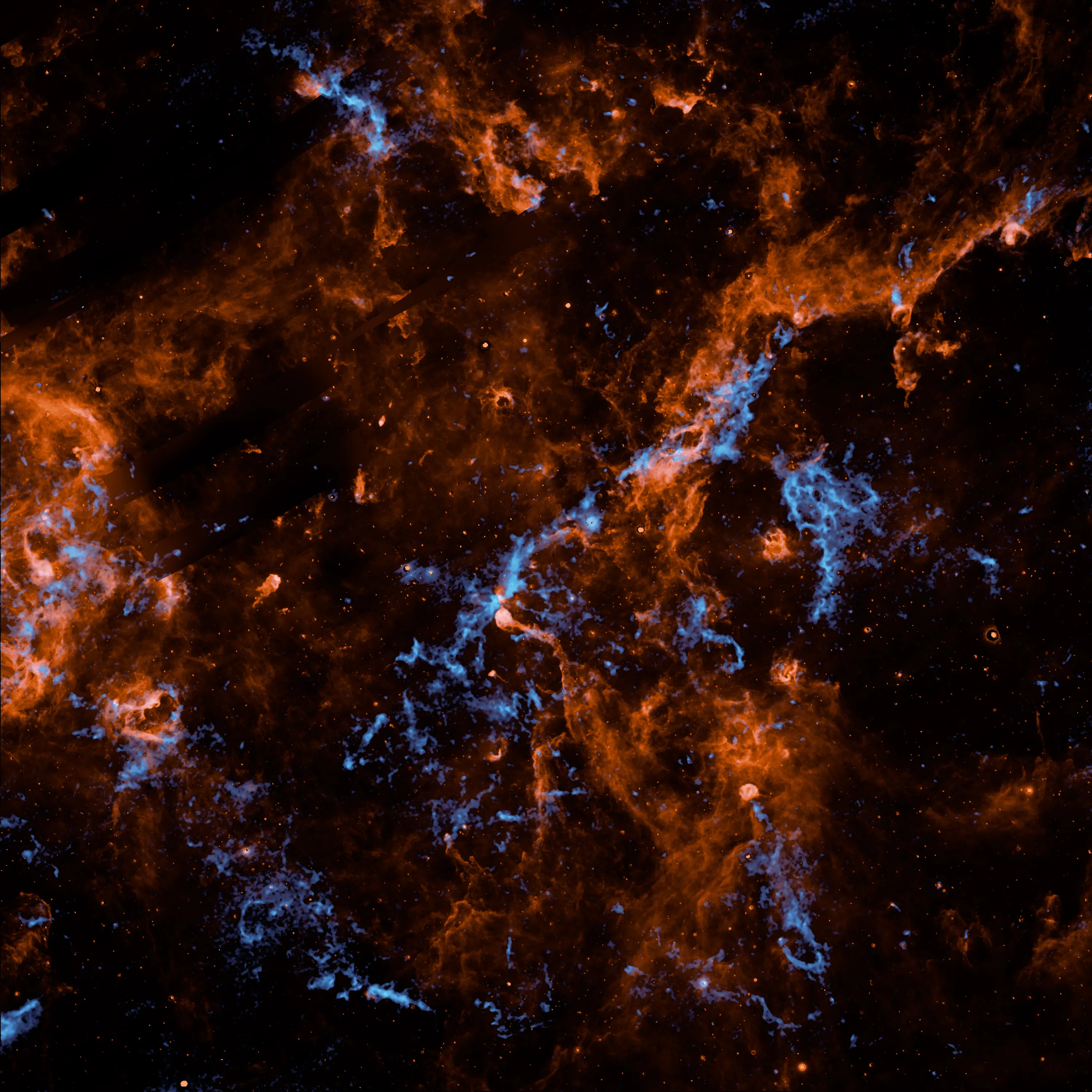
Apr 17, 2026 Image ArticleAn observation made by NASA’s SPHEREx (Spectro-Photometer for the History of the Universe, Epoch of Reionization, and Ices Explorer) shows the chemical signatures of water ice (shown in bright blue) and polycyclic aromatic hydrocarbons (orange) in Cygnus X, one of the most active and turbulent regions of star birth in our Milky Way galaxy. The image was released on April 15, 2026, along with a study detailing the observation.
One of SPHEREx’s main goals is to map the chemical signatures of various types of interstellar ice. This ice includes molecules like water, carbon dioxide, and carbon monoxide, which are vital to the chemistry that allows life to develop. Researchers believe these ice reservoirs, attached to the surfaces of tiny dust grains, are where most of the universe’s water is formed and stored. The water in Earth’s oceans — and the ices in comets and on other planets and moons in our galaxy — originates from these regions.
SPHEREx launched March 11, 2025, and has the unique ability to see the sky in 102 colors, each representing a different wavelength of infrared light that offers distinctive information about galaxies, stars, planet-forming regions, and other cosmic features.
Read more about what SPHEREx found.
Image credit: NASA/JPL-Caltech/IPAC/Hora et al.