2 min read
NASA’s Two-in-One Satellite Propulsion Demo Begins In-Space TestTara Friesen
Dec 17, 2025 ArticleNASA is working with commercial partners to create high-performing, reliable propulsion systems that will help small spacecraft safely maneuver in orbit, reach intended destinations across the solar system, and accomplish mission operations.
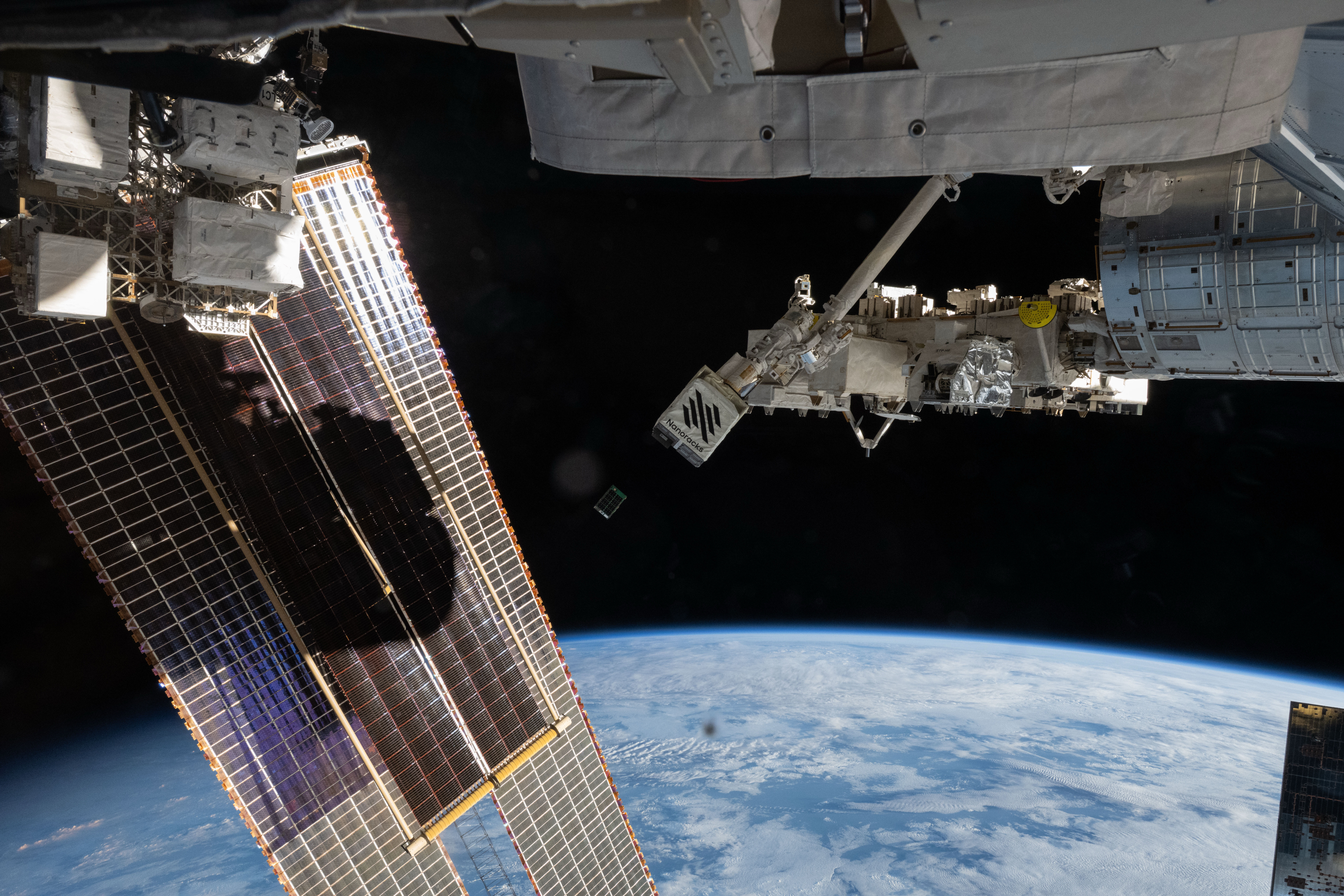
Two new micropropulsion technologies are being tested in space onboard a CubeSat called DUPLEX (Dual Propulsion Experiment) that deployed into low Earth orbit from the International Space Station on Dec. 2. The CubeSat is fitted with two thruster systems that use spools of polymer fibers to provide performance levels of propulsion comparable to existing systems but with greater safety during assembly and more affordability.
One of the propulsion technologies is a fiber-fed pulsed plasma thruster system which employs an electric pulse to vaporize Teflon material and uses the resulting ions to deliver strong, efficient thrust while using very little fuel. The other propulsion technology is a monofilament vaporization propulsion system – inspired by 3D printers – which heats and vaporizes a common polymer material known as Delrin to create continuous thrust.
On orbit, DUPLEX will test its advanced propulsion systems by raising and lowering its orbit over two years, demonstrating the systems’ capabilities to maintain a vehicle’s orbit over time. Micropropulsion solutions enable a variety of cost-efficient capabilities necessary for operators in a bustling low Earth orbit economy, including maintaining and adjusting orbits to avoid debris or nearby spacecraft, and coordinating maneuvers between spacecraft to perform maintenance, inspections, and other critical activities. The systems tested on DUPLEX can also make spacecraft capable of lower cost extended missions in areas that are farther from Earth, such as the Moon and Mars.
Technologies like those demonstrated onboard DUPLEX open the door for U.S. industry to provide efficient, affordable spacecraft systems for various space-based applications, building a stronger orbital economy to meet the needs of NASA and the nation.
The DUPLEX spacecraft was developed by Champaign-Urbana Aerospace in Illinois. NASA’s Small Spacecraft and Distributed Systems program at the agency’s Ames Research Center in California’s Silicon Valley supported the development, with funding from the Small Business Innovation Research program and a 2019 Tipping Point industry partnership award through the agency’s Space Technology Mission Directorate.
Share
Details
Last Updated Dec 17, 2025Related Terms
- Ames Research Center
- CubeSats
- International Space Station (ISS)
- SBIR STTR
- Small Spacecraft Technology Program
- Space Technology Mission Directorate
Explore More
2 min readNASA Launches Research Program for Students to Explore Big Ideas
Article 22 hours ago 7 min readThrough Astronaut Eyes: 25 Years of Life in Orbit
Article 22 hours ago 1 min readNASA ORBIT Challenge 2026
Article 1 day ago Keep ExploringDiscover More Topics From NASA
Missions
Humans in Space
Climate Change
Solar System