NASA Webb Mission Team
Goddard Space Flight Center
Feb 25, 2026 ArticleContents
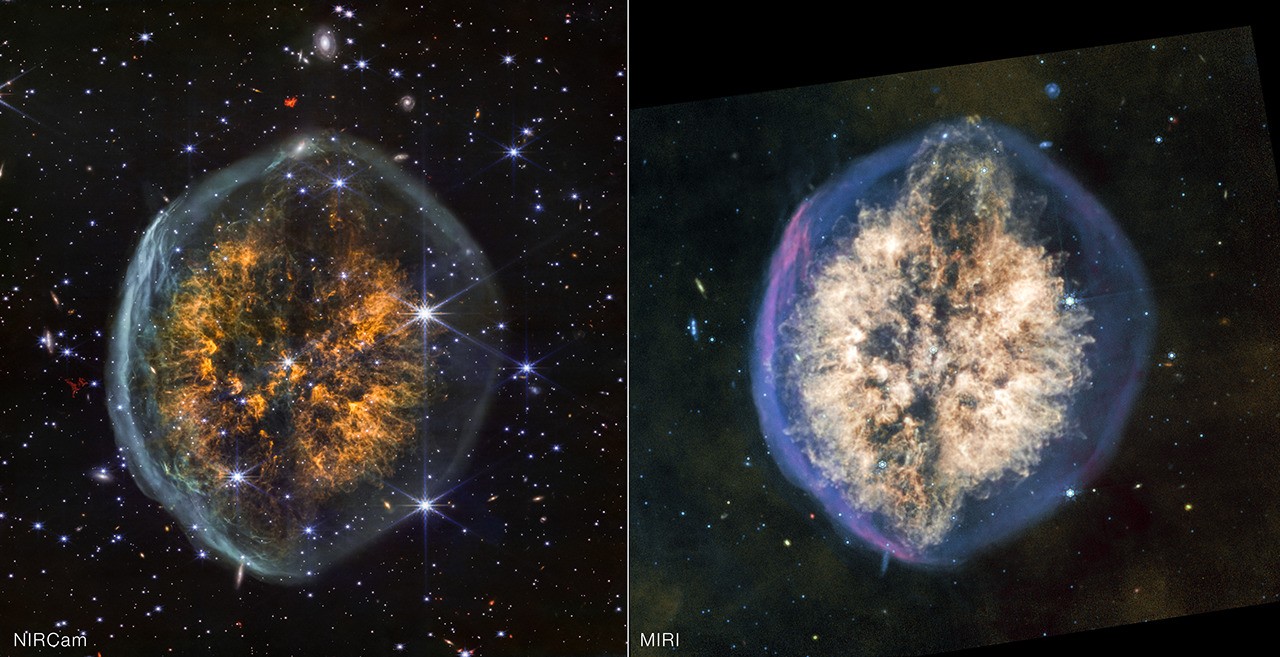
- first revealed in infrared light by a predecessor to Webb, NASA’s now-retired Spitzer Space Telescope, more than a decade ago. Webb’s advanced instruments show detail that enhances the nebula’s brain-like appearance.
Image: Exposed Cranium Nebula (NIRCam and MIRI Images)
The differences in what Webb’s infrared instruments reveal and conceal within the PMR 1 “Exposed Cranium” nebula is apparent in this side-by-side view. More stars and background galaxies shine through NIRCam’s view, while cosmic dust glows more prominently in MIRI’s mid-infrared.Image: NASA, ESA, CSA, STScI; Image Processing: Joseph DePasquale (STScI)The nebula appears to have distinct regions that capture different phases of its evolution — an outer shell of gas that was blown off first and consists mostly of hydrogen, and an inner cloud with more structure that contains a mix of different gases. Both Webb’s NIRCam (Near-Infrared Camera) and MIRI (Mid-Infrared Instrument) show a distinctive dark lane running vertically through the middle of the nebula that defines its brain-like look of left and right hemispheres. Webb’s resolution shows that this lane could be related to an outburst or outflow from the central star, which typically occurs as twin jets burst out in opposite directions. Evidence for this is particularly notable at the top of the nebula in Webb’s MIRI image, where it looks like the inner gas is being ejected outward.
While there is still much to be understood about this nebula, it’s clear that it is being created by a star near the end of its fuel-burning “life.” In their end stages, stars expel their outer layers. It’s a dynamic and fairly fast process, in cosmic terms. Webb has captured a moment in this star’s decline. What ultimately happens will depend on the mass of the star, which is yet to be determined. If it’s massive enough, it will explode in a supernova. A less massive Sun-like star will continue to shed layers until only its core remains as a dense white dwarf, which will cool off over eons.
The James Webb Space Telescope is the world’s premier space science observatory. Webb is solving mysteries in our solar system, looking beyond to distant worlds around other stars, and probing the mysterious structures and origins of our universe and our place in it. Webb is an international program led by NASA with its partners, ESA (European Space Agency) and CSA (Canadian Space Agency).
To learn more about Webb, visit:
Downloads & Related Information
The following sections contain links to download this article's images and videos in all available resolutions followed by related information links, media contacts, and if available, research paper and Spanish translation links.
Related Images & Videos
Exposed Cranium Nebula (NIRCam and MIRI Images)
The differences in what Webb’s infrared instruments reveal and conceal within the PMR 1 “Exposed Cranium” nebula is apparent in this side-by-side view. More stars and background galaxies shine through NIRCam’s view, while cosmic dust glows more prominently in MIRI’s mid-infrared
Exposed Cranium Nebula (NIRCam and MIRI Compass Image)
These images of the “Exposed Cranium” nebula PMR 1, captured by the James Webb Space Telescope’s NIRCam (Near-Infrared Camera) and MIRI (Mid-Infrared Instrument) include compass arrows, scale bar, and color key for reference.
Observations of the Exposed Cranium Nebula
This video compares infrared views of the PMR 1 “Exposed Cranium” nebula taken by NASA’s retired Spitzer Space Telescope, as well as NASA’s James Webb Space Telecope’s NIRCam (Near-Infrared Camera) and MIRI (Mid-Infrared Instrument). Spitzer’s ...
Related Links
Read more:Webb First to Show 4 Dust Shells ‘Spiraling’ Apep
Explore more: ViewSpace: V838 Monocerotis
Watch:NASA’s Universe of Learning Visualization of Eta Carinae
Explore more:SuperStar Eta Carinae
Explore more: ViewSpace: Star Death: Helix Nebula
Share
Details
Last Updated Feb 25, 2026 LocationNASA Goddard Space Flight Center Contact MediaLaura Betz
NASA’s Goddard Space Flight Center
Greenbelt, Maryland
laura.e.betz@nasa.govLeah Ramsay
Space Telescope Science Institute
Baltimore, MarylandChristine Pulliam
Space Telescope Science Institute
Baltimore, MarylandRelated Terms
- James Webb Space Telescope (JWST)
- Astrophysics
- Goddard Space Flight Center
- Nebulae
- Planetary Nebulae
- Science & Research
- The Universe
Related Topics
James Webb Space Telescope
Webb is the premier observatory of the next decade, serving thousands of astronomers worldwide. It studies every phase in the…
Webb Image Galleries
Science Overview
Universe